จำนวน Repository ( 4 )
นวัตกรรมสารสกัดน้ำมันกระเทียมบนกระดาษชั้นในเครื่องกรอง PM2.5 ในการกำจัดมลพิษจุลินทรีย์ปนเปื้อนในอากาศ เพื่อก้าวผ่านสถานการณ์ COVID-19
Garlic is an ancient food and medicinal plant that has been used for centuries. The research team was interested in creating a garlic oil extract that could help reduce microbial contamination in the air during the prolonged period of the COVID-19 situation. A prototype sugarcane leaf paper filter was treated with garlic oil extract to improve its air purification properties and to reduce the number of microorganisms. This study investigated garlic oil extracts that were produced by a garlic fermentation process with isolated lactic acid bacteria. The oil was then extracted using steam distillation or maceration with 80% ethyl alcohol. Both these methods demonstrated that they were effective in inhibiting pathogenic microorganisms contaminating isolated from air (Fungi: Penicillium sp. Aspergillus spp. and Rhizopus sp. and Bacteria: E. coil Bacillus subtilis and Staphylococcus sp.) by Agar Diffusion method. It was found that the garlic oil extract distilled from steam was the best choice for further development as a coating for filter paper. Garlic oil extract can be stored at room temperature for at least 15 days after being coated on filter papers. After that the filters with garlic extract-coated filters made by sewing together four folded filter papers could remove the dust of 2.5 sizes as well as HEPA filters but had a disadvantage in filtering dust that was at least 10 PPM. This paper filter prototype was environmentally friendly because it could decompose on the ground within 12-15 days and reduce the spread of infection problems. From overall the prototype of the garlic oil extraction process can be developed at a commercial industrial level to produce large quantities of garlic extract with desired quality tracking features. It helps reducing environmental problems in a sustainable way; reducing waste conserving energy and using environmentally friendly materials.
ผลิตภัณฑ์ซองเส้นใยเปลือกข้าวโพดเคลือบสารสกัดน้ำมันผิวมะกรูด ทดแทนซองพลาสติกเพื่อบรรจุซิลิกาสำหรับดูดความชื้น
In order to maintain food and materials including drying products at the original dried condition silica gel can be one choice for absorbing moisture. Most silica gel is packed in an Parcel made from plastic which is difficult to naturally degrade thus causing environmental problems. This research therefore have developed packaging material from agricultural waste corn husks for absorbing moisture from food rice. From the study it was found that the corn husk paper had characteristic of smooth paper surface. When making it into a corn fiber Parcel its maximum moisture absorption from saturated humidity was 9.22±0.92% and it could absorb the moisture from the rice stored at room temperature when compared to the plastic sachet at 8.26±0.50% and 9.30±0.08% respectively. When coated with kaffir lime oil extract the corn husk Parcel had the capability in anti-fungus commonly habituated in corn husks up the concentration of 15000 ppm. It could naturally be degraded within 12 days. Therefore with these advantageous qualification the natural Parcel made of corn husk paper harboring silica is for moisture absorption as sustainable and environmental conservation material.
เทคนิคการสกัดน้ำมันและการผลิตไบโอดีเซลจากน้ำมันเมล็ดกระบก
This paper presents the experimental results of the oil extraction process from wild almond seeds by mechanical and chemical methods. The optimum conditions for the biodiesel production from the extracted oil via transesterification reaction using methanol and potassium hydroxide (KOH) are reported. Chemical extraction was found to be an effective technique for wild almond oil extraction. Simple distillation was used as oil extraction unit applying 140 ml of n-hexane as solvent at 70ºC for 20 min. The oil yield was 43.11±0.98%. This extracted oil was used as raw material for biodiesel production with the maximum yield of 83.20±1.11%. The optimum conditions for biodiesel production were the catalyst loading of 0.5 wt% and 9:1 molar ratio of methanol to oil in a controlled reaction temperature of 70ºC for 60 min. Finally the properties of biodiesel were analyzed and most properties met the requirements of the department of energy business standard.
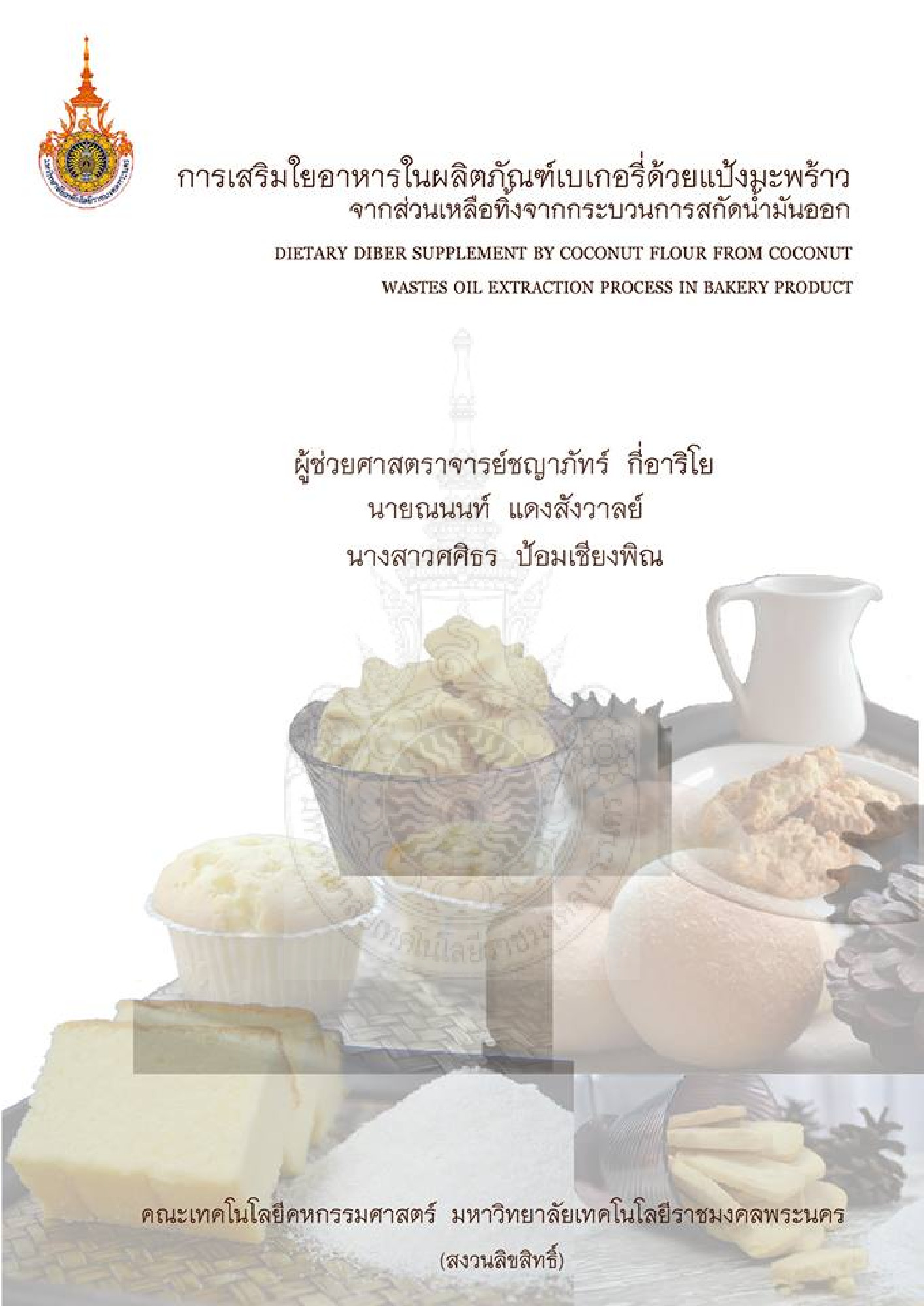
การเสริมใยอาหารในผลิตภัณฑ์เบเกอรี่ด้วยแป้งมะพร้าวจากส่วนเหลือทิ้งจากกระบวนการสกัดน้ำมันออก
The studies of Dietary Fiber Supplement by coconut flour from coconut Wastes Oil Extraction process in Bakery Product was investigated Production of coconut flour from coconut wastes oil extraction drying at 55 ° C for 12 hours and then grinding to powder gave the off-white fine powder. The chemical compositions of coconut flour were 57.70 % carbohydrate 29.4 % fat 6.23 % moisture 5.20 % protein and 1.48 % ash by dye weigh. Butter cake making experiment by substitution of wheat flour with coconut flour at 5 % of wheat flour weigh which has the highest sensory scores comparing butter cake with the control found that increase dietary fiber 1.34 g. /100 g. The majority of the tested consumers (92%) accepted butter cake with 5 % of coconut flour substitution. Muffin making experiment by substitution of wheat flour with coconut flour at 15 % of wheat flour weigh which has the highest sensory scores comparing muffin with the control found that increase dietary fiber 2.34 g /100 g. The majority of the tested consumers (81%) accepted muffin with 15 % of coconut flour substitution. Cornflake cookie making experiment by substitution of wheat flour with coconut flour at 20 % of wheat flour weigh which has the highest sensory scores comparing cornflake cookie with the control found that increase dietary fiber 3.54 g. /100 g. The majority of the tested consumers (94 %) accepted cornflake cookie with 20 % of coconut flour substitution. Butter cookie making experiment by substitution of wheat flour with coconut flour at 10 % of wheat flour weigh which has the highest sensory scorescomparing butter cookie with the control found that increase dietary fiber 3.04 g. /100 g. The majority of the tested consumers (94 %) accepted Butter cookie with 10 % of coconut flour substitution. Frozen cookie making experiment by substitution of wheat flour with coconut flour at 20 % of wheat flour weigh which has the highest sensory scores comparing cookie with the control found that increase dietary fiber 4.02g. /100 g. The majority of the tested consumers (93 %) accepted 20 % of coconut flour substitution. Butter bread making experiment by substitution of wheat flour with coconut flour at 15 % of wheat flour weigh which has the highest sensory scores comparing butter bread with the control found that increase dietary fiber 2.22 g. /100 g. The majority of the tested consumers (75 %) accepted 15% of coconut flour substitution. Whole wheat bread making experiment by substitution of wheat flour with coconut flour at 15 % of wheat flour weigh which has the highest sensory scores comparing whole wheat bread with the control found that increase dietary fiber 2.09 g. /100 g. The majority of the tested consumers (79 %) accepted 15 % of coconut flour substitution. Pie crust making experiment by substitution of wheat flour with coconut flour at 15 % of wheat flour weigh which has the highest sensory scores comparing pie crust with the control found that increase dietary fiber 2.91 g. /100 g. The majority of the tested consumers (82 %) accepted 15 % of coconut flour substitution.