จำนวน Repository ( 3 )
การพัฒนาผลิตภัณฑ์ผัดไทยกรอบชนิดแท่ง
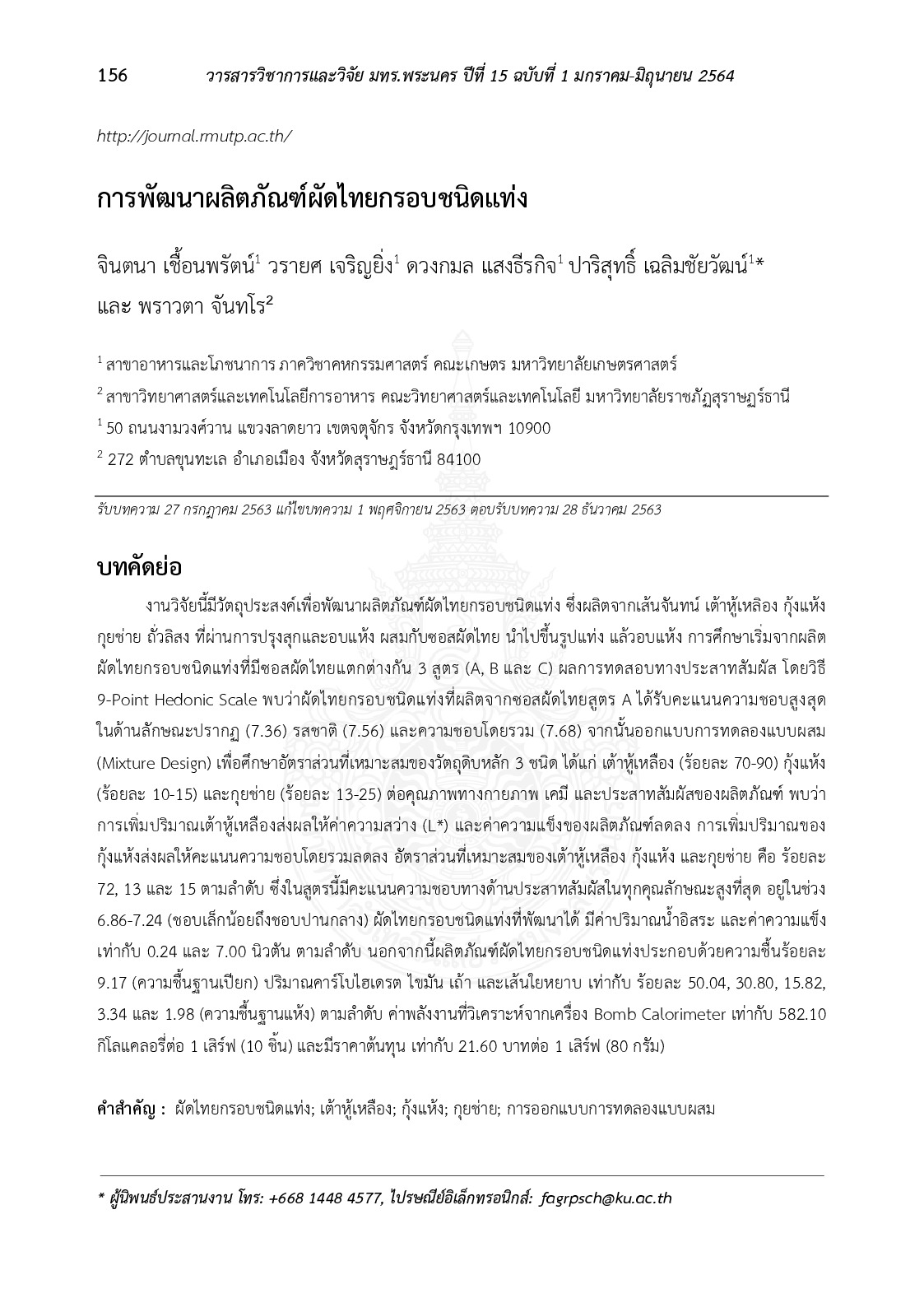
The aim of this research was to develop Pad Thai crispy bar which is made from rice noodle (Chanthaburis noodle) tofu dried shrimp garlic chives and peanut that have been cooked and dried.Mixed with Pad Thai sauce then forming into a bar and dried. The study started with produced Pad Thai crispy bar made from three formula of Pad Thai sauce (A B and C). Sensory evaluation by using 9- point hedonic scale showed that the highest liking score of appearance ( 7. 36) taste ( 7. 56) and overall liking (7.68) were obtained from formula A. Mixture design was used to optimize the formula of the Pad Thai crispy bar. The effect of three variables: tofu (70-90%) dried shrimp (10-15%) and garlic chives ( 13- 25% ) on the physical chemical and sensory qualities of the product were investigated. The results showed that increasing the tofu decreased the lightness (L*) and hardness values of the product. Increasing the dried shrimp decreased the overall liking score. Optimum formula of tofu dried shrimp and garlic chives was 72% 13% and 15% respectively. At this formula had the highest score of all sensory attributes were in the range of 6. 86-7. 24 ( like slightly – like moderately) . The developed Pad Thai crispy bar had the value of aw and hardness value 0. 24 and 7.00 N respectively. In addition the developed product consisted of 9.17% moisture (wet weight basis) total carbohydrate fat ash and crude fiber which were 50.04% 30.80% 15.82% 3.34% and 1.98% (dry weight basis) respectively. The energy value determined by Bomb calorimeter which were 582.10 Kcal per serving (10 pieces) and the cost of Pad Thai crispy bar was 21.60 bath per serving (80 g).

การศึกษากรรมวิธีการผลิตเครื่องปรุงผงก๋วยเตี๋ยวผัดไทย
This paper aimed to study the process of making instant Pad Thai powder by Spray Drying method. The appropriate temperature of hot gas and the quantity of Maltodextrin in processing instant Pad Thai powder by Spray Drying method were studied. Factorial in Completely Randomized Design (CRD) was used. The study found that the appropriate quantity of Maltodextrin was 20% and the appropriate temperature for in and out hot gas was 150/90 ºC. The color variation of the finishing instant Pad Thai powder was as follow: Bright colors L* 88.32 Red a* 0.99 Yellow b* 8.26. The color variation after cooking the product was: Bright colors L* 30.73 Red a* 3.08 Yellow b* 8.25. aw 0.22. The moisture of the powder was 1.24. Then the consumer satisfaction was studied by using 3 types of Pad Thai Noodles; Pad Thai Noodles with Instant pad Thai Powder Pad Thai Noodles with regular Pad Thai sauce and Pad Thai Noodles sold in general market. Randomized Complete Block Design RCBD was used. The study of the consumer satisfaction revealed that there was no difference between pad Thai Noodles made with Instant Pad Thai Powder and Pad Thai Noodles made with regular Pad Thai sauce at the statistical significance (p>0.05). The testers rated the overall taste of Pad Thai Noodles at 7.57. Next the researcher studied the expiration period of Instant Pad Thai Powder by packing the product in double vacuum foil and storage the product at 4 different temperatures 30 35 45 and 55 degree Celsius. Then the product was studied to evaluate the physical chemical microorganism and sensory property. The product kept at 55 ºC was the most different of the four storage products at p ≥ 0.05 with the highest level of consumer satisfaction at color = 7.33 smell = 7.30 taste = 7.90 texture = 7.57 and total = 7.40. The amount of microorganism yeast and fungus were at the safe level to comsume.
The Study of Instant Pad Thai Powder Processing
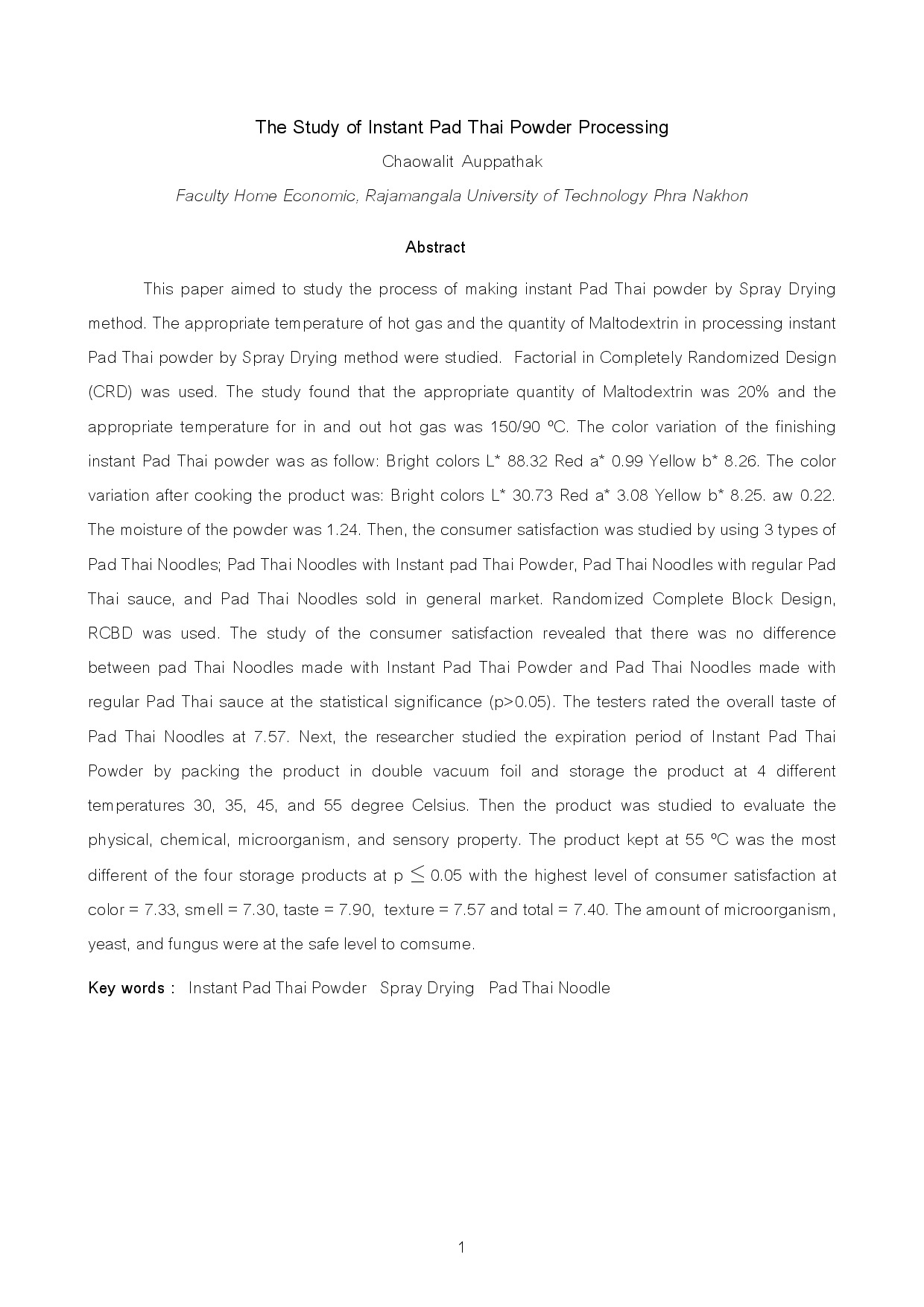
This paper aimed to study the process of making instant Pad Thai powder by Spray Drying method. The appropriate temperature of hot gas and the quantity of Maltodextrin in processing instant Pad Thai powder by Spray Drying method were studied. Factorial in Completely Randomized Design (CRD) was used. The study found that the appropriate quantity of Maltodextrin was 20% and the appropriate temperature for in and out hot gas was 150/90 ºC. The color variation of the finishing instant Pad Thai powder was as follow: Bright colors L* 88.32 Red a* 0.99 Yellow b* 8.26. The color variation after cooking the product was: Bright colors L* 30.73 Red a* 3.08 Yellow b* 8.25. aw 0.22. The moisture of the powder was 1.24. Then the consumer satisfaction was studied by using 3 types of Pad Thai Noodles; Pad Thai Noodles with Instant pad Thai Powder Pad Thai Noodles with regular Pad Thai sauce and Pad Thai Noodles sold in general market. Randomized Complete Block Design RCBD was used. The study of the consumer satisfaction revealed that there was no difference between pad Thai Noodles made with Instant Pad Thai Powder and Pad Thai Noodles made with regular Pad Thai sauce at the statistical significance (p>0.05). The testers rated the overall taste of Pad Thai Noodles at 7.57. Next the researcher studied the expiration period of Instant Pad Thai Powder by packing the product in double vacuum foil and storage the product at 4 different temperatures 30 35 45 and 55 degree Celsius. Then the product was studied to evaluate the physical chemical microorganism and sensory property. The product kept at 55 ºC was the most different of the four storage products at p ≤ 0.05 with the highest level of consumer satisfaction at color = 7.33 smell = 7.30 taste = 7.90 texture = 7.57 and total = 7.40. The amount of microorganism yeast and fungus were at the safe level to comsume.