จำนวน Repository ( 4 )
การปรับปรุงคุณภาพไฟฟ้าในระบบจำหน่ายไฟฟ้าโดยการเชื่อมต่อแหล่งผลิตไฟฟ้าแบบกระจายตัวพลังงานแสงอาทิตย์
This thesis presents improving power quality in power distribution system with integration of photovoltaic energy distributed generation having objectives to improve power quality in distribution system model of voltage sag and voltage swell in distribution system model of power loss in distribution system application of mathematical model model of power generation by using solar energy and distributed generation connection technique simulation. In this thesis the power flow was tested with Newton-Raphson algorithm joining with mathematical model. The case study was done by reduction of power loss in distribution system by using techniques of connection of distributed generation joining with model of distribution system 33 bus. The case study about improvement of voltage sag and voltage swell in distribution system used connection techniques of distributed generation joining with model of distribution system 69 bus. The study found that technique of connection of distributed generation that was presented could reduce power loss and showed the percentage of improvement of voltage sag and voltage swell in distribution system especially voltage sag case according to IEEE 1159-1995 standard. This thesis showed that severity level of voltage sag depended on the size and duration of each distribution system model situation by photovoltaic energy distributed generation can reduce voltage sag.
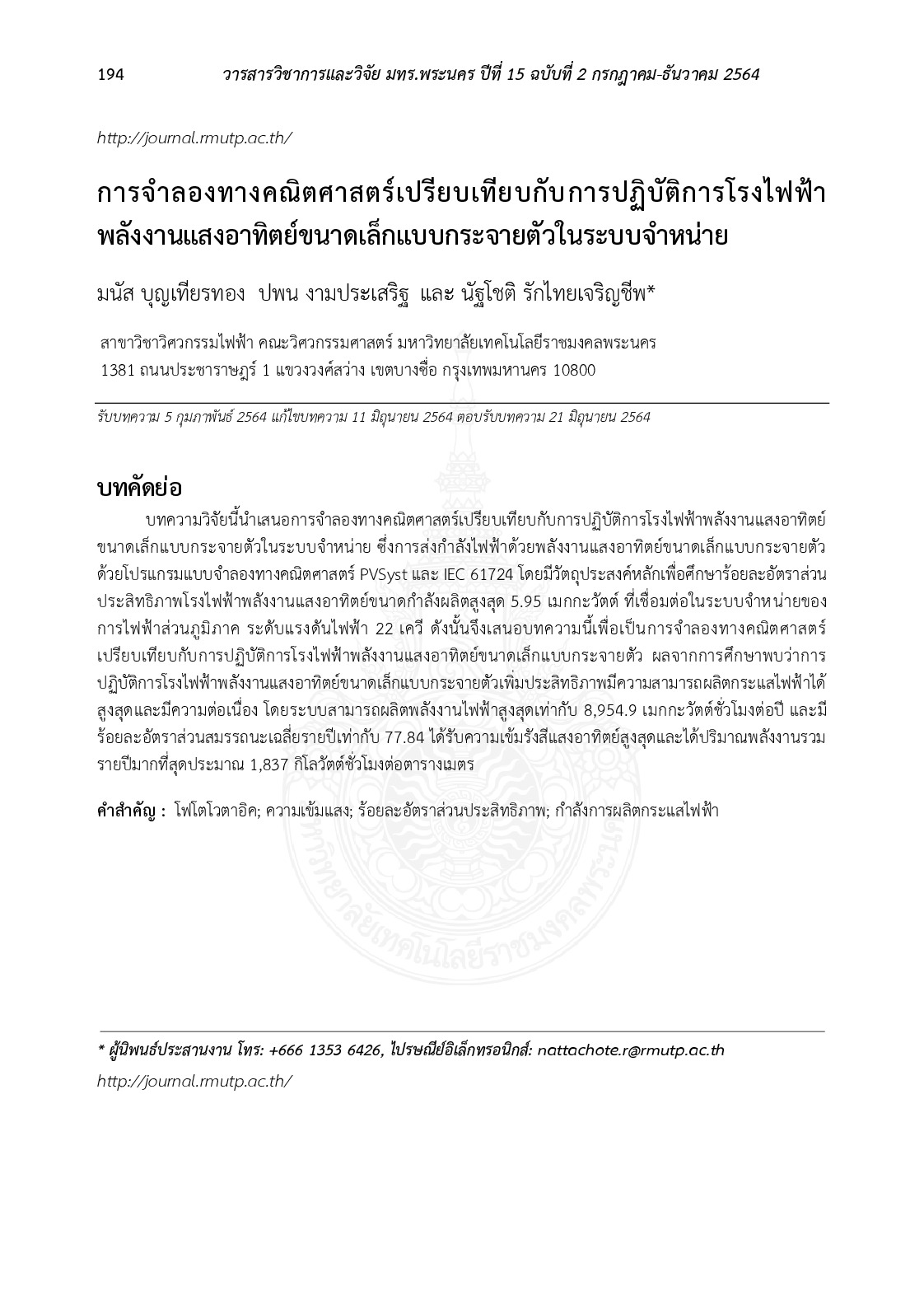
การจำลองทางคณิตศาสตร์เปรียบเทียบกับการปฏิบัติการโรงไฟฟ้าพลังงานแสงอาทิตย์ขนาดเล็กแบบกระจายตัวในระบบจำหน่าย
This paper presents a mathematical simulation to compared to operations a small distributed photovoltaic power plant in the distribution system. Practices transmission of electric power by small distributed solar energy With the PVSyst and IEC 61724 mathematical modeling programs the main objective was to study the % performance ratio photovoltaic power plants 5.95 MWp connected in the distribution system of the Provincial Electricity Authority voltage level 22 kV. Therefore this paper is presented as a mathematical simulation compared to operations a small distributed photovoltaic power plant in a distribution system. The results of the study show that the operation of small distributed solar power plants increases the efficiency to be able to produce the maximum electricity and continuously. The system was able to produce the highest power of 8954.9 MWh/year and had an average annual efficiency ratio of 77.84% receiving the highest solar radiation intensity and the highest annual total energy output of approximately 1837 kWh/m2
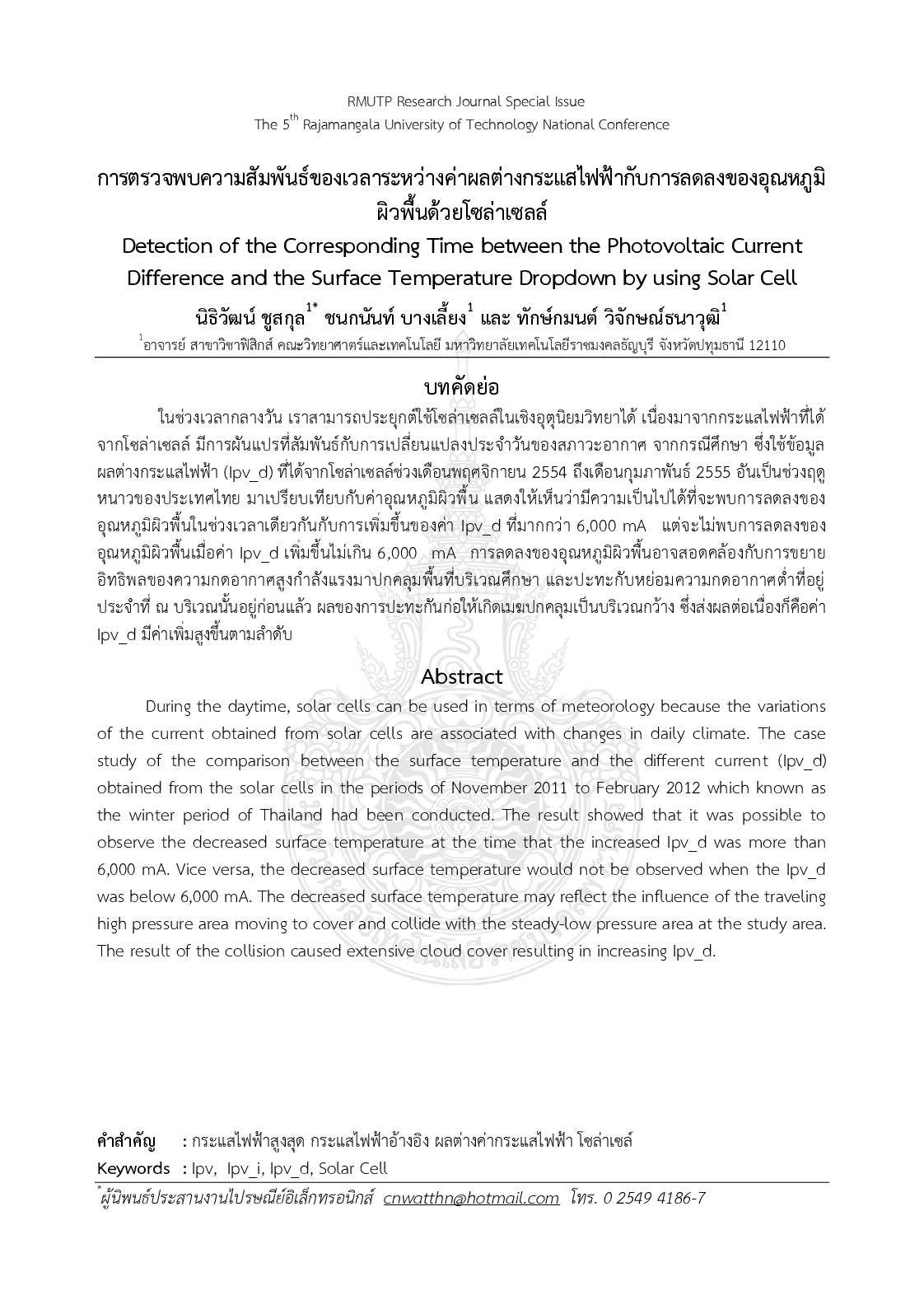
Detection of the corresponding time between the photovoltaic current difference and the surface temperature dropdown by using solar cell
During the daytime solar cells can be used in terms of meteorology because the variations of the current obtained from solar cells are associated with changes in daily climate. The case study of the comparison between the surface temperature and the different current (Ipv_d) obtained from the solar cells in the periods of November 2011 to February 2012 which known as the winter period of Thailand had been conducted. The result showed that it was possible to observe the decreased surface temperature at the time that the increased Ipv_d was more than 6000 mA. Vice versa the decreased surface temperature would not be observed when the Ipv_d was below 6000 mA. The decreased surface temperature may reflect the influence of the traveling high pressure area moving to cover and collide with the steady-low pressure area at the study area. The result of the collision caused extensive cloud cover resulting in increasing Ipv_d.
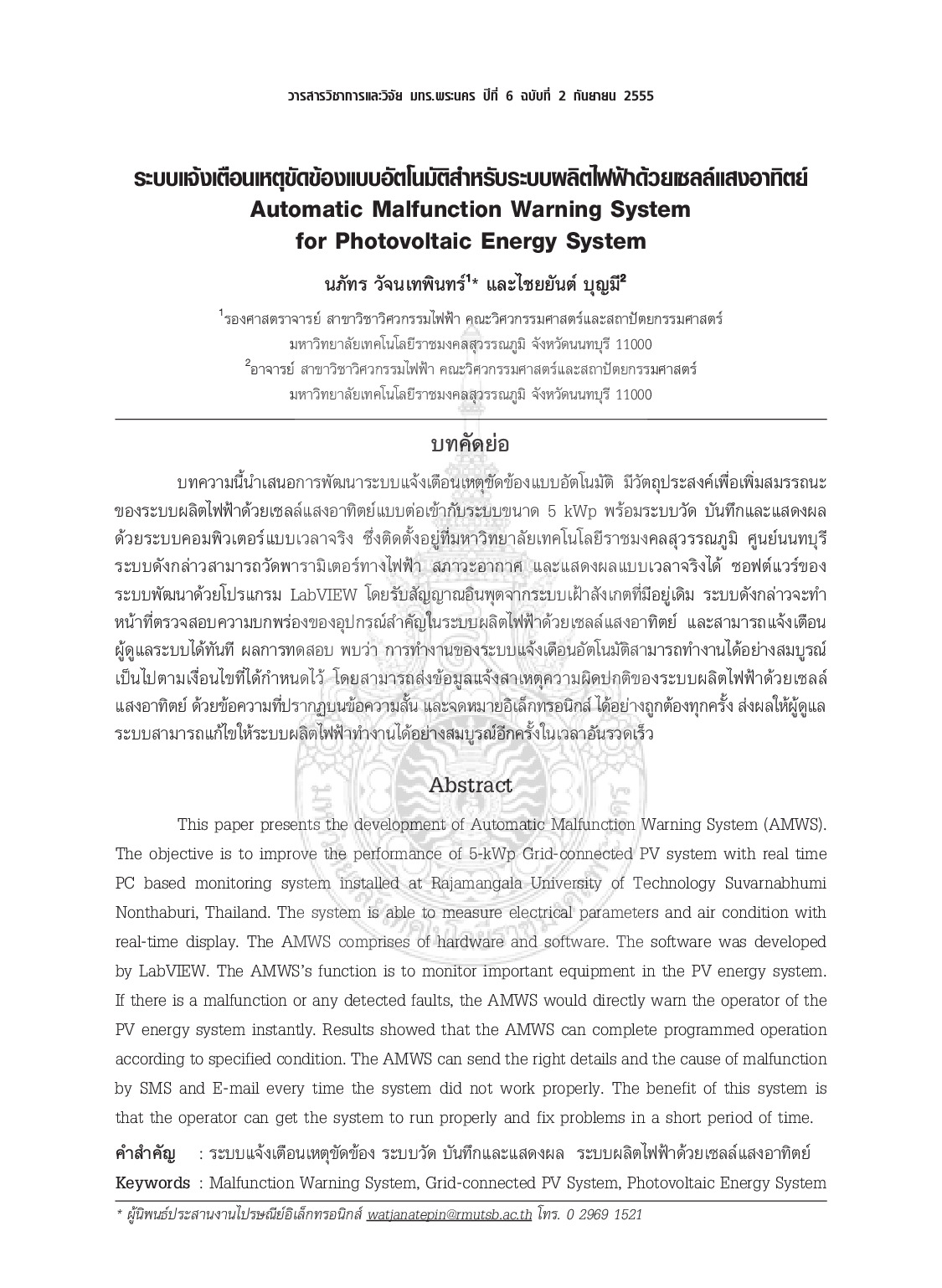
Automatic Malfunction Warning System for Photovoltaic Energy System
This paper presents the development of Automatic Malfunction Warning System (AMWS). The objective is to improve the performance of 5-kWp Grid-connected PV system with real time PC based monitoring system installed at Rajamangala University of Technology Suvarnabhumi Nonthaburi Thailand. The system is able to measure electrical parameters and air condition with real-time display. The AMWS comprises of hardware and software. The software was developed by LabVIEW. The AMWSs function is to monitor important equipment in the PV energy system. If there is a malfunction or any detected faults the AMWS would directly warn the operator of the PV energy system instantly. Results showed that the AMWS can complete programmed operation according to specified condition. The AMWS can send the right details and the cause of malfunction by SMS and E-mail every time the system did not work properly. The benefit of this system is that the operator can get the system to run properly and fix problems in a short period of time