จำนวน Repository ( 2 )
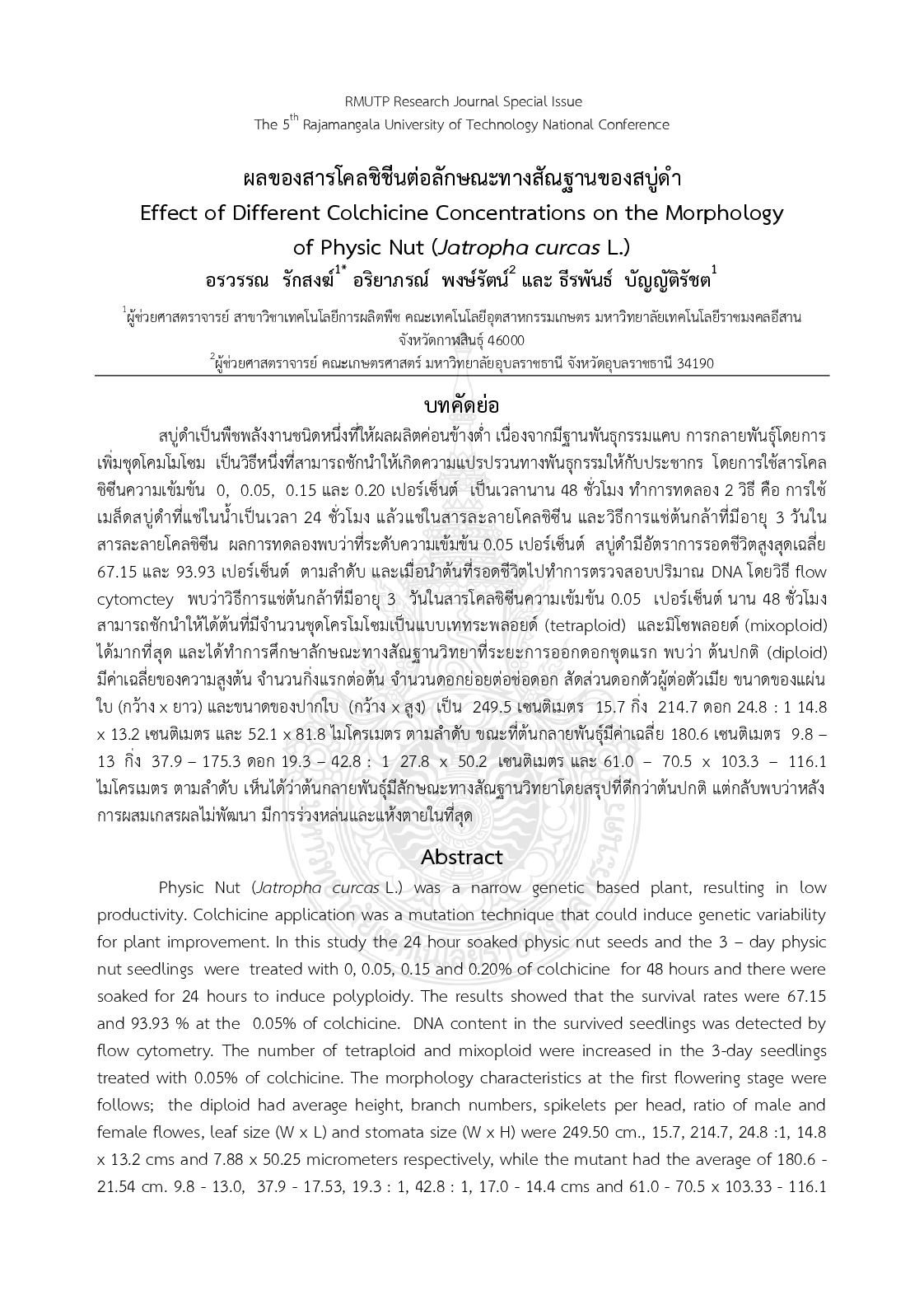
Effect of different colchicine concentrations on the morphology of physic nut (jatropha curcas l.)
Physic Nut (Jatropha curcas L.) was a narrow genetic based plant resulting in low productivity. Colchicine application was a mutation technique that could induce genetic variability for plant improvement. In this study the 24 hour soaked physic nut seeds and the 3 – day physic nut seedlings were treated with 0 0.05 0.15 and 0.20% of colchicine for 48 hours and there were soaked for 24 hours to induce polyploidy. The results showed that the survival rates were 67.15 and 93.93 % at the 0.05% of colchicine. DNA content in the survived seedlings was detected by flow cytometry. The number of tetraploid and mixoploid were increased in the 3-day seedlings treated with 0.05% of colchicine. The morphology characteristics at the first flowering stage were follows; the diploid had average height branch numbers spikelets per head ratio of male and female flowes leaf size (W x L) and stomata size (W x H) were 249.50 cm. 15.7 214.7 24.8 :1 14.8 x 13.2 cms and 7.88 x 50.25 micrometers respectively while the mutant had the average of 180.6 - 21.54 cm. 9.8 - 13.0 37.9 - 17.53 19.3 : 1 42.8 : 1 17.0 - 14.4 cms and 61.0 - 70.5 x 103.33 - 116.1 micrometers respectively. so The mutant had better characteristics but their fruits could not mature.

การใช้กาวฟีนอลผลิตแผ่นฟ้าเพดาน T-Bar จากต้นสบู่ดำ
This research aims to produce the T-BAR particleboard from Physic nuts for interior building which are brought agricultural wastes to used for beneficial materials. Under the Thailand industrial standard (TIS-876-2547) specified the evaluated values such as desnsity water content water absorption thickness swelling bending strength elastic modulus and internal bonded. The experiment and evaluation processes between Physic nuts per Urea Formaldehyde ratio and Physic nuts per Phenol-cyanate based on 90:10 92:8 95:5 and 97:3 in consequence that we found the thickness of particleboard not more than 2 cm. The suitable ratio for Phenol-cyanate 92:8 percentage (Physic nuts 92% with Phenol-cyanate 8%) and suitable ratio for Urea Formaldehyde 90:10 percentage (Physic nuts 90% with Urea Formaldehyde 10%) at 120 Celsius temperature on pressing process. The Phenol-cyanate glue ratio of 0.80 gram per cubic centimeter suited to produce the particleboards averaged water content before pressing 8.89% suitable pressure in process 150 pound per square inch water content 7.65% density 0.818 gram per cubic centimeter water absorption 14.23% during 2 hours thickness swelling 8.02% during 2 hours internal bond 0.56 MPa bending strength 21.45 MPa modulus 2116 MPa. The Urea Formaldehyde glue ratio of 0.82 gram per cubic centimeter suited to produce the particleboards averaged water content before pressing 9.84% suitable pressure in process 152 pound per square inch water content 8.63% density 0.833 gram per cubic centimeter water absorption 14.36% during 2 hours thickness swelling 8.95% during 2 hours internal bond 1.39 MPa bending strength 22.37 MPa modulus 2117 MPa. As the results shown that both of Urea Formaldehyde and Phenol-cyanate with Physic nuts passed the TIS 876-2547 standard. The Physic nuts can produce the particleboards for using inside building.