จำนวน Repository ( 4 )
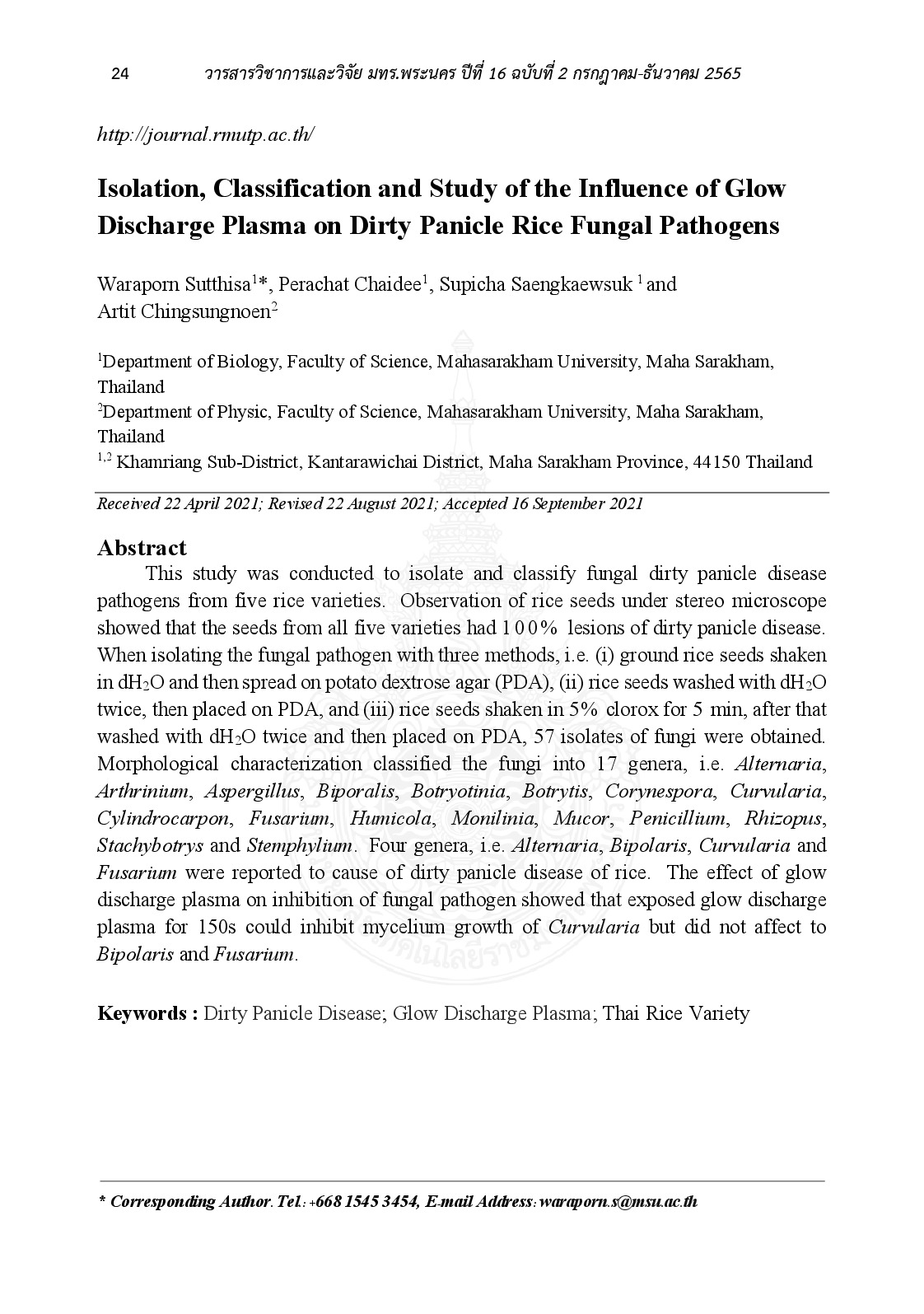
Isolation, classification and study of the influence of glow discharge plasma on dirty panicle rice fungal pathogens
This study was conducted to isolate and classify fungal dirty panicle disease pathogens from five rice varieties. Observation of rice seeds under stereo microscope showed that the seeds from all five varieties had 100% lesions of dirty panicle disease. When isolating the fungal pathogen with three methods i.e. (i) ground rice seeds shaken in dH2O and then spread on potato dextrose agar (PDA) (ii) rice seeds washed with dH2O twice then placed on PDA and (iii) rice seeds shaken in 5% clorox for 5 min after that washed with dH2O twice and then placed on PDA 57 isolates of fungi were obtained. Morphological characterization classified the fungi into 17 genera i.e. Alternaria Arthrinium Aspergillus Biporalis Botryotinia Botrytis Corynespora Curvularia Cylindrocarpon Fusarium Humicola Monilinia Mucor Penicillium Rhizopus Stachybotrys and Stemphylium. Four genera i.e. Alternaria Bipolaris Curvularia and Fusarium were reported to cause of dirty panicle disease of rice. The effect of glow discharge plasma on inhibition of fungal pathogen showed that exposed glow discharge plasma for 150s could inhibit mycelium growth of Curvularia but did not affect to Bipolaris and Fusarium.
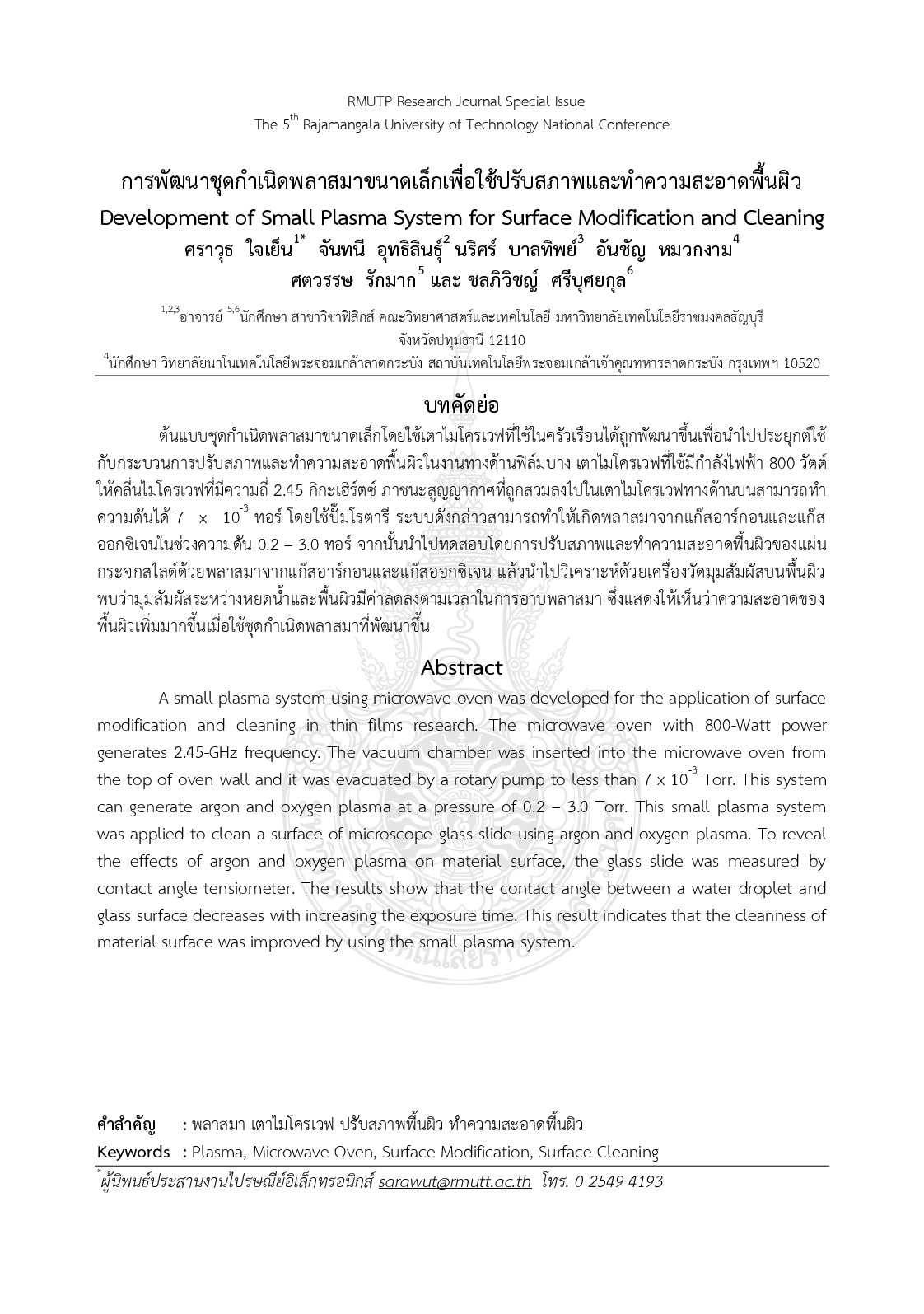
Development of small plasma system for surface modification and cleaning
A small plasma system using microwave oven was developed for the application of surface modification and cleaning in thin films research. The microwave oven with 800-Watt power generates 2.45-GHz frequency. The vacuum chamber was inserted into the microwave oven from the top of oven wall and it was evacuated by a rotary pump to less than 7 x 10⁻³ Torr. This system can generate argon and oxygen plasma at a pressure of 0.2 – 3.0 Torr. This small plasma system was applied to clean a surface of microscope glass slide using argon and oxygen plasma. To reveal the effects of argon and oxygen plasma on material surface the glass slide was measured by contact angle tensiometer. The results show that the contact angle between a water droplet and glass surface decreases with increasing the exposure time. This result indicates that the cleanness of material surface was improved by using the small plasma system.
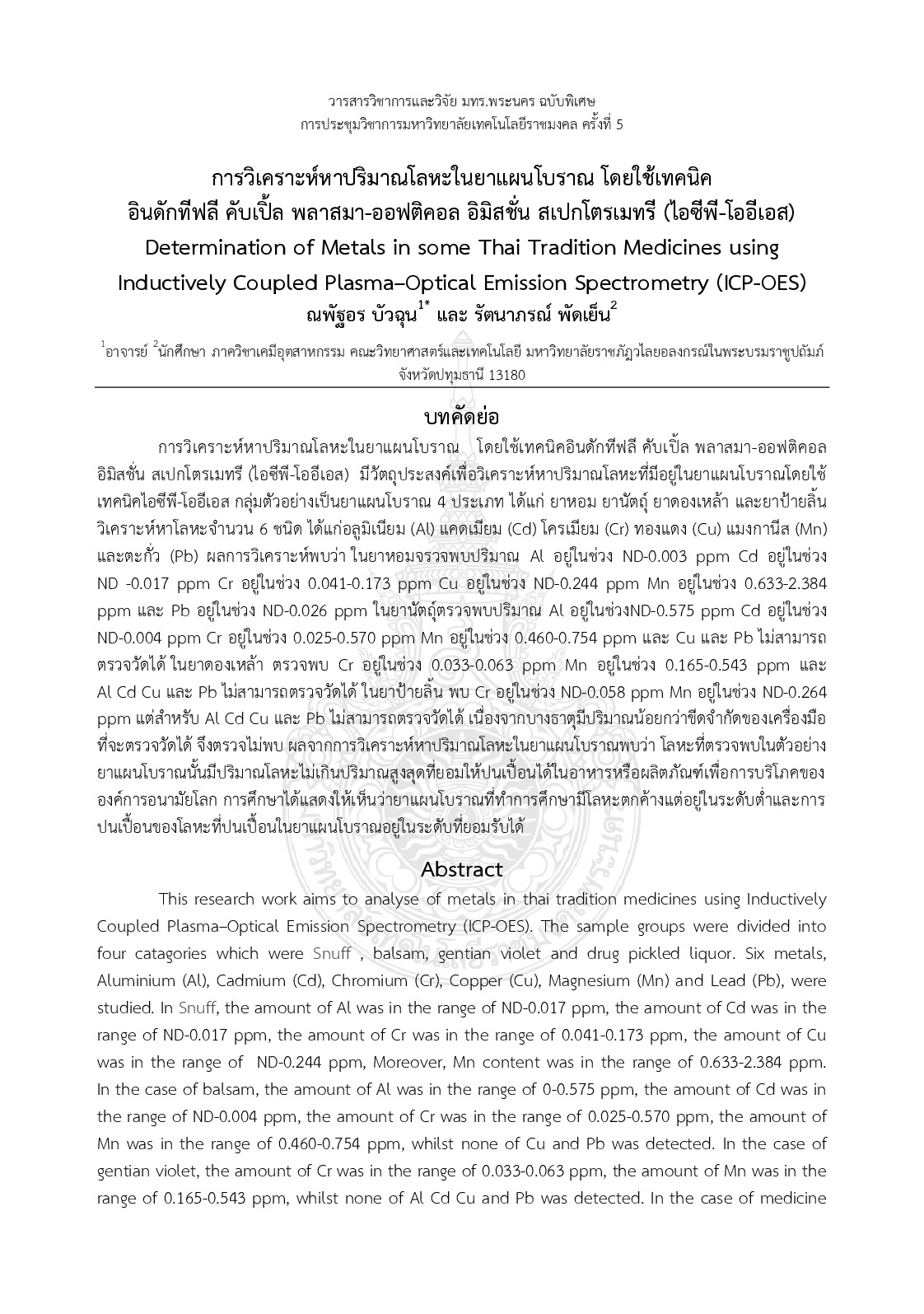
Determination of metals in some thai tradition medicines using inductively coupled plasma–optical emission spectrometry (ICP-OES)
This research work aims to analyse of metals in thai tradition medicines using Inductively Coupled Plasma–Optical Emission Spectrometry (ICP-OES). The sample groups were divided into four catagories which were Snuff balsam gentian violet and drug pickled liquor. Six metals Aluminium (Al) Cadmium (Cd) Chromium (Cr) Copper (Cu) Magnesium (Mn) and Lead (Pb) were studied. In Snuff the amount of Al was in the range of ND-0.017 ppm the amount of Cd was in the range of ND-0.017 ppm the amount of Cr was in the range of 0.041-0.173 ppm the amount of Cu was in the range of ND-0.244 ppm Moreover Mn content was in the range of 0.633-2.384 ppm. In the case of balsam the amount of Al was in the range of 0-0.575 ppm the amount of Cd was in the range of ND-0.004 ppm the amount of Cr was in the range of 0.025-0.570 ppm the amount of Mn was in the range of 0.460-0.754 ppm whilst none of Cu and Pb was detected. In the case of gentian violet the amount of Cr was in the range of 0.033-0.063 ppm the amount of Mn was in the range of 0.165-0.543 ppm whilst none of Al Cd Cu and Pb was detected. In the case of medicine pickled the amount of Cr was in the range of ND-0.058 ppm the amount of Mn was in the range of ND-0.264 ppm the amount of Ni was in the range of 0-0.034 ppm no metals Al Cd Cu and Pb was observed. The detected metals in thai tradition medicines have the contamination value under the optimization scale for consumable under WHO. It show that some metals were retained in thai tradition medicines and the contamination level of metals in were acceptable.
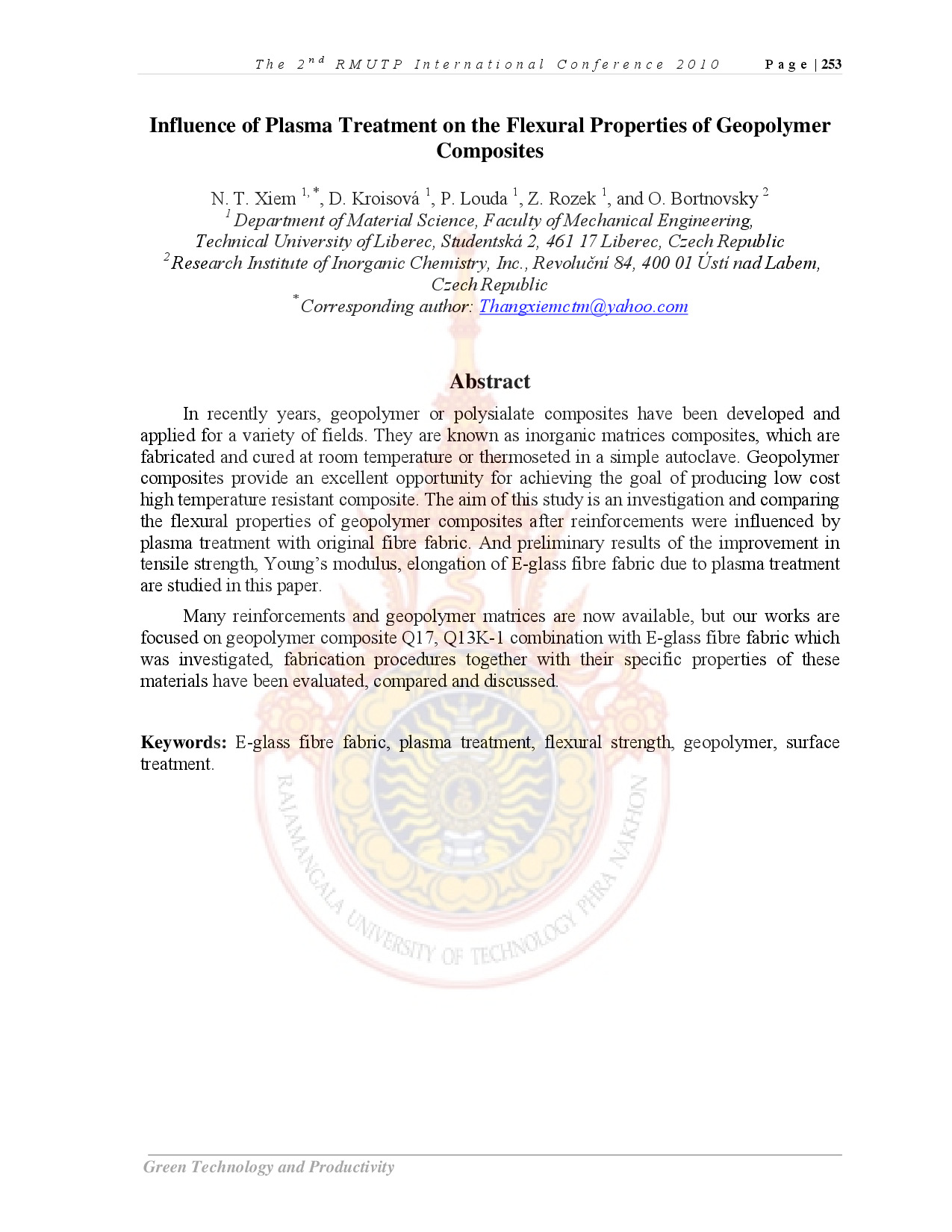
Influence of Plasma Treatment on the Flexural Properties of Geopolymer Composites
In recently years geopolymer or polysialate composites have been developed and applied for a variety of fields. They are known as inorganic matrices composites which are fabricated and cured at room temperature or thermoseted in a simple autoclave. Geopolymer composites provide an excellent opportunity for achieving the goal of producing low cost high temperature resistant composite. The aim of this study is an investigation and comparing the flexural properties of geopolymer composites after reinforcements were influenced by plasma treatment with original fibre fabric. And preliminary results of the improvement in tensile strength Young’s modulus elongation of E-glass fibre fabric due to plasma treatment are studied in this paper. Many reinforcements and geopolymer matrices are now available but our works are focused on geopolymer composite Q17 Q13K-1 combination with E-glass fibre fabric which was investigated fabrication procedures together with their specific properties of these materials have been evaluated compared and discussed.