จำนวน Repository ( 4 )

การพัฒนาคุณภาพผลิตภัณฑ์จากฐานภูมิปัญญาท้องถิ่นเรื่องสมุนไพรแปรรูป ของกลุ่มสตรีสหกรณ์เกษไชโยจังหวัดอ่างทองเพื่อเพิ่มศักยภาพการผลิต
This research aims to 1) improve quality of processed herbal product by developing recipe and production procedures 2) develop packaging of processed herbal products in oder to add value exhibit uniqueness and response to customers’ need and 3) transfer technology and body of knowledge about improving products’ quality and developing packaging of processed herbal products. Results from developing of recipe and production procedure of kaffir lime in syrup show that period in boiling kaffir lime before sweetening in syrup has an effect on textures. The suitable period of 5 minutes for boiling kaffir lime results in reducing hardness of kaffir lime core increasing lightness and gaining the highest sensory scores from testers. The suitable amount of fructose syrup used in place of sugar in producing sweetened kaffir lime at 80 percent of sugar weight results in increasing lightness reducing hardness increasing value of red color (a*) and aw when compared with the control group and increasing quality of texture with the highest sensory scores from testers. Quality of microorganism appearance color ordor and texture of sweetened kaffir lime stored in tight-closed polypropylene (PP) bag at room temperature could be maintained for at least 24 days. Regarding satisfactory in packaging prototype it was found that customers were highly satisfied in both overall (4.48) and by aspect of packaging form (4.48) and packaging graphic (4.49). In terms of transferring the technology to a target group of 30 people it was found that trainees were highly satisfied with the technology transfer process (4.56). The highest satisfaction level by aspects was usefulness of service at 4.64 followed by service of staff trainers and service procedure at 4.58 4.57 and
การพัฒนาต่อยอดภูมิปัญญาท้องถิ่นผลิตภัณฑ์อาหารจากปลา ของกลุ่มผู้ประกอบการจังหวัดสิงห์บุรีเพื่อประโยชน์เชิงพาณิชย์
The research on local wisdom in local Phetchaburi food of elderlies in Ban Huay Sai Nue to transfer and enhance learning capacity through online learning system is both quantitative and qualitative. It aims to collect local wisdom in local Phetchaburi food from both knowledge and direct experience of elderlies in Ban Huay Sai Nue Cha-am City Municipality Phetchaburi province in order to transfer the local wisdom to youths in Ban Huay Sai Nue and nearby areas as well as to develop local food recipe and procedure in both image and video formats through online learning system to enhance learning capacity of youths and other people. The target group was members of elderly group in Ban Huay Sai Nue which was divided into the major target the minor target and the recipents of technology transfer. Tools used in this reearch included a structured interview form and food recipe recording form. The research was divided into 4 main steps: selection of local wisdom collection of local wisdom transfer of local wisdom and distribution of local wisdom. Results of the research show that the target group selected 12 food recipes 8 dessert recipes and 2 drink recipes. The local wisdom was demonstrated by 9 members of elderly group in Ban Huay Sai Nue. The technology was tranferred to 40 students on Tessaban 6 School Ban Huay Sai Nue Cha-am City Municipality. Results of achievement test showed that trainees’ post-training knowledge was significantly diferent from pre-training knowledge at statistical level of 0.05 and satisfaction in the training process was highest in overall.
ภูมิปัญญาท้องถิ่นด้านอาหารพื้นบ้านจงัหวัดเพชรบุรีของกลุ่มผู้สูงอายุ บ้านห้วยทรายเหนือเพื่อการถ่ายทอดและเสริมสร้างสมรรถนะการเรียนรู้ ผ่านระบบออนไลน์
The research on local wisdom in local Phetchaburi food of elderlies in Ban Huay Sai Nue to transfer and enhance learning capacity through online learning system is both quantitative and qualitative. It aims to collect local wisdom in local Phetchaburi food from both knowledge and direct experience of elderlies in Ban Huay Sai Nue Cha-am City Municipality Phetchaburi province in order to transfer the local wisdom to youths in Ban Huay Sai Nue and nearby areas as well as to develop local food recipe and procedure in both image and video formats through online learning system to enhance learning capacity of youths and other people. The target group was members of elderly group in Ban Huay Sai Nue which was divided into the major target the minor target and the recipents of technology transfer. Tools used in this reearch included a structured interview form and food recipe recording form. The research was divided into 4 main steps: selection of local wisdom collection of local wisdom transfer of local wisdom and distribution of local wisdom. Results of the research show that the target group selected 12 food recipes 8 dessert recipes and 2 drink recipes. The local wisdom was demonstrated by 9 members of elderly group in Ban Huay Sai Nue. The technology was tranferred to 40 students on Tessaban 6 School Ban Huay Sai Nue Cha-am City Municipality. Results of achievement test showed that trainees’ post-training knowledge was significantly diferent from pre-training knowledge at statistical level of 0.05 and satisfaction in the training process was highest in overall.
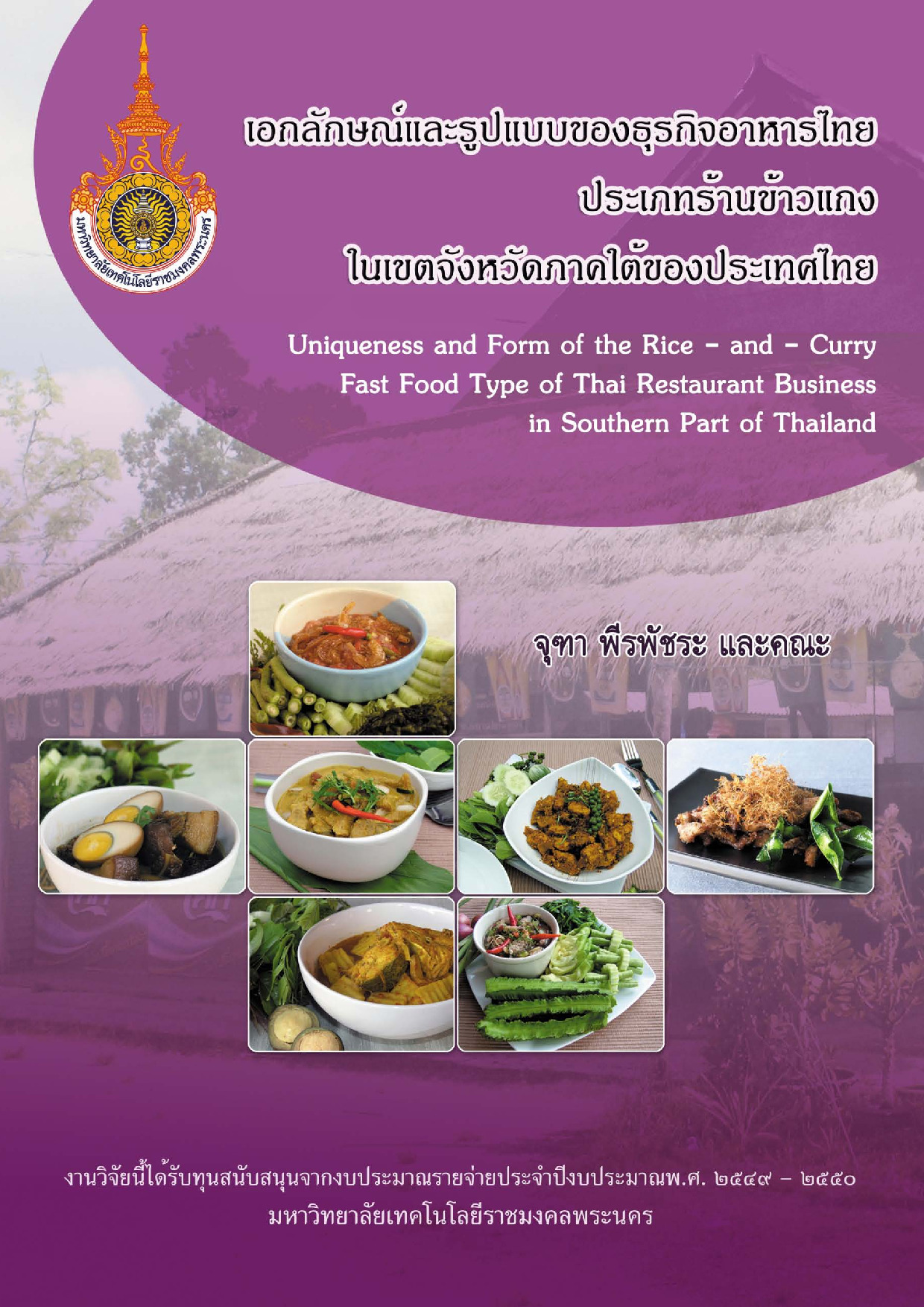
Uniqueness and Form of the Rice - and - Curry Fast Food Type of Thai Restaurant Business in Southern Part of Thailand
The research on uniqueness and form of the rice-and-curry fast-food type of Thai restaurant business in southern part of Thailand is a combined quantitative and qualitative research which aims to study the uniqueness of the rice-and-curry fast-food type of Thai restaurant business in terms of raw materials and cooking method. It has three main purposes: to study the form of the rice-and-curry fast-food type of Thai restaurant business in terms of administration decoration and sale in order to compare the uniqueness of Thai rice-and-curry fast-food in each province; to compare the form of rice-and-curry fast-food type of Thai restaurant business in each province; and to organize standard recipes for Thai rice-and-curry fast-food in southern provinces of Thailand. The sample used in this research were rice-and-curry fast-food shops from Nakhon Sri Thammarat Krabi Phang-nga Songkhla and Satun provinces - 5 shops each - with a total of 25 shops. The tool used in this study consisted of survey questionnaire food test questionnaire and record form for food recipe raw materials and equipment. Data were collected bymeans of survey and interview and were statistically analyzed for frequency and percentage together with a qualitative analysis.