จำนวน Repository ( 7 )

Bananas drying performance with a developed hot Air dryer using waste heat from charcoal production process
The purpose of this research is to develop a hot air dryer using waste heat from a200 liter kiln for drying bananas and to investigate its drying performance. The main parts of the dryer consist of the drying chamber that has dimensions 0.71x0.83x.091 m3 the air circulation system and a heat exchanger which receives waste heat from the exhaust tube and kiln surface. The dryer was developed by designing a drying chamber on the top of a 200 liter kiln to reduce heat lost in the structure and an exhaust gas heat exchanger was developed using groups of copper tubes for increasing then heat transferred to the air. The drying performances were analyzed by measuring specific drying rates and specific energy consumption. Experiments were performed under different temperatures of 60 70 and 80℃ And at a constant velocity of 1.8 ms-1. Eucalyptus was selected as the heat source. Thirty kg of peeled bananas were prepared at an initial moisture content of 241.19±31.50% dry basis and were dried until to final moisture content of 48.47±10.46% dry basis. All experiments were carried out in duplicate. For temperatures of 60 70 and 80 ℃ the ave age specific drying rates were 0.085±0.0004 0.114±0.0009 and 0.1277±0.010 kg water h-1kesolid-1 and the average specific energy consumptions were 1.42±0.055 1.21±0.355 and 1.04±0.074 MJ/kg water respectively. Some dried bananas had burned at a temperature of 80℃ so at temperature of 70 ℃ was the optimal condition in this experiment. This produced good color a high specific drying rate and low specific energy consumption.
การศึกษาอุณหภูมิการหล่อต้นแบบแว็กซ์ชนิด EC 500 เพื่อลดของเสียจากกระบวนการผลิตเครื่องประดับเงิน
This research is a study of the optimum heat temperature for baking sintered castings for burnout removal of EC 500 type ash wax from cast mortar. Improving jewelry casting process to reduce waste from silver jewelry production process. By studying the temperature of the mortar. To burn remove wax from the mortar and clean the gaps. Then try to bring silver water instead of metal casting. The results of a baked casing study using the EC500 housing prototype from the study showed that the EC500 wax material is melted from all solids to ash wax by heating at 850 ° C to burn. Remove ash wax which makes the cavity clean. When the casting was casted with 925 sterling silver the most complete workpiece after the improvement of the waste jewelry casting process was found to be 1 piece 1 percent 99 pieces or 99 percent.
การศึกษาอุณหภูมิการหล่อต้นแบบแว็กซ์ชนิด EC 500 เพื่อลดของเสียจากกระบวนการผลิตเครื่องประดับเงิน
The purpose of this research was to investigate the optimum heat temperature for the EC500 wax cured basecoat extrusion from all castings without waxing in the mortar. To reduce waste when the casting mortar through the casting process Silver Sterling 925 silver jewelry company Muang District Chiang Mai where the waste is caused by waxing outflow. The imperfections and leave waxing inside. Experiment with high temperature heat in mortar. And analyze the quality of work surface after casting with microscope. To find defects such as droplets and porosities caused by a range of temperatures. Temperature of baking mortar There is a difference from the conventional waxing mortar temperature. That is outflow of EC500 type wax. In the mortar to live. High heat The results of the 100 sample EC500 wax samples were tested at a temperature of 25 ° C. The mortar temperature was 700 ° C. 60 percent of waste was found the mortar was laid at 750 ° C 54 percent of waste was found. The mortar temperature was 800 ° C 32 percent waste was found the mortar temperature was 850° C Detecting 1 percent waste. The results of the study show that heat temperatures of up to 850 ° C can solve the problem of casting sterling silver alloys from the EC500 wax model. Finds the least waste.
การเพิ่มประสิทธิภาพกระบวนผลิตอุปกรณ์เครื่องใช้ไฟฟ้าโดยวิธีการจัดสมดุลสายการผลิต
This research aims to increasing efficiency in production and eliminate the problem of insufficient production capacity with respect to customer demand for electrical appliance factory by applying the line balancing method. Thus the study then developed two problem-solving approaches. The first approach is a method by which a firm applies the line balancing concept and ECRS technique (Eliminate Combine Rearrange and Simplify). On the contrary the second approach is required an investment in testing machine with value of 1000000 baht in order to support sufficient production capacity to meet customer demand. Also ECRS method is used to accomplish this process. Based on the results the first approach provided the production line efficiency improvement representing of 82.59% and reduced the labor cost of 277220 baht per year. However the loss of commercial opportunity has remained the same of 6336000 baht per year. Accordingly the second approach demonstrated of 92.11% of the production line efficiency improvement and the labor cost reduction valued of 277220 baht per year. As we expected the second approach satisfied production efficiency by eliminating the loss of commercial opportunity with value of 6336000 baht per year delivering a return of investment within two months.
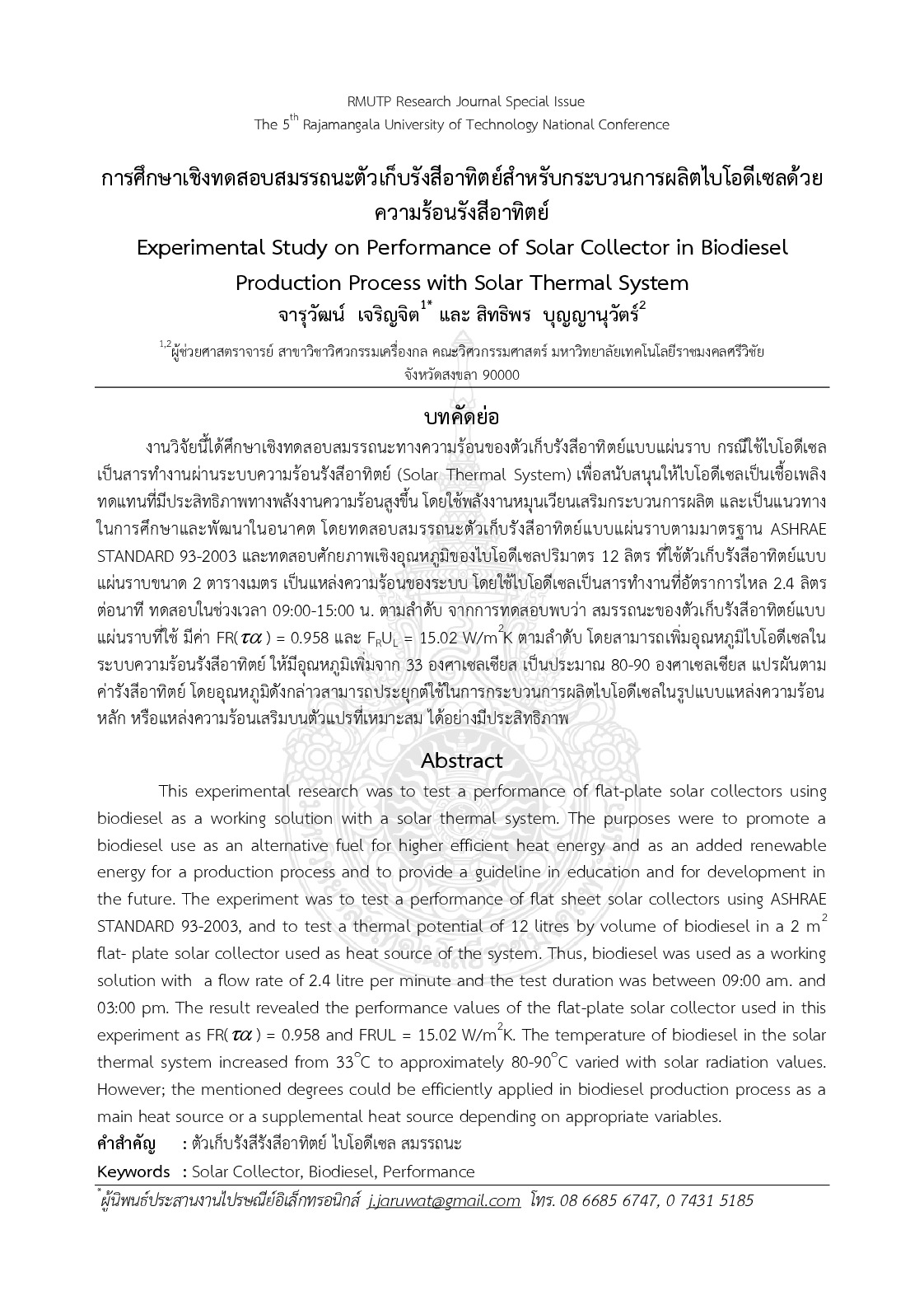
Experimental study on performance of solar collector in biodiesel production process with solar thermal system
This experimental research was to test a performance of flat-plate solar collectors using biodiesel as a working solution with a solar thermal system. The purposes were to promote a biodiesel use as an alternative fuel for higher efficient heat energy and as an added renewable energy for a production process and to provide a guideline in education and for development in the future. The experiment was to test a performance of flat sheet solar collectors using ASHRAE STANDARD 93-2003 and to test a thermal potential of 12 litres by volume of biodiesel in a 2 m2 flat- plate solar collector used as heat source of the system. Thus biodiesel was used as a working solution with a flow rate of 2.4 litre per minute and the test duration was between 09:00 am. and 03:00 pm. The result revealed the performance values of the flat-plate solar collector used in this experiment as FR( ) = 0.958 and FRUL = 15.02 W/m2K. The temperature of biodiesel in the solar thermal system increased from 33๐C to approximately 80-90๐C varied with solar radiation values. However; the mentioned degrees could be efficiently applied in biodiesel production process as a main heat source or a supplemental heat source depending on appropriate variables.