จำนวน Repository ( 8 )
การผลิตก๊าซชีวภาพจากวัสดุเศษเหลือทางการเกษตร โดยระบบหมักไร้อากาศแบบแห้ง สำหรับครัวเรือนในชุมชนตำบลเกาะขันธ์ จังหวัดนครศรีธรรมราช
This research was studied and transferred the biogas production technology with the community participation using anaerobic dry fermentation system from agricultural residues. The production of renewable energy for replacing LPG in household cooking of Koh Khan Sub-district community Cha-Uat District Nakhon Si Thammarat Province was carried out. The efficiency of the biogas production from different co-digestion material with fresh cow manure was studied for 45 days. The experiment 1 bananas and papaya and the experiment 2 rice straw and coconut meal were used for fermented materials. It was found that the system using rice straw and coconut meal as a fermented material had a higher potential than using bananas and papaya. The system produced averaged biogas of 150 L/d and an average methane content of 67.68% respectively within just 15 days after start-up. While bananas and papaya as fermented materials took more time with more than 30 days after start-up the system. The system produced averaged biogas of 120 L/d and an average methane content of 64.64%. For usability test It was found that 150 L of biogas could continuously cook for 45-60 minutes. The 85% of the technology transfer recipients regarded that the knowledge gained as practical and reduced household expenditures. Additionally the system can produce biogas for a long time without adding new fermented materials. Therefore this biogas system could be applied to local agricultural waste for biogas production which can be expanded to other areas.
ความสัมพันธ์ของการกระจายตัวของสารป้องกันกำจัดศัตรูพืชตกค้างในดินเพาะปลูกข้าวและระดับการปนเปื้อนในเมล็ดข้าว
The effect of pesticides on farmers and the distribution of residual pesticides in rice plants and rice grain was studied in rice farming area covered in Samchuk district Suphanburi province. The situation and health effects related to pesticides was conducted using an individual interview and filled-form questionnaire with 126 samples. The participants were male of 68.3% and female of 31.7%. Educational level of participants was to be 36.5% and 24.6% for primary and elementary levels respectively. One-third of farmers (33.3%) reported a monthly income in the range of 5000 to 10000 Baht. A quarter of farmers (25.4%) got higher a monthly income with 10001 to 15000 Baht. Family members was found to be 4 persons (54%) 5 persons (19.8%) and over 5 persons (11.1%). All participants concerned the behavior and perception related pesticides for their highly toxicities and extremely dangerously death. A half of herbicide (50%) was glyphosate. Seriously paraquat (commercial name of Gramoxone) was found to be 22%. On the other hand the most of insecticide (55%) was an abamectin and carbofuran (commercial name of Furadan) was found to be 15%. A 20 samples of rice plants and rice grain was collected by random sampling. The residual carbofuran and glyphosate in rice plants and rice grain was determined using standard method. It was found that carbofuran was found in the range of ND-0.05 μg/kg and ND-0.08 μg/kg for rice plants and rice grain respectively. Glyphosate was found in the range of ND-0.26 μg/ kg and ND– 0 . 2 2 μg/ kg for rice plants and rice grain respectively. The residual levels of carbofuran and glyphosate in rice plants and rice grain depended on a spray period time their decomposition and the concentration of carbofuran and glyphosate. The residual levels of carbofuran and glyphosate did not significantly quantitative correlation between rice plants and rice grain.

การผลิตถ่านอัดแท่งจากวัสดุเหลือทิ้งทางการเกษตรโดยใช้เปลือกทุเรียนผสมเปลือกลูกจาก
This research focuses on the production of charcoal briquettes from agricultural residues by using durian and nypa palm peel mixtures. The objectives of this study are to study the combustion efficiency of charcoal briquettes; study the suitable ratio for the production of briquettes with the ratios of durian : nypa palm peel mixtures as 100:0 50:50 25:75 and 0:100; recycle the agricultural residues as the renewable energy sources and analyze the fuel characteristics; moisture content ash content volatile matters fixed carbon and heating value. The results showed that the best ratio for the combustion efficiency of charcoal briquettes is 50:50 with the minimum moisture content of 4.68% the minimum ash content of 2.70% the volatile matters of 10.33% ; the maximum fixed carbon of 25.56% and all characteristics are met with the standard of charcoal briquettes from the local community products. In the ratio of 100:0 it showed the maximum heating value as 5399 calories per gram. Therefore the 50:50 charcoal briquettes are suitable as the renewable energy source. Besides the capacity of odor adsorption was analyzed by adding the odor substances (mothball) in two bottles with three mothballs for each bottle for two consecutive days before removal. Then sic of 50:50 charcoal briquettes were added into one bottle. Ten testers smelled the bottle every two days for six days. The result showed that the bottle with the charcoal briquettes had odor less than the bottle without briquettes. Hence the charcoal briquettes from durian and nyla palm peel mixtures have the best odor adsorption capacity and are suitable for household uses.
The used of bamboo residues from chopstick production for mushroom cultivation material
Bamboo sawdust from chopstick production process was used as substrate for Indian oyster (Phoenix mushroom) cultivation. Experimental studies in cultivation material including wood sawdust bamboo sawdust and fermented chopped straw for 4 experiments - first experiment used 100 % of wood sawdust the second experiment used 25 % of bamboo sawdust mixed with 75 % of fermented chopped straw the third one used 50 % of bamboo sawdust mixed with 50 % of fermented chopped straw the forth one used 75 % of bamboo sawdust mixed with 25 % of fermented chopped straw and the last one used 100 % of bamboo sawdust. All experiments were analyzed for chemical properties nutrients in substrates for mushroom growing and yield of mushroom. The results showed that each type of mushroom substrate with different humidity. pH is suitable for use as a mushroom cultivation material. For quantity of nutrients in bamboo sawdust is more than wood sawdust. Increasing of nutrients is depending on increase fermented chopped straw. For mycelia growth in wood sawdust were faster than a bamboo sawdust culture. Yield of Indian oyster (Phoenix mushroom) found in any treatments. Especially in experiment 3 (50 % of bamboo sawdust mixed with 50 % of fermented chopped straw) is more suitable for Indian oyster (Phoenix mushroom) cultivation which compared to the other treatments because of highest yield mushrooms (175.11 grams per piece).
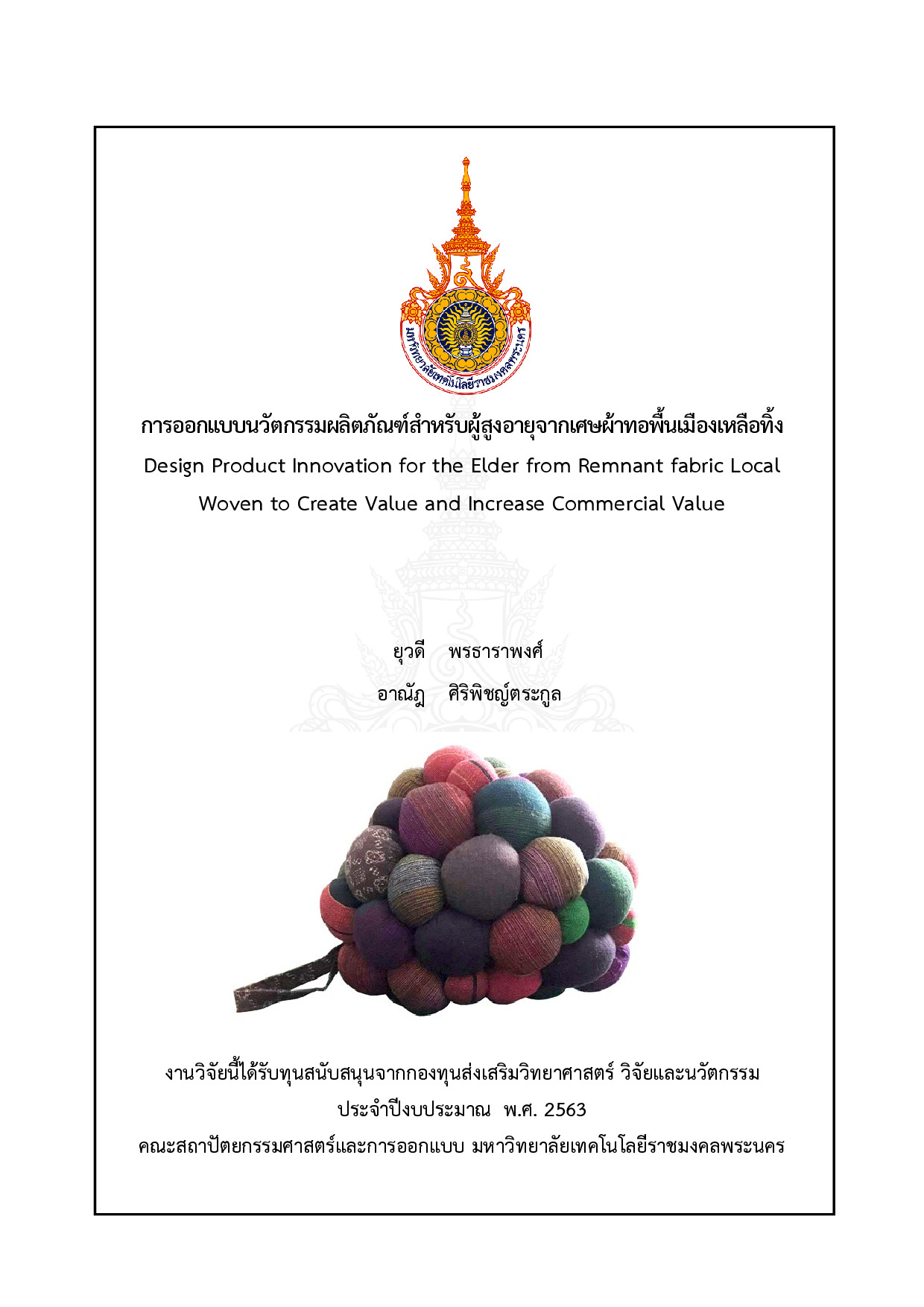
การออกแบบนวัตกรรมผลิตภัณฑ์สำหรับผู้สูงอายุจากเศษผ้าทอพื้นเมืองเหลือทิ้ง
The objectives of this research are: 1. to design innovative products for the elderly from local woven fabric scraps left over from sewing that can help and promote health in their lives; 2. to create product guidelines for the elderly from woven fabric scraps. Native leftovers from tailoring that are unique create value and add commercial value. From the study of rags from local woven cloth left over from sewing Weaving indigenous fabrics which are local wisdom. Has been used to process various products such as clothing bags guards there will be a discarded part that is not used Therefore in this research the rag was used to develop the design of products for the elderly. There is a worthwhile use of local fabric scraps. focus on style Techniques for creating curved surfaces Embossed into a ball to create a texture and pressure. In terms of shape design it can be used with the elderly. can help and promote health in life Characteristics of the product is a product that can be administered to muscles. parts of the body of the elderly. The results of the experiment by bringing innovative products for the elderly from the waste of local woven cloth were tested on 22 elderly people in terms of form beauty function use. It was found that the elderly were satisfied with the innovative products for the elderly. with an average of 4.51 is the most innovative product for the elderly from various forms of local woven fabrics It is designed to be a guideline for application. production for sale This will result in the community learning to design products related to the elderly. Community can develop potential Community products and products for the elderly resulting in the creation of local product identity It is a process of creating a body of knowledge and extending local wisdom for benefits.