จำนวน Repository ( 5 )
รูปแบบการจัดการตลาด SMEs 4.0 เสื้อผ้าแบรนด์ไทยของกลุ่มเจนเนอเรชันวาย
This research aims to 1) analyze the SMEs 4.0 market management factors for Thai clothing brands among generation Y 2) to study personal factors affecting the SMEs 4.0 market management for Thai clothing brands among generation Y and 3) to generate the SMEs 4.0 market management model for Thai clothing brands among generation Y. This study uses qualitative and quantitative research methods. In-depth interviews served as a qualitative data collection methodology. Seventeen participants were grouped into experts stores managers and specialist contemporary Thai clothing brands. For the quantitative data collection methodology the researcher used questionnaires with a specific group of 430 Generation Y male and female participants who used to purchase or frequently purchase Thai clothing brands. To analyze data percentage mean and multiple classification analysis with a statistically significant level at 0.05 the researcher used G*power. Furthermore it was analyzed if the results were consistent with the qualitative data. The research results show that market management factors significantly relate to Thai clothing brand customers’ purchasing behaviors. These factors include purchasing rationale factor purchasing motivation factor brand management factor and demand management factor. The research findings link to the best practices in the market management model both online and offline markets and sustainable development in 5.0 society including 1) a rapid technology replacement 2) adding creative value to the society 3) natural harmonization management and 4) sustainable development.
การพัฒนานวัตกรรมทางการบัญชีของธุรกิจขนาดกลางและขนาดย่อม (SMEs)
This research aimed to study organizational characteristics and organizational supporters that affect the innovative development of small and medium enterprises (SMEs). The independent variables were organizational characteristics based on McKinsey’s 7S framework (strategy structure systems style staff skills and shared values) and organizational supporters (technology and government support). The dependent variables were guidelines for accounting innovation development. Sizes of the organization were control variables. The sample group in the study consisted of 309 small and medium enterprise entrepreneurs. Data were analyzed using descriptive statistics and inferential statistics (multiple linear regression). The results showed that strategy systems staff technology and governmental support affect the innovative development of small and medium enterprises (SMEs) at the .05 level of significance. According to small and medium enterprise entrepreneurs management accounting innovation and financial innovation were very important to SMEs (X ±S.D. equal 3 . 6 1 ± 0 . 8 2 ) . To develop SMEs’ accounting innovation entrepreneurs need to determine clear strategies policies and goals for innovation manage data systems to be exchanged in organizations and set a motivation system for innovation development. Staff development plans should be created for knowing and understanding innovation. Apart from organization management SMEs need to get government support and adapt technologies to accounting to increase the efficiency of accounting information.

The criteria for pivotal load officers and credit analysts in the business of lending to SMEs of kasikorn bank public company limited and siam commercial bank public company limited in bangkok and its vicinity
The objectives of this research are to study the credit considerations criteria the opinion about credit analyzing for SMEs business of the credit analysts and the problems of the credit consideration process of SMEs business in Kasikorn Bank Public Company Limited and Siam Commercial Bank Public Company Limited. The sample groups are 181 credit analysts of Kasikorn Bank Public Company Limited and 219 credit analysts of Siam Commercial Bank Public Company Limited. The collected data by questionnaire. The result of this study is the main information which the questionnaire answerers use for credit consideration are the personal document of borrower. The most important information use is the current account statement. The financial statement which is used in credit consideration the most important is income statement. The objective of using financial statement in credit consideration is analyzing the solvency. The important transaction in financial statement which is used for credit consideration are profit/loss and revenue/expense. To give priority to the qualitative analysis the result is the majority of questionnaire answerers give priority to collateral the majority of questionnaire answerers give priority to the statement of cash flow. The opinion about the problem of credit consideration process the result is the majority of questionnaire answerers give priority to look for the customers. The result of assumption test is the overall qualitative analysis quantitative analysis and problems in credit consideration process are different.
The design and development problem in wear house and decoration group for one Tumbon one product production group (OTOP), mini and medium SMEs in pathumthani province.
This research aimed to study and analyse conditions and problems in designing and developing household and decorative products of One Tambon One Product (OTOP) small and medium enterprises (SMEs) in Pathumthani province. The informants were 4 OTOP entrepreneurs and 205 OTOP SMEs. The research was conducted by means of interviews observations and questionnaires. The data was statistically analysed using frequency percentages mean and standard deviation. The results showed that conditions and problems in designing and developing household and decorative OTOP products ranged from home-based production site a lack of knowledge in product design and development transportation creativity artistic relations product specifications marketing to product design and development laws. Four entrepreneurs from these groups of products: lotus-fiber flowers silk flowers and bamboo lamps were found to have the problem of dyeing materials whilst those from the group of Thai/Japanese clay flowers had the problem of clay. The researcher had analysed piloted and concluded the problems and then passed on product development techniques to the entrepreneurs. It was found that they could use the given knowledge to make beautiful products and they satisfied with the reducing cost of production.
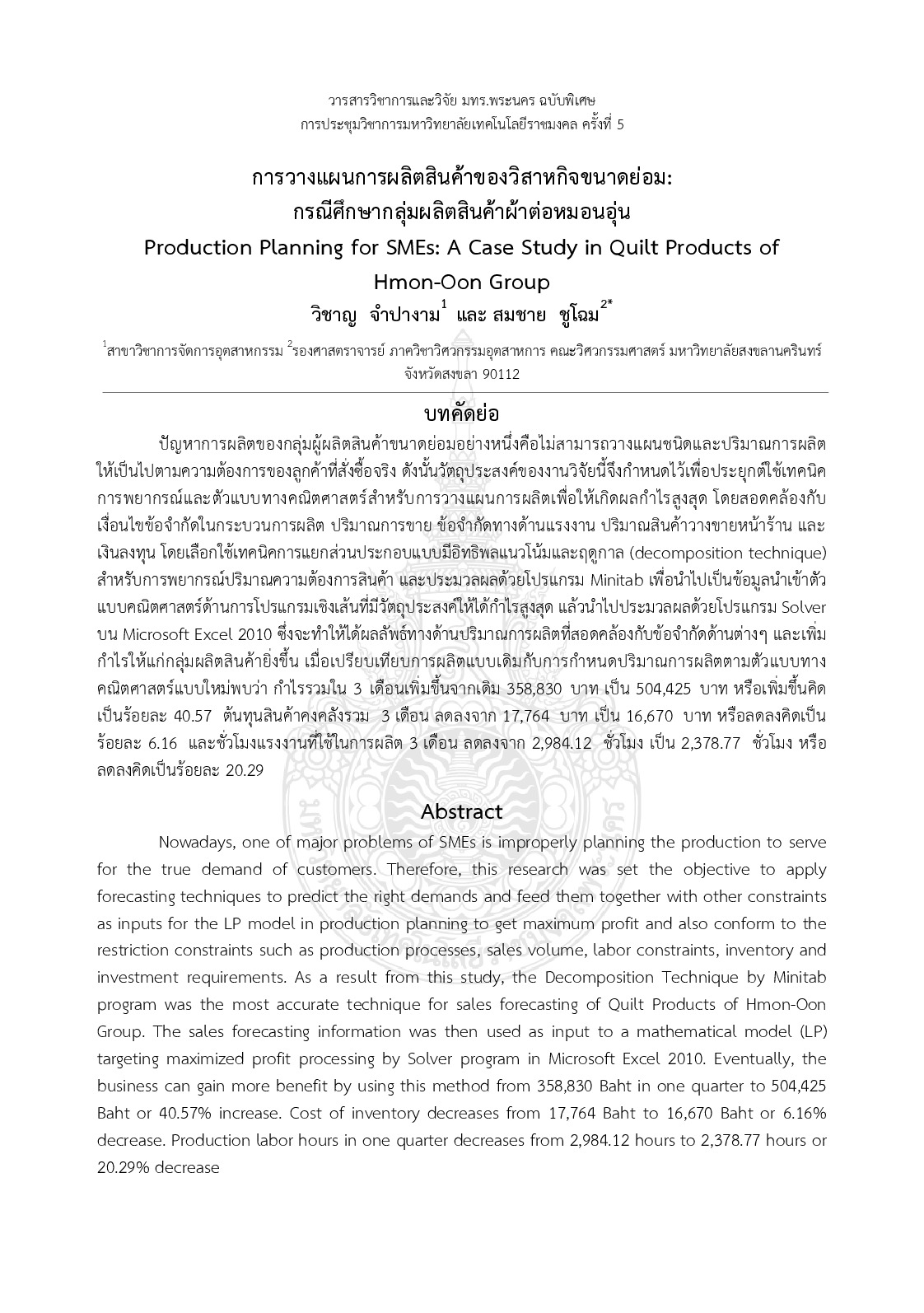
Production planning for SMEs: a case study in quilt products of hmon-oon group
Nowadays one of major problems of SMEs is improperly planning the production to serve for the true demand of customers. Therefore this research was set the objective to apply forecasting techniques to predict the right demands and feed them together with other constraints as inputs for the LP model in production planning to get maximum profit and also conform to the restriction constraints such as production processes sales volume labor constraints inventory and investment requirements. As a result from this study the Decomposition Technique by Minitab program was the most accurate technique for sales forecasting of Quilt Products of Hmon-Oon Group. The sales forecasting information was then used as input to a mathematical model (LP) targeting maximized profit processing by Solver program in Microsoft Excel 2010. Eventually the business can gain more benefit by using this method from 358830 Baht in one quarter to 504425 Baht or 40.57% increase. Cost of inventory decreases from 17764 Baht to 16670 Baht or 6.16% decrease. Production labor hours in one quarter decreases from 2984.12 hours to 2378.77 hours or 20.29% decrease