จำนวน Repository ( 3 )

พฤติกรรมการประหยัดพลังงานไฟฟ้าของนักศึกษาคณะบริหารธุรกิจ มหาวิทยาลัยเทคโนโลยีราชมงคลพระนคร
The study objectives of the electrical energy saving behavior of student in faculty of business administration Rajamangala University of Technology Phra Nakhon 1) to study psychological trait factor psychological state factor and situational factor in overall group and subgroup of the students’ electrical energy saving behavior in faculty of business admimistration RMUTP 2) to study the interaction effect between psychological trait factor psychological state factor and situational factors related to the students] electrical energy saving behavior in overall group and subgroup. The sample size was 361 students of bachelor’ s degree. The study factors were 7 independents future orientation and self-control) 1 psychological state factors (appropriate model from family knowledge on the electrical energy saving and the information about electricity saving). The dependent factor was the electrical energy saving behavior. Frequency percentage arithmetic mean and standard deviation were used for descriptive statistic while stepwise multiple regression and two-way ANOVA were used for inferential statistics in overall group and subgroup according to social demographic characteristics. The research findings were as follows : Firstly all 7 factors of psychological trait factors psychological state factor and situational factoe could predict 52% of variance of the electrical energy saving behavior. The most prediction power factors were appropriate model from family positive attitude towards saving behavior receives electricity saving information and well-being respectively. Secondly the interaction effect was found well-being and electricity saving information with the electrical energy saving behavior of student which was male and female group and freshman and sophomore group junior and senior group G.P.A above 3.00 and parents’ income lower than 30000 thb Thirdly the interaction effect was found the future orientation and self-control and knowledge on the electrical energy saving behavior with the group of student who mother has an education lower than undergraduate.
The Factors that Effects 0n Household Saving Behaviors in Koh Peah Community, Trang Province
The Factors that Effects on Household Saving Behaviour in Koh Peach Community Trang Province This study investigates effects on household saving behaviour in Koh Paech Community Trang Province. The objectives are (1) to examine the household saving behaviour (2) to analyse various factors affecting the household saving behaviour and (3) to compare household saving behaviour between general household and those which are members of the Saving Group for Production. For primary data questionnaires are employed to obtain information from a total 326 households interviewed in July 2012. These data are examined and evaluated by way of simple statistical analysis with multiple regression used to investigate the relationship between household saving and factors determining it such as the household leader’s age income expenditure and level of education. The study includes consideration of the boosting household consumption policies of the Thai government. Results of this paper indicate that most household leaders are male (70.9%) and half of them are over the age of 50 years. The majority are agriculturists (57%) and most have an elementary education (58.3%). Average number of dependents is two and the average income of households interviewed is 352904 baht/year. Average household expenditure is 186151 baht/year average assets are 2681596 baht/year average debt is 311809 baht and average household saving is 91008 baht/year. Multiple regression analysis reveals that income (0.78) and assets (0.18) both have highly significant positive relationships with household saving while for expenditure (-0.36) there is a highly significant negative relationship. An unexpected finding of no effect from interest rates on household saving may be due to a preference for convenience over returns from saving. In comparing saving behaviour the result show that households which are members of the Saving Group for Production have an average saving of 80342 baht/year. They mostly save money before spending and usually have monthly security deposits. For general households the average saving is 96274 baht/year. They mostly spend rather than save money and have infrequent security deposits.
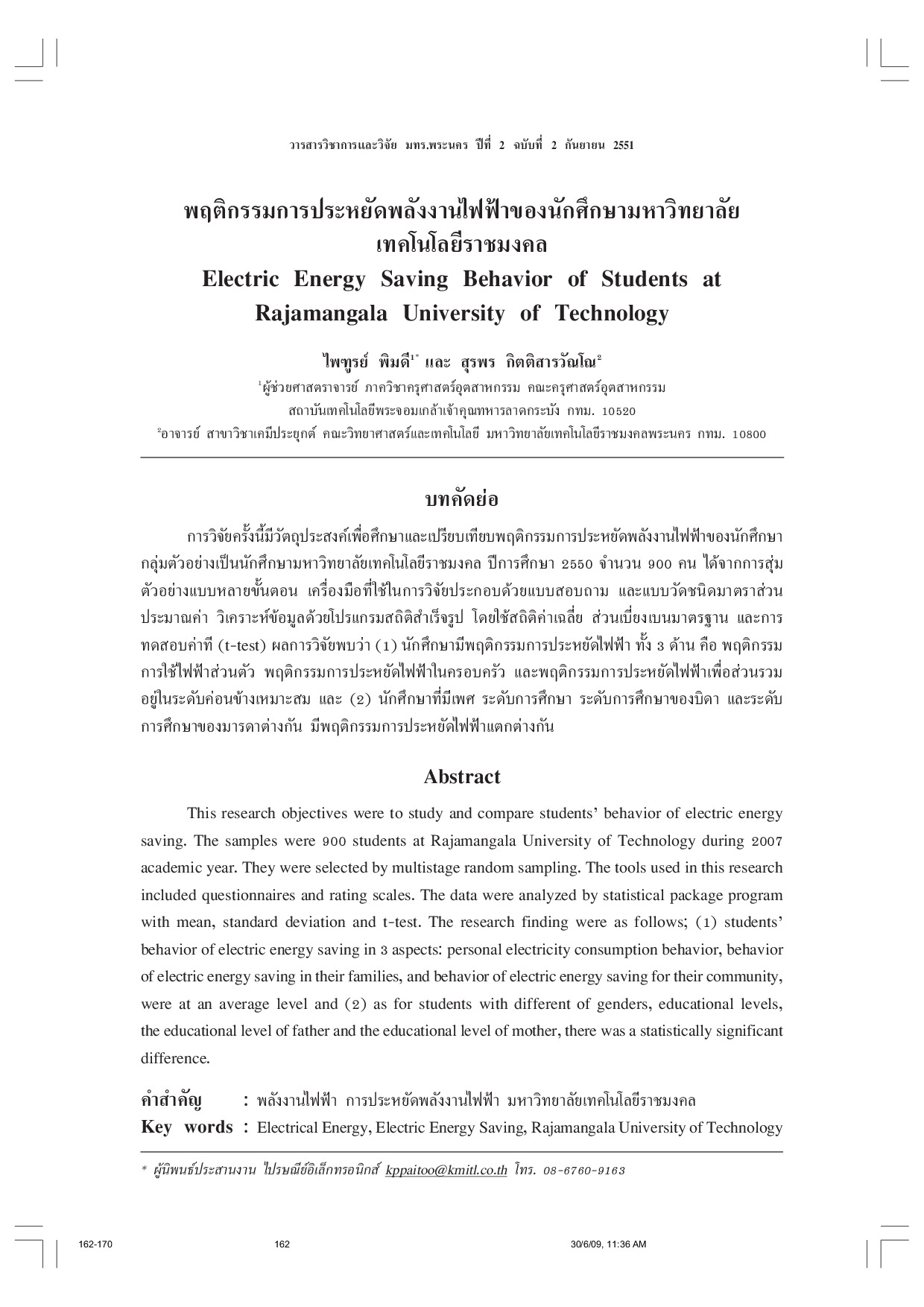
Electric Energy Saving Behavior of Students at Rajamangala University of Technology
This research objectives were to study and compare students’ behavior of electric energy saving. The samples were 900 students at Rajamangala University of Technology during 2007 academic year. They were selected by multistage random sampling. The tools used in this research included questionnaires and rating scales. The data were analyzed by statistical package program with mean standard deviation and t-test. The research finding were as follows; (1) students’ behavior of electric energy saving in 3 aspects: personal electricity consumption behavior behavior of electric energy saving in their families and behavior of electric energy saving for their community were at an average level and (2) as for students with different of genders educational levels the educational level of father and the educational level of mother there was a statistically significant difference.