จำนวน Repository ( 372 )

การออกแบบชุดปีกหน้า และปีกหลัง สำหรับรถแข่งสูตรนักศึกษา
Problem with the development of performance for racing cars. When a car is without a front wing and rear wing it will affect the racing car unstable. So we had an idea to study and design the front wing and rear wing for installation on a student formula racing car to increase efficiency the racing car turning when is compared with the racing car without front wing and rear wing. In operation. First plan the implementation of the project. Then study subject content such as Computational Fluid Dynamics Fluid Mechanics Aerodynamics TSAE competition rules and steps to using the SOLIDWORKS Program. We use SOLIDWORKS to compare the aerodynamic performance of each front and rear wing and analyze the results. Flow Simulation using the SOLIDWORKS Program We have got Flow Simulation performed on the front wing and rear wing of 1 2 and 3 elements. In terms of flow simulation we use a 50 km/h wind speed to hit the front and rear wings. The results showed that the front wing and rear wing when assembled with a car. We have studied and selected the angle of attack that has the highest life coefficient to be assembled on the Student Formula Racing Car. The Front Wing and Rear Wing are 2 elements of the Front Wing and 2 elements of the Rear Wing. They have a Drag Coefficient of 0.38 and a Lift Coefficient of 0.30.
การออกแบบล้อรันแฟลทสำหรับรถยนต์นั่งส่วนบุคคลด้วยระเบียบวิธีไฟไนต์เอลิเมนต์
The objective of this research was to design run flat wheels made of aluminum for passenger cars and investigate the stress strain and deformation of run flat wheels and their components. The original 17 inch run flat wheels were made of AISI 1020 steel with a weight of 11.3 kg per wheel. The main problems were from the high-level weight as well as the untighten connection together with noticed gaps taking place between the run flat wheel and the wheel. Therefore in this study the AISI 1020 material was changed to the Aluminum 6063 T6 material. The Numerical methodology using the finite element program was also chosen to indicate the comparative differences in the strain values engaged at various locations of both run flat wheels and pan wheels. The results obtained from both approaches using SolidWorks Simulation Program uncovered the consistent results of the experiments with a 10-16% difference in strain values. The complicated 17 inch wheel pan model was next built using reverse engineering and employed as a key reference to design the cross-sectional area of the new run flat wheels made of Aluminum 6063 T6. All these two parts could be connected tightly. The SolidWorks Simulation program was employed to design and examine the strength of both designed aluminum run flat wheels made of aluminum and the wheel pan made of 17 inch aluminum alloy to build passenger cars. The finite element model was furthermore applied for the run flat wheels made of aluminum 6063 T6 and it provided run flat wheels composed of 2 light weighted pieces. The stress strain and deformation measured were proven and suggested in the test. The output Von Mises stress did not exceed the Yield stress within the linear elastic limit and 3 times safety integrity value. The results from the study were that the obtained run flat wheels allowed the driver to continuously drive for a further 50 kilometers at a speed of 50 kilometers per hour without losing control. They allowed possible tire repairing or replacing when situated in a safe and convenient location.
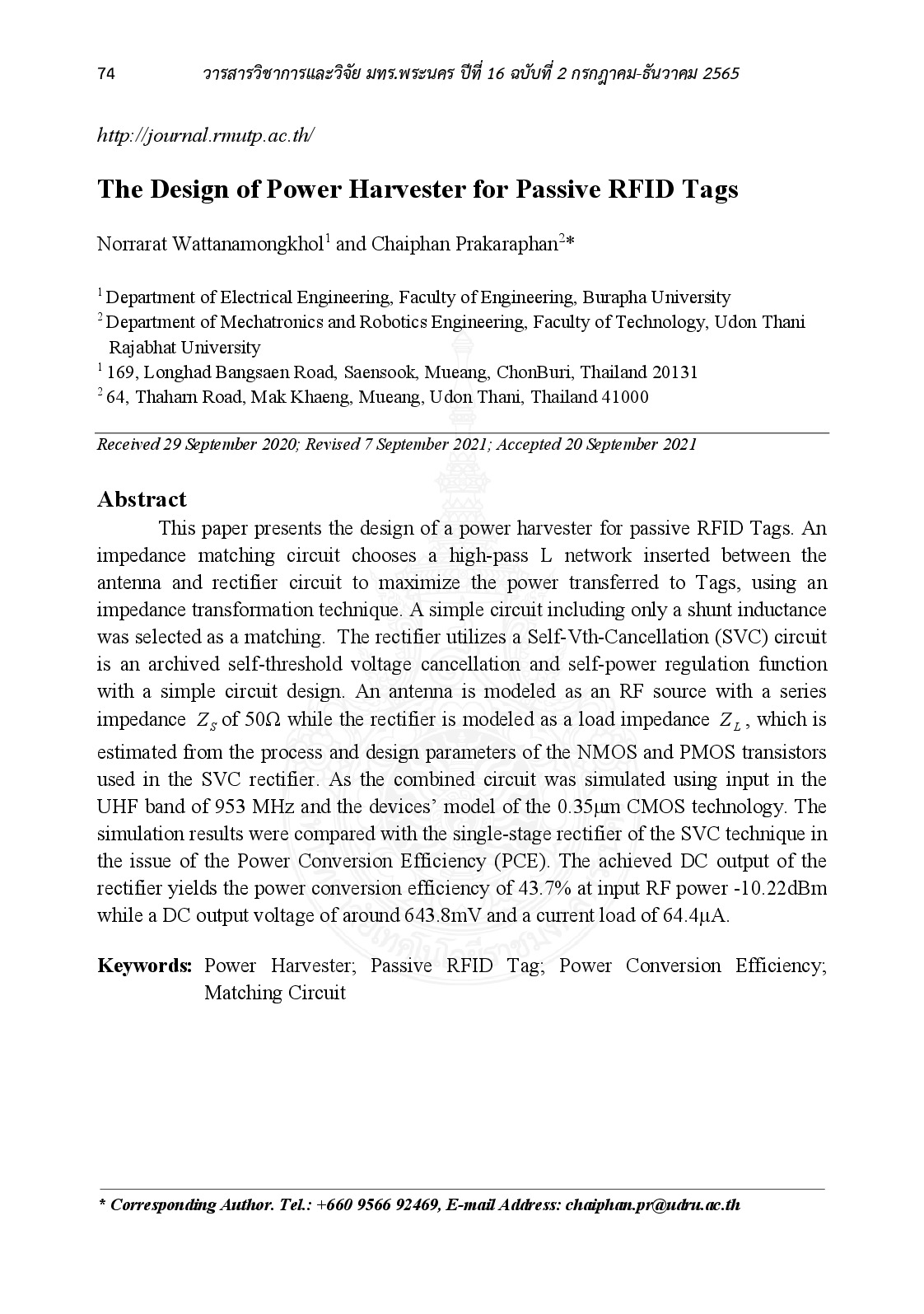
The Design of power harvester for passive RFID Tags
This paper presents the design of a power harvester for passive RFID Tags. An impedance matching circuit chooses a high-pass L network inserted between the antenna and rectifier circuit to maximize the power transferred to Tags using an impedance transformation technique. A simple circuit including only a shunt inductance was selected as a matching. The rectifier utilizes a Self-Vth-Cancellation (SVC) circuit is an archived self-threshold voltage cancellation and self-power regulation function with a simple circuit design. An antenna is modeled as an RF source with a series impedance Zs of 50Ω while the rectifier is modeled as a load impedance ZL which is estimated from the process and design parameters of the NMOS and PMOS transistors used in the SVC rectifier. As the combined circuit was simulated using input in the UHF band of 953 MHz and the devices’ model of the 0.35μm CMOS technology. The simulation results were compared with the single-stage rectifier of the SVC technique in the issue of the Power Conversion Efficiency (PCE). The achieved DC output of the rectifier yields the power conversion efficiency of 43.7% at input RF power -10.22dBm while a DC output voltage of around 643.8mV and a current load of 64.4μA.
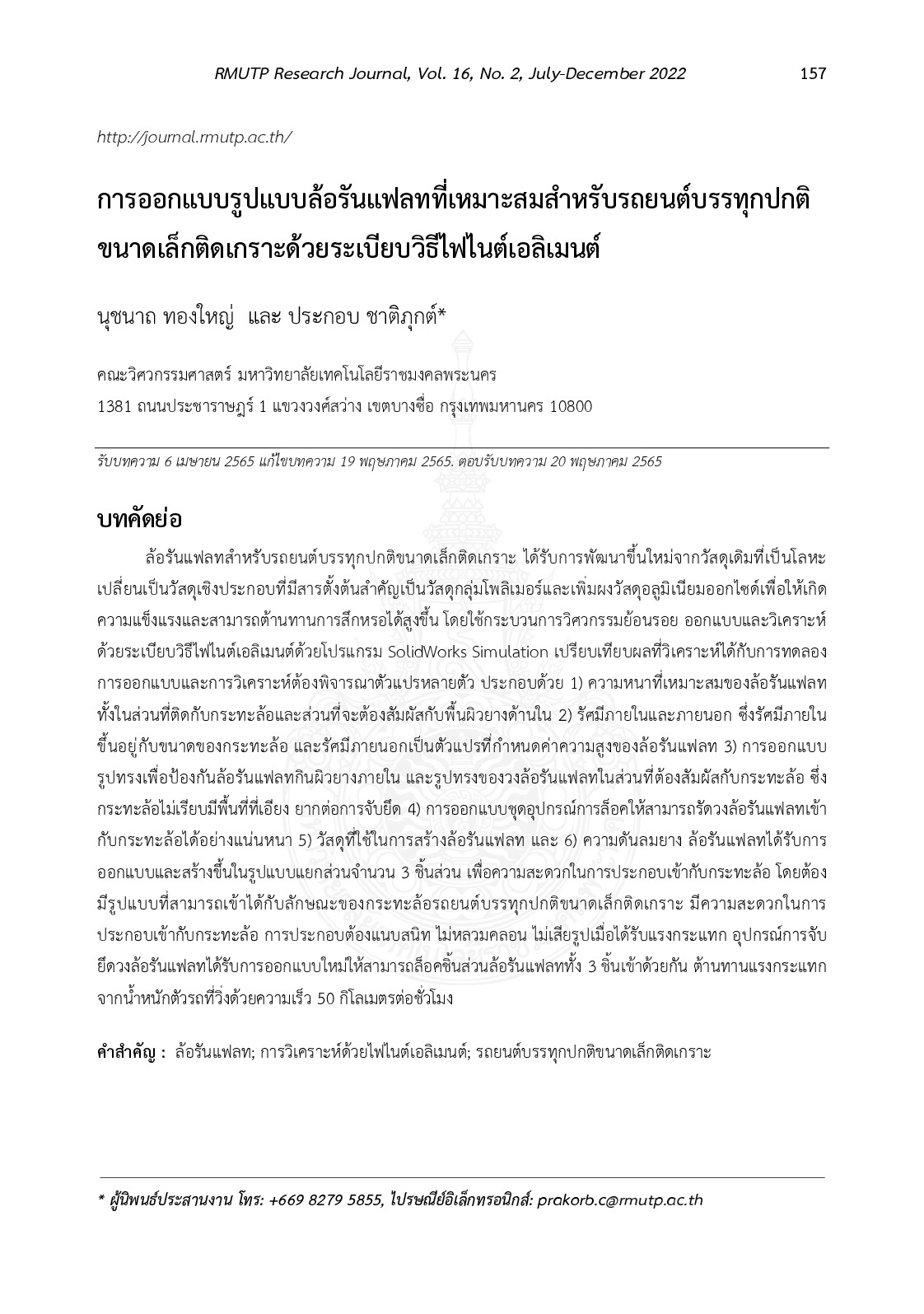
การออกแบบรูปแบบล้อรันแฟลทที่เหมาะสมสำหรับรถยนต์บรรทุกปกติขนาดเล็กติดเกราะด้วยระเบียบวิธีไฟไนต์เอลิเมนต์
Run flat wheels for small armored regular trucks have been re-developed by transformation from the original metallic material to compound materials polymer group materials as important raw materials then added with aluminum oxide powder to achieve higher strength and wear resistance. The research was performed by using reverse engineering processes including designing and analysis with finite element methodology with the SolidWorks Simulation program and comparing the analyzed results with outcome experiments. Several variables used for the design and analysis were 1) the optimal width of the run flat wheel at the parts both attached to the wheel pan and contacted with the inner rubber surface 2) internal and external radiuses. The internal radius is depending on the size of the wheel pan and the external radius is a variable that determines the height of the Run flat wheel. 3) the shape designed to prevent wearing of the inner tire surface of the run flat wheel and the shape of the run flat reel in the part contacted with the wheel pan. This wheel pan part is such uneven inclined area which is difficult to hold. 4) a design locking kit for tightly fastening the run flat reels to the wheel pan 5) the material used to create the run flat wheel and 6) tire pressure. The run-flat wheels were then designed and constructed in a modular form of 3 parts for ease of the wheel pan assembly. In designing pattern the assembling run flat reels had to be fit into the characteristics of a small armored regular truck wheel pan convenient to assemble with a wheel pan and tightly attached without looseness or deformation when impacted. The run flat reel gripping device has been redesigned to lock all three run flat parts together. It brought up the impact resistance from body weight was at 50 km/hr.
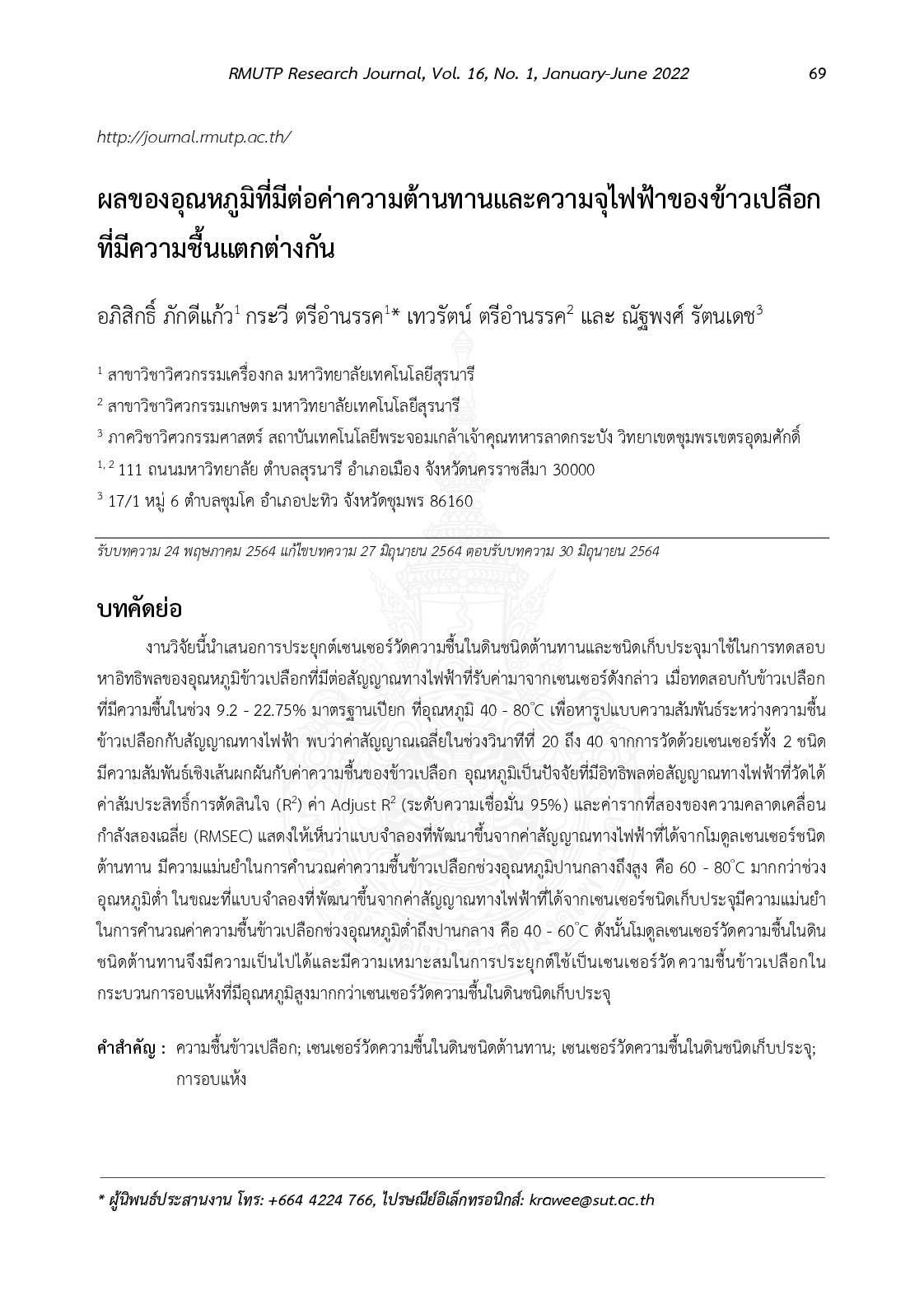
ผลของอุณหภูมิที่มีต่อค่าความต้านทานและความจุไฟฟ้าของข้าวเปลือกที่มีความชื้นแตกต่างกัน
This research proposes an application of resistive and capacitive soil moisture sensors to investigate the influences of paddy temperature on the electrical signal received from sensors when tested with paddy moisture in the range 9.2 - 22.75%wb at 40 - 80ºC to determine the relationship between paddy moisture and electrical signals. It was found that the mean signal values between 20 - 40 seconds from both sensors were inversely linear correlation with the moisture content of the paddy. Temperature is the factors that influence the measured electrical signal. R2 Adjust R2 (95% confidence interval) and RMSEC showed that the model developed from the resistive sensor signals was accurate in calculating the moisture content of paddy between medium to high temperature in range 60 - 80ºC more than the low temperature range. While the capacitive sensor signals model is accurate in calculating paddy moisture between low to medium temperature in range 40 - 60 ºC. Therefore the resistive soil moisture sensor is possible and more suitable for applying as a paddy moisture sensor in the high temperature drying processes than a capacitor soil moisture sensor.