จำนวน Repository ( 15 )
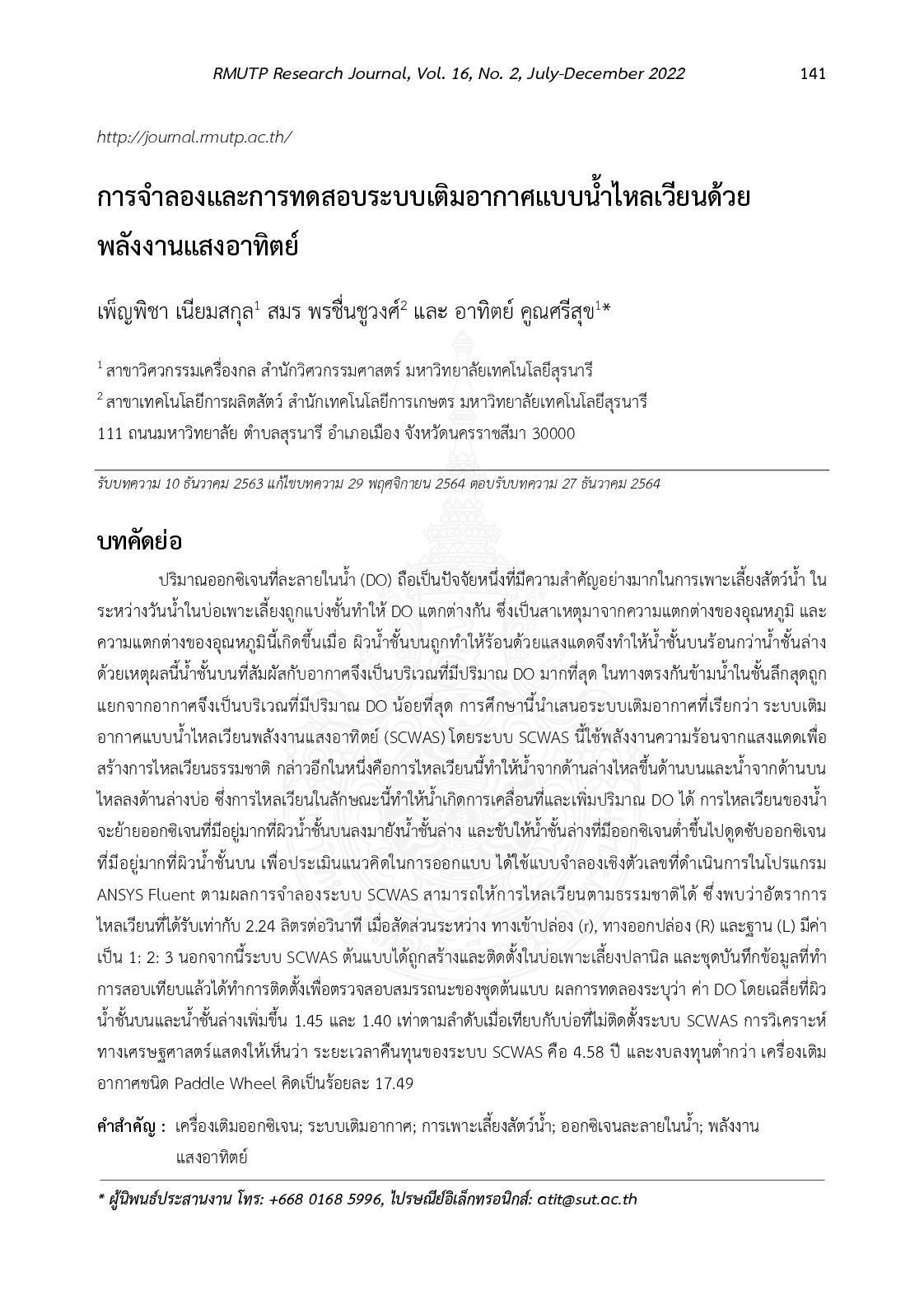
การจำลองและการทดสอบระบบเติมอากาศแบบน้ำไหลเวียนด้วยพลังงานแสงอาทิตย์
The amount of dissolved oxygen (DO) in aquaculture ponds is considered to be one of the most important aspects for the survival of fishes. The water in aquaculture ponds is stratified into distinct layers with different DO caused by differences in temperature. This temperature difference occurs when the surface layer of water heated by the sun becomes hotter than the lower water layer. Since the top layer is in contact with the air it contains the most DO. On the other hand the deepest layer is isolated from the air it contains the lowest amount of DO. This study proposed an aeration system called a Solar Circulating-Water Aeration System (SCWAS). The SCWAS uses solar thermal energy to create a natural water circulation. In other words it provides an upward current of water from the bottom to the pond surface and a downward current from the surface to the bottom. This circulation creates the movement of surface water and then increases the DO content of the surface water. This water circulation moves highly oxygenated surface water to the bottom layer forcing low oxygen water from the bottom up to the surface where it can absorb oxygen. To evaluate this design concept the numerical simulations of the system were conducted using ANSYS Fluent software. According to the simulation results the SCWAS can provide the natural water circulation. It was found that a flow rate of 2.24 L/s is obtained when the ratio between the draft tube inlet (r) the draft tube outlet (R) the base (L) is 1: 2: 3. In addition an SCWAS prototype was built and installed in a tilapia aquaculture system. A calibrated measuring system was installed to investigate the prototype performance. The experimental results indicate that the average DO values at the water surface and at the bottom of the pond increased by 1.45 and 1.40 times respectively compared with those of a pond without SCWAS. Economic analysis shows that the payback period of SCWAS is 4.58 years and its investment cost is 17.49% less than that of the paddle-wheel aerator.
เกมล่าโบราณวัตถุในสภาพแวดล้อมโบราณสถานเสมือนจริง
The objectives of the project study were to 1) create the treasure hunting in a real ancient ruin simulation game 2) evaluate suitability of the treasure hunting in a real ancient ruin simulation game and 3) assess satisfaction of game players to the game. The data collected by selective method consisted of 2 sample groups including 3 experts to evaluate suitability of the game who were specialist about 3D VR Game Design and History and 30 game players the treasure hunting in a real ancient ruin simulation game who were ages between of 15-35 years. Statistical data analysis was mean and standard deviation. The results showed that the treasure hunting in a real ancient ruin simulation game overall satisfaction was at a high level (𝒙̅=3.83 S.D.=0.50). Players of the treasure hunting in a real ancient ruin simulation game had overall satisfaction was at a high level (𝒙̅=4.35 S.D.=0.65).
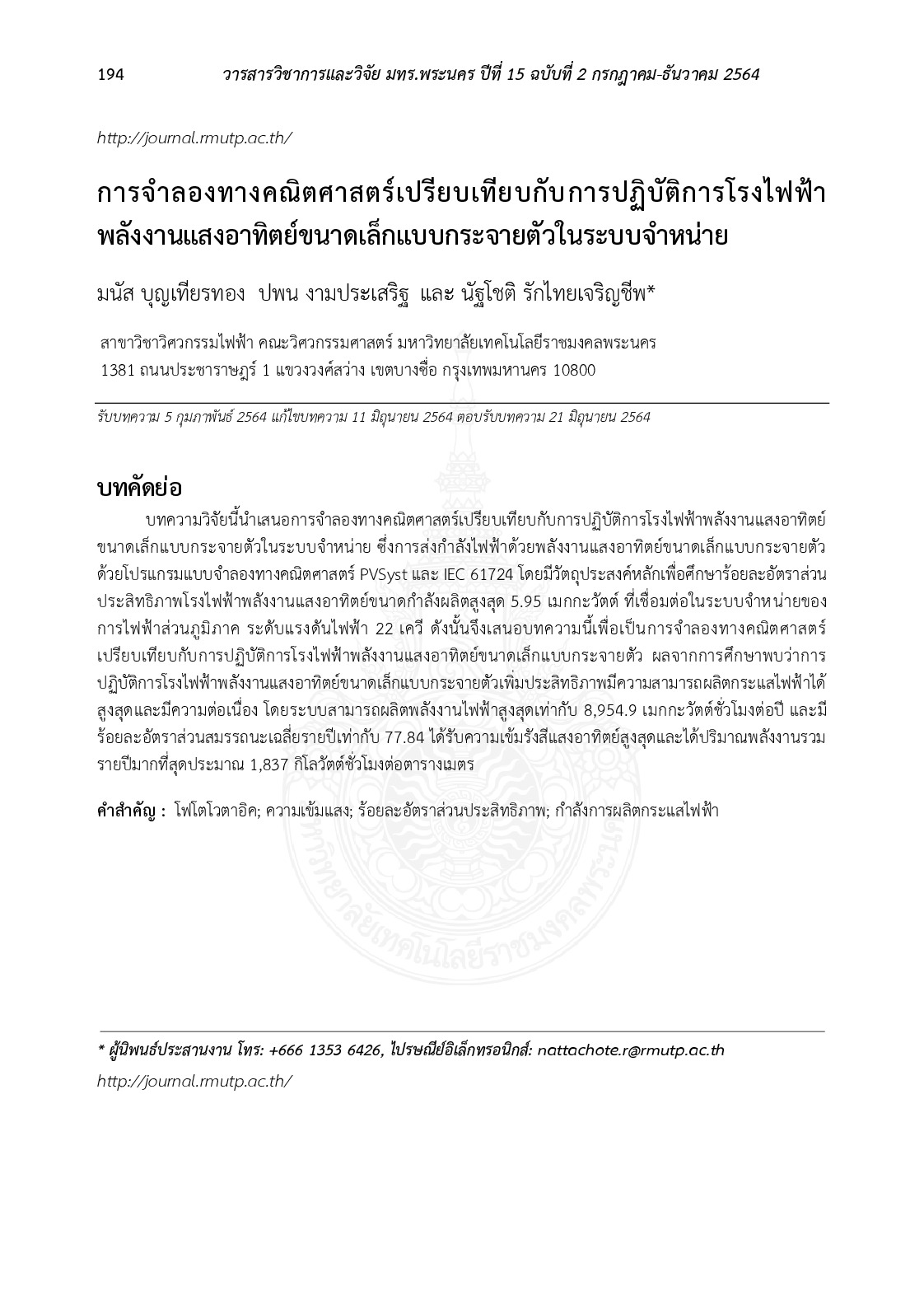
การจำลองทางคณิตศาสตร์เปรียบเทียบกับการปฏิบัติการโรงไฟฟ้าพลังงานแสงอาทิตย์ขนาดเล็กแบบกระจายตัวในระบบจำหน่าย
This paper presents a mathematical simulation to compared to operations a small distributed photovoltaic power plant in the distribution system. Practices transmission of electric power by small distributed solar energy With the PVSyst and IEC 61724 mathematical modeling programs the main objective was to study the % performance ratio photovoltaic power plants 5.95 MWp connected in the distribution system of the Provincial Electricity Authority voltage level 22 kV. Therefore this paper is presented as a mathematical simulation compared to operations a small distributed photovoltaic power plant in a distribution system. The results of the study show that the operation of small distributed solar power plants increases the efficiency to be able to produce the maximum electricity and continuously. The system was able to produce the highest power of 8954.9 MWh/year and had an average annual efficiency ratio of 77.84% receiving the highest solar radiation intensity and the highest annual total energy output of approximately 1837 kWh/m2
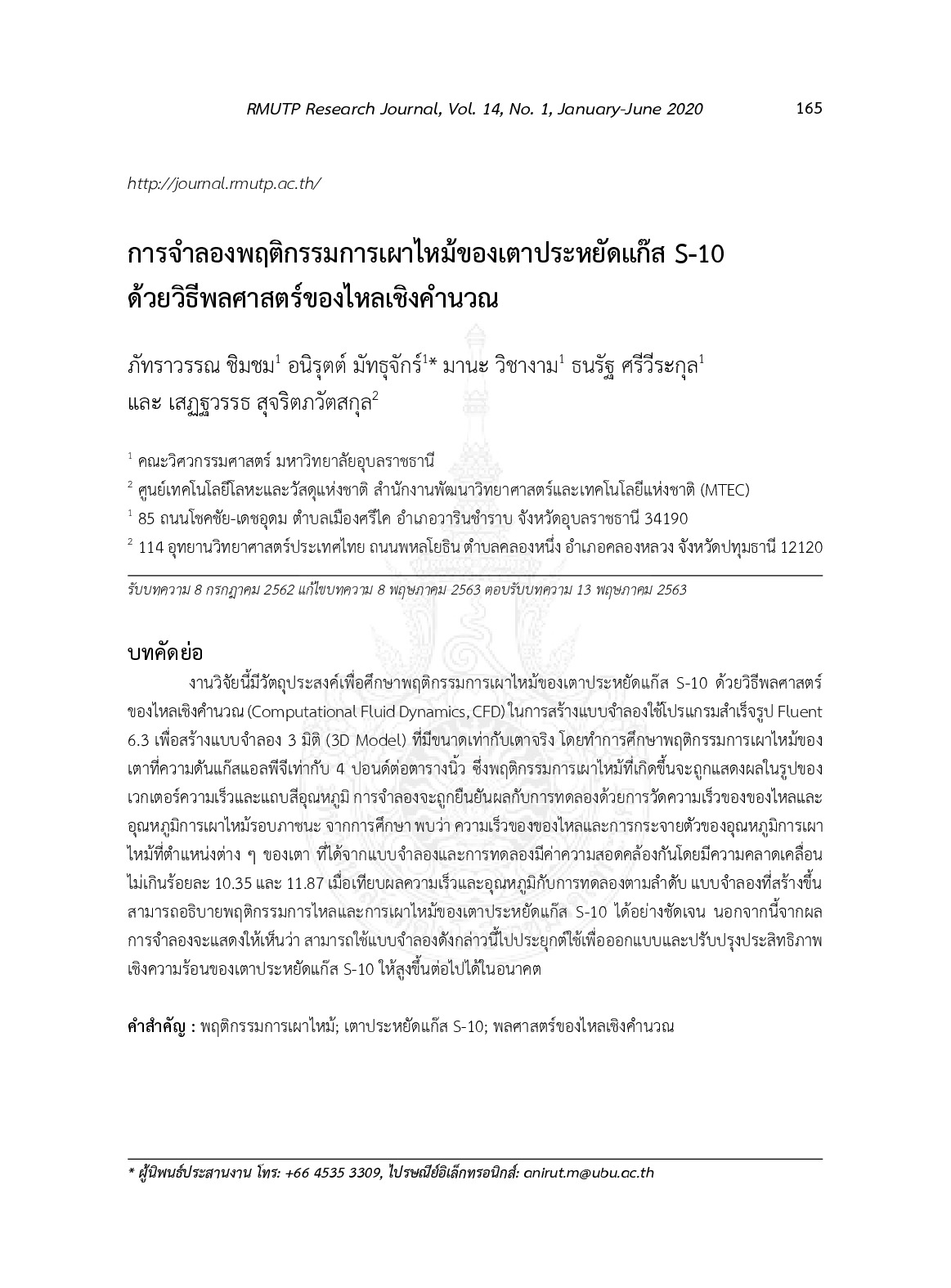
การจำลองพฤติกรรมการเผาไหม้ของเตาประหยัดแก๊ส s-10 ด้วยวิธีพลศาสตร์ของไหลเชิงคำนวณ
The objective of this research is to study the combustion behavior of a gas-saving burner S-10 using computational fluid dynamics (CFD). The simulation model was created using Fluent 6.3 in 3D-model of the same size of the burner. LPG pressure of 4 psi was released for this study. The combustion behavior was shown in temperature contour and velocity vector. The CFD results were verified by measuring the temperature around the burner head with a vessel. From the study it was found that the CFD’s results of flow velocity and combustion temperature distributions were validated with the experimental values. The CFD’s result errors were less than 10.35% and 11.87% comparing with the velocity and temperature measurement respectively. The fluid flow and combustion behaviors can be described by this CFD model. Moreover the CFD model of the gas-saving burner S-10 can be applied to improve the thermal efficiency of the burner in the future.
การพัฒนาโปรแกรมจำลองปฏิบัติการระบบสื่อสารโดยใช้ GUI MATLAB
With the objective 1) to develop communication system operating simulation program using GUI MATLAB 2) To find the efficiency of communication system simulation program using GUI MATLAB and 3) To compare the calculation results from the developed program with the calculation results The parameters of the high frequency transmission line which were developed to be programmed Classified by type of transmission lines in the air depending on the frequency and use including two-wire transmission cables. Twin-plane transmission cables And coax signal transmission lines The program components are divided into 3 screens namely the main screen the main program screen And parameter calculation screen Systematic quality and efficiency checks by 5 experts That has specialized expertise The tools used in the research were the quality inspection evaluation form which is divided into 2 parts which are part 1 program testing and part 2 testing the statistical system used for data analysis including mean percentage and standard deviation. The research found that 1. The result of the development of communication system simulation program using GUI MATLAB with the structure of the program design Dividing operations into 3 main parts Namely the calculation of two signal transmission lines. The calculation of the twin plane transmission line program And the calculation of the coax transmission line program n each part of the program calculation there is a working principle of the program. Each part of the calculation of the program has a working principle of the program. Divided into the terms of the scope of the transmission line Calculate capacity Calculate the conductivity Calculate inductance Calculate resistance And calculate the impedance value In which all calculations can show calculation results Select the calculation of various transmission lines. The program that the research team developed The signal transmission line is divided according to the type of usage and frequency. There are 3 signal transmission lines which are two-wire transmission lines. Twin-plane transmission cables And coax signal transmission lines 2. The result of finding the efficiency of the communication system simulation program using GUI MATLAB is divided into 2 parts. Part 1 Result of the language order and ability test for all 5 sub-processes Is correct No errors in the process In which each working process is linked as designed Overall the system development can work without errors. And when evaluating system acceptance It was found that the developed program could be used as a research tool. When considering each aspect found that Design. Design standards Design quality And the structure that is not complicated design is accepted by experts As a percentage between 82% - 85% Working process sorting work process Understanding of working language is accepted by experts. As a percentage between 82% - 87% And in front of work how to work in each work Compliance with user needs is accepted by experts. As a percentage between 80% - 95% And part 2 finding the performance of the communication system simulation program using GUI MATLAB developed found that the developed program has a high level of performance (x ̅ = 4.16 S.D. = 0.35) 3. Comparison between the calculated results from the developed program and the calculated results With matching calculation results Therefore shows that The developed program can be used in place of efficient calculation by hand.