จำนวน Repository ( 5 )
จักรยานพลังงานไฟฟ้าที่ติดตั้งแผง Solar Cell
This project presents an electric bicycle equipped with Solar Cell which will charge the battery with a solar panel. To be used to drive electric bicycles electric bicycles can be powered by two systems that are powered by the users cycling and from brushed DC motors from battery charging with solar panels the test will be tested by charging the panel with a time interval that the output voltage value From the solar panel which time interval is closer to the actual panel at 24 volts and charged into the batteryto test whether the electric bike can actually be used by a test drive starting with a displacement speed of 10 and 20 km/h at a distance of 100 meters. Using experiments with weight sizes of 50 60 and 70 kg respectively it was found that electric bicycles can actually be used. However the above project has been made into two parts. is the part that charges the battery from the solar panel and the second part is a separate electric bicycle.
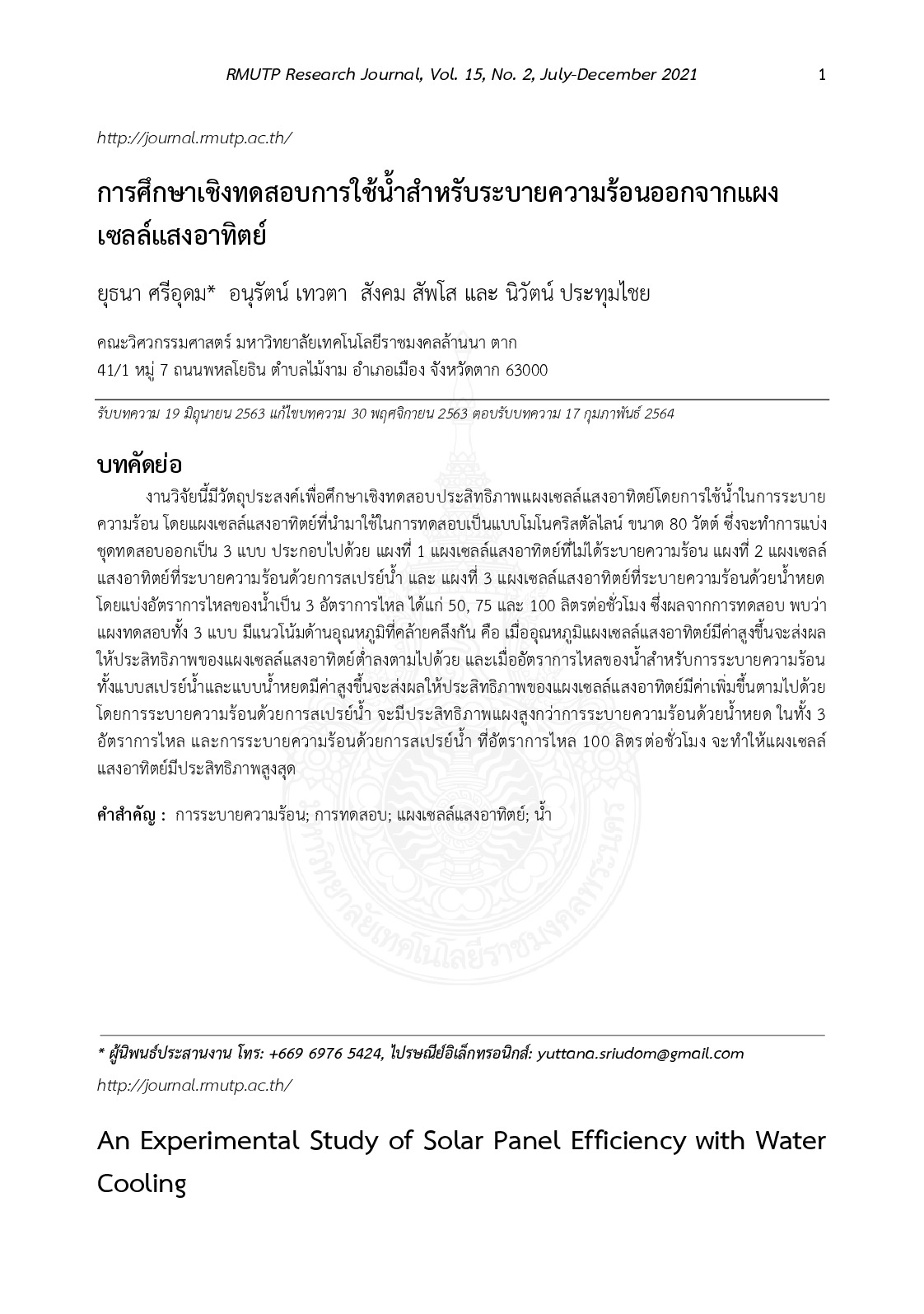
การศึกษาเชิงทดสอบการใช้น้ำสำหรับระบายความร้อนออกจากแผงเซลล์แสงอาทิตย์
This research aimed to experimentally study of solar panel efficiency with water cooling. Three mono-crystalline solar panels with the capacity of 80 W (for each panel) were used for this test. The first panel was a solar panel without water cooling. The second panel was a panel with water spray cooling. The last panel was a solar panel with water drop cooling. The cooling water flow rate was varied to 50 75 and 100 LPH. From the test it was found that the temperatures of all solar panels had the similar trends. The solar panel efficiency decreased when the temperature of solar panel increases. The solar panel efficiency increased when the cooling water flow rate was increased for both of water spray cooling and water drop cooling. For all water cooling flow rates the water spray cooling solar panel performed higher efficiency than water drop cooling solar panel. The highest solar panel efficiency in this test occurred when the water spray cooling flow rate of 100 LPH.

การศึกษาเชิงทดลองการเพิ่มประสิทธิภาพแผงเซลล์แสงอาทิตย์โดยใช้ท่อความร้อนแบบแบน
The purpose of this research was to improve the efficiency of solar cell modules by cooling with heat pipes. The test set consisted of three 80 watt solar modules that were made of mono-crystalline. The first module did not install heat pipes while the second module installed heat pipes using ethanol as the working fluid and the third module installed heat pipes using R-11 as working fluid. Solar radiation intensity electrical energy produced by the solar modules and temperature of the solar modules were recorded. The results showed that the average temperature of the first solar cell module was 52.9oC and the case of not install heat pipes on module. For the units with heat pipes it was found that unit with ethanol heat pipe had an average temperature of 50.7oC and efficiency at 10.2% whereas the unit using R-11 heat pipe had an average temperature at 49.2oC and efficiency at 11.8% From the experiments it was concluded that the installation of heat pipes could increase the efficiency of solar cell mokules.
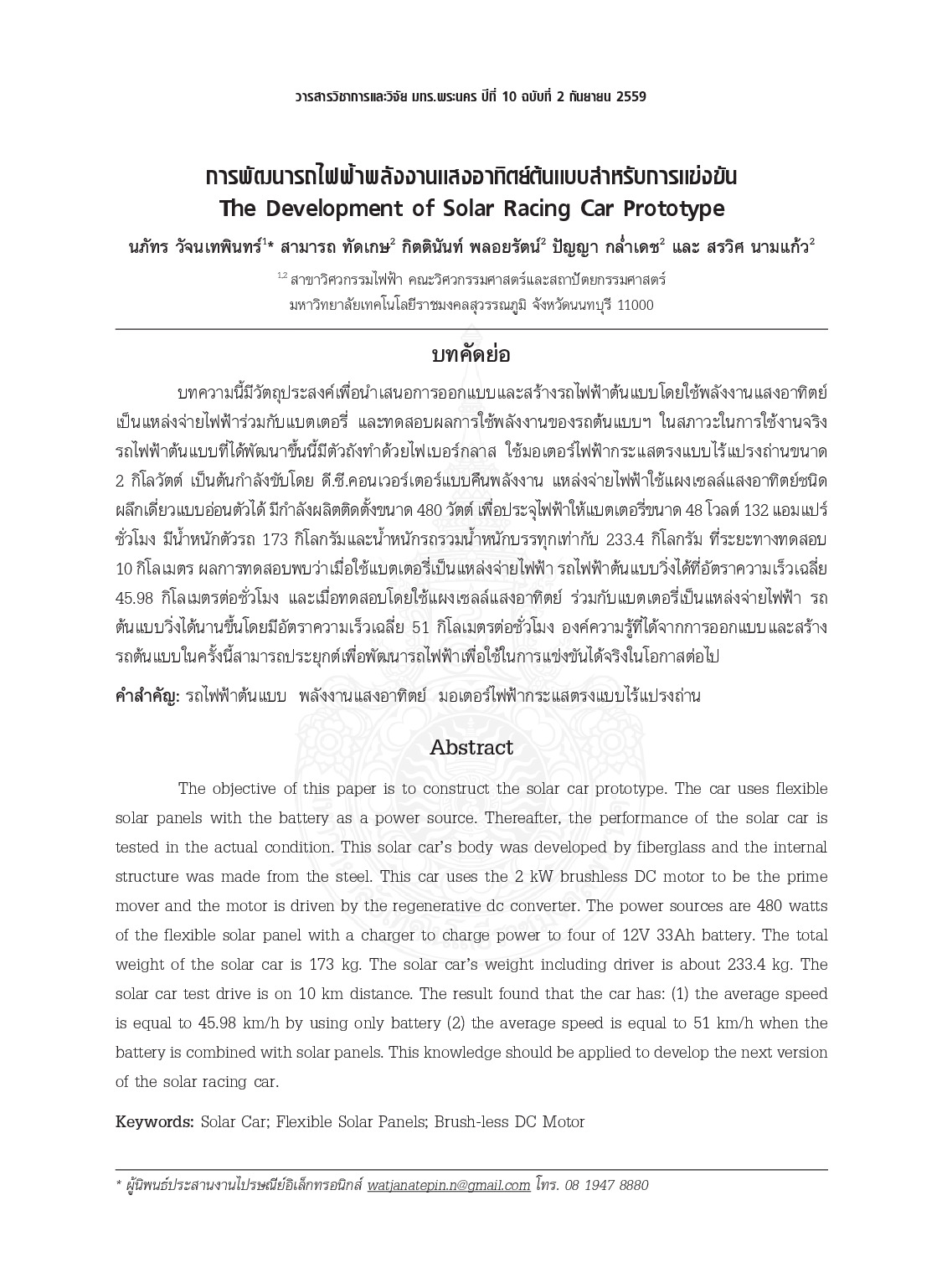
การพัฒนารถไฟฟ้าพลังงานแสงอาทิตย์ต้นแบบสำหรับการแข่งขัน
The objective of this paper is to construct the solar car prototype. The car uses flexible solar panels with the battery as a power source. Thereafter the performance of the solar car is tested in the actual condition. This solar car’s body was developed by fiberglass and the internal structure was made from the steel. This car uses the 2 kW brushless DC motor to be the prime mover and the motor is driven by the regenerative dc converter. The power sources are 480 watts of the flexible solar panel with a charger to charge power to four of 12V 33Ah battery. The total weight of the solar car is 173 kg. The solar car’s weight including driver is about 233.4 kg. The solar car test drive is on 10 km distance. The result found that the car has: (1) the average speed is equal to 45.98km/h by using only battery (2) the average speed is equal to 51 km/h when the battery is combined with solar panels. This knowledge should be applied to develop the next version of the solar racing car.
Automatic watering system using solar PV tracking
This paper presents the design of automatic watering system using sun tracking as an energy source .The objective is to design the automatic watering system for fruits grown in both areas without electricity. The solar panel can be moved along the direction of the sun cover an altitude - azimuth dual axis as an energy source of the system. The 20 longan trees are used in the experiment. The DC motors and the solar panel is controlled and rotated by the microcontroller to the position of the maximum light intensity. The watering system section will use a technique to measure the soil moisture sensors ECHO2-20 with real time PC based monitor system by Visual Basic Studio. As for the experiment results it was found that the energy stored by the developed solar tracker increased to 17.72 percent in comparison to a solar panel fixed installation. The watering appropriate soil moisture content is 12 percent and stops at 25 percent resulting for the garden moderators to save time and labor.