จำนวน Repository ( 4 )
การวิเคราะห์โครงการผลิตหมึกพิมพ์รองพื้นสีขาวฐานตัวทำละลายสำหรับผลิตบรรจุภัณฑ์อ่อนตัว
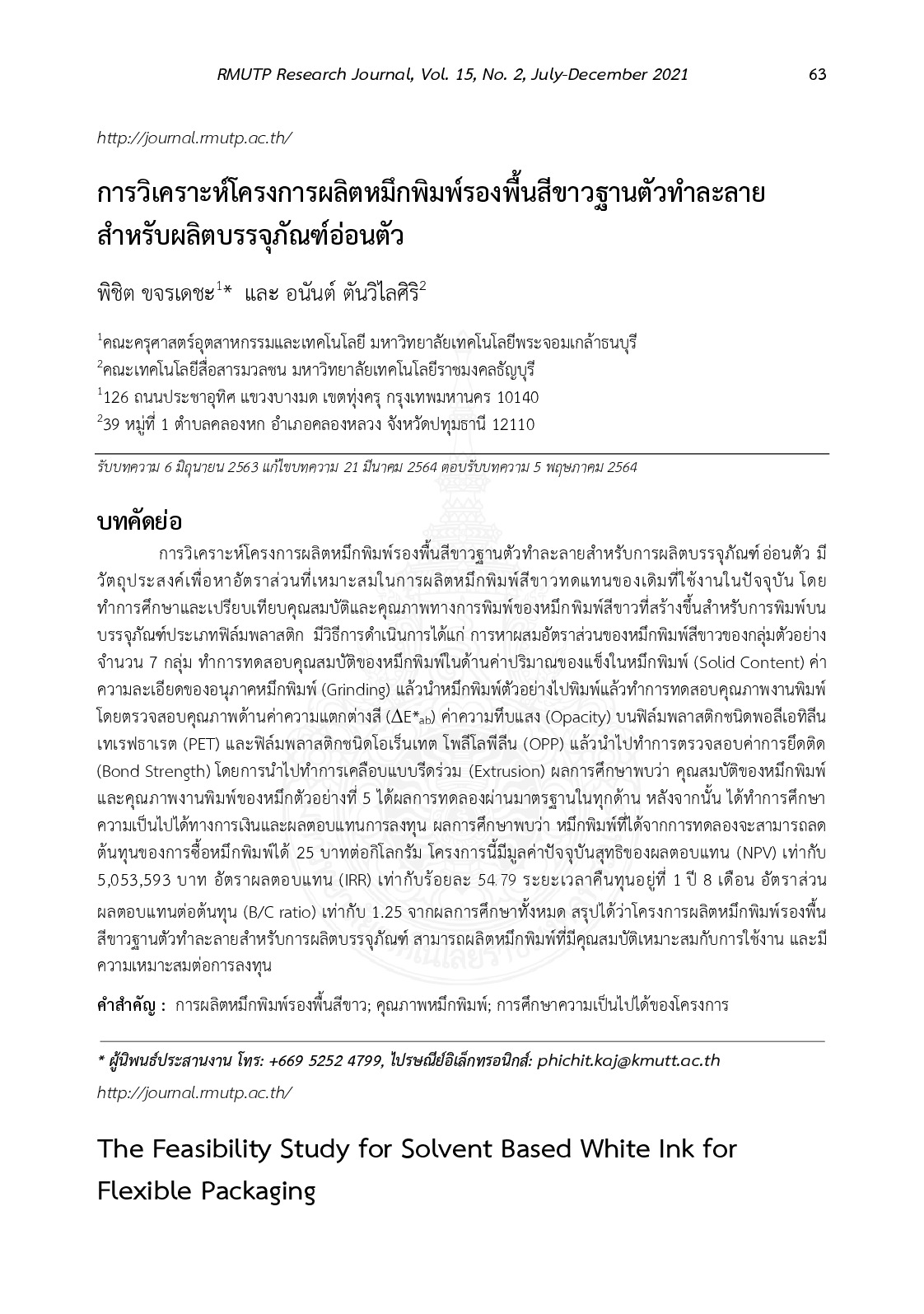
The research proposes to find an optimum ratio of solvent based white ink for flexible package development by studying and comparing the qualification of white ink on plastic film. The process consists of separating the white ink ratio into 5 sampling group ratios and then examining ink quality by its’ solid content and grinding. The viscosity is controlled in 16 second and then measured by Zahn’s cup no. 3. The sampling ink is printed and inspected printing quality by (1) E*ab and opacity on polyethylene terephthalate (PET) plastic film and oriented polypropylene (OPP) and (2) bond strength by extrusion. The result shows that sampling ink with hardener substances and ink and varnish ratio is at 90:10 certifies in all aspects compare with other sample. Indicators are the net present value (NPV) Benefit/Cost Ratio: B/C Ratio Pay Back Period and internal rate of return of investment (IRR). The Feasibility Study found that the projects are the net present value (NPV) of 5053593 baht payback period of 1 year 8 month and rate of return on investment (IRR) was 54.79 %. B/C ratio = 1.25
การพัฒนาวิธีสำหรับวิเคราะห์แกมมา-โอริซานอบในรำข้าวด้วยตัวทำละลายที่เป็นมิตรกับสิ่งแวดล้อม
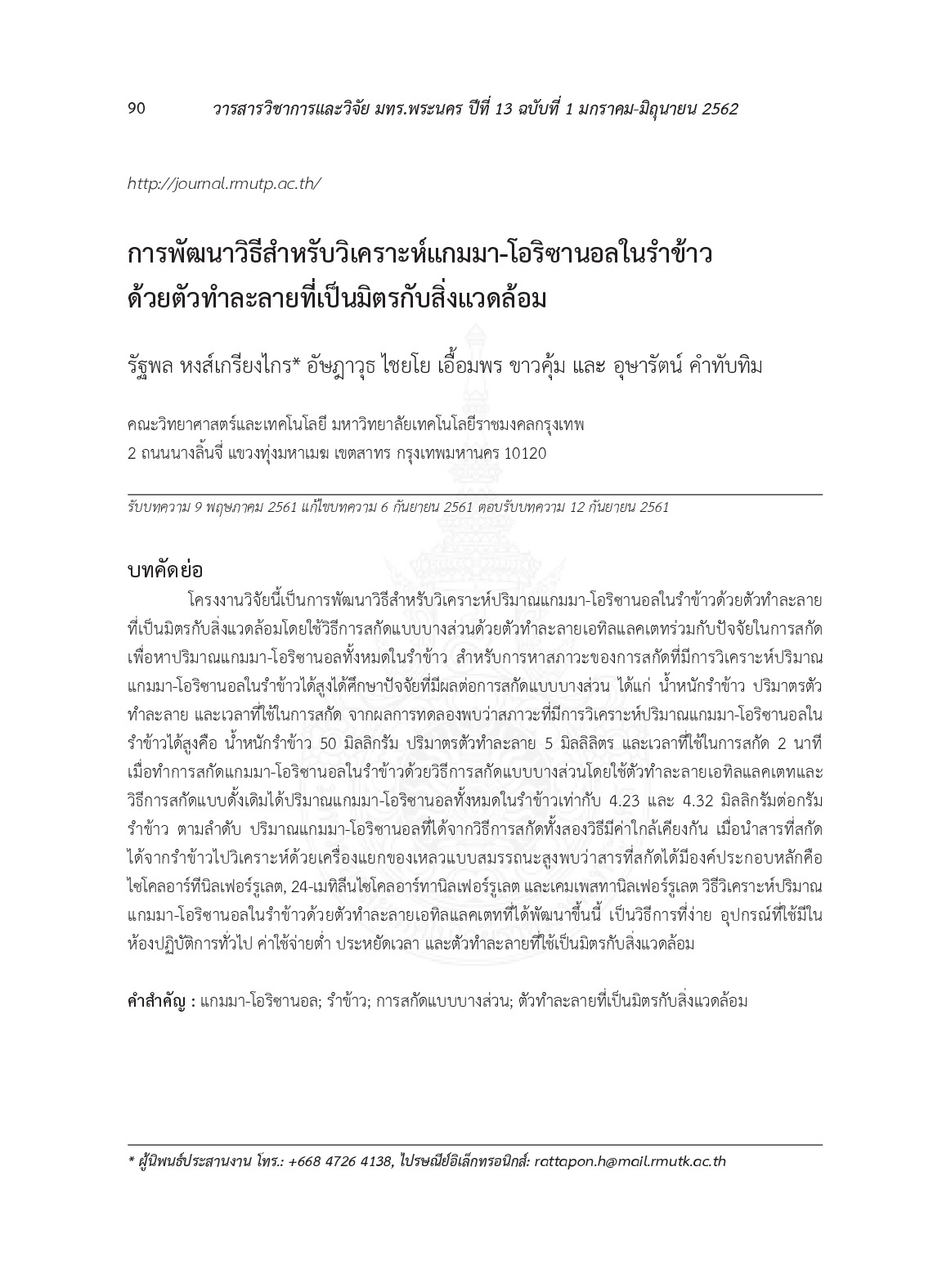
This research project aim to develop method for analysis of gamma-oryzanol in rice bran with environmental friendly solvent. The total content of gamma-oryzanol in rice bran was investigated using the combination between partial extraction method with ethyl lactate solvent and the study of factors on partial extraction. The parameters that effect the amount of gamma-oryzanol with partial extraction method consist of weight of rice bran volume of solvent and extraction time were conducted. The result shown the maximum content of gamma-oryzanol that extracted with 50 milligrams of rice bran 5 milliliters of ethyl lactate and 2 minutes of extraction time. The quantity of gamma-oryzanol in rice bran that observed using partial extraction method with ethyl lactate solvent and classical extraction method were 4.23 and 4.32 milligram per gram rice bran respectively. The results from both extraction methods were well agreement. When the extracted rice bran was separated with High Performance Liquid Chromatography the result shown the main compositions of extracted rice bran including cycloartenyl ferulate 24-Methylene cycloartanyl ferulate and campestanyl ferulate. The develop method for analysis of gamma-oryzanol in rice bran using partial extraction with ethyl lactate solvent is easy use only small apparatus in laboratory cheap short-time consuming and use environmental friendly solvent.
ฤทธิ์ต้านอนุมูลอิสระของกุ่มบก
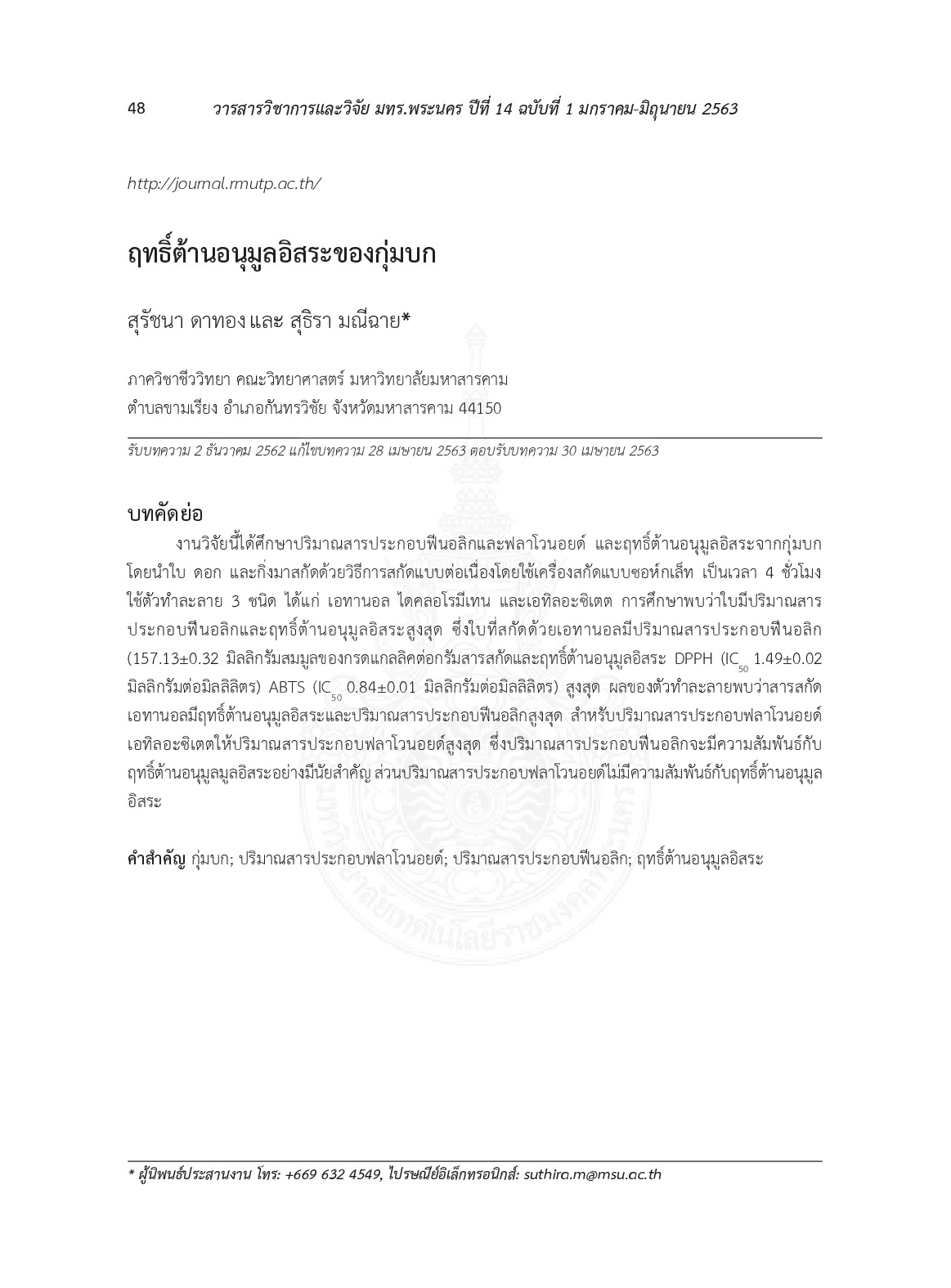
The aim of this research was determine total phenolic content total flavonoid content and antioxidant activity by DPPH and ABTS assay from leaves flower and stem of Crateva adansonii DC. subsp. trifoliate (Roxb) Jacobs that was extracted by Soxhlet method using ethanol dichloromethane and ethyl acetate as solvent. Leaves extract showed the highest total phenolic content and antioxidant activity. Ethanolic leaf extract showed the highest total phenolic content (157.13±0.32 mg GAE/g extract) and antioxidant activity by DPPH assay (53.64±3.78% (IC50 = 1.49±0.02 mg/ml)) and ABTS assay (76.51±0.97% (IC50 = 0.84±0.01 mg/ml)).When we considering solvent effect found that ethanolic extract showed the highest total phenolic content and antioxidant activity. Total flavonoid content ethyl acetate extract showed the highest total flavonoid content. Total phenolic content significantly correlated with antioxidant activity.
Preparation of Ceria Fibers Via Electrospinning Process
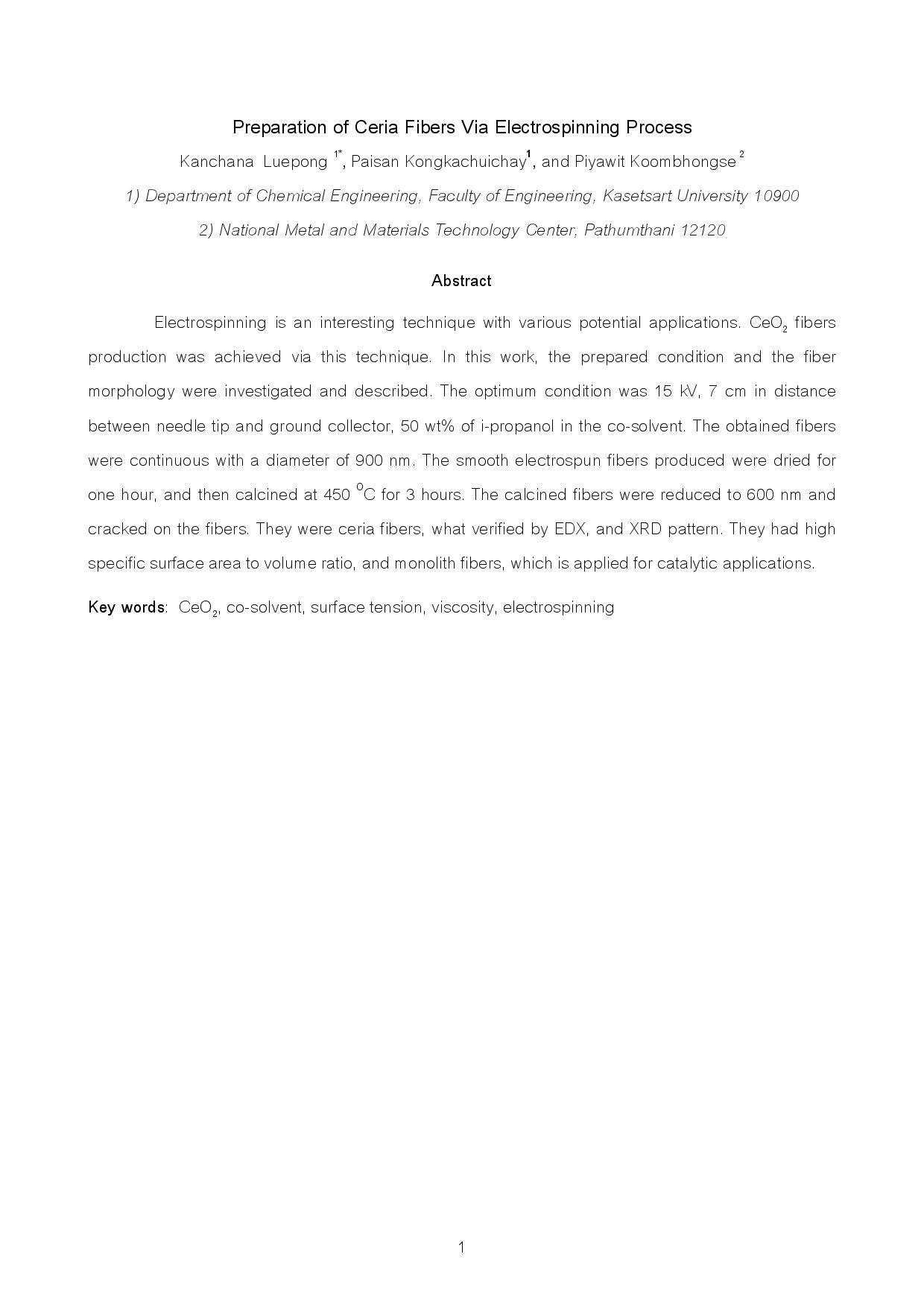
Electrospinning is an interesting technique with various potential applications. CeO2 fibers production was achieved via this technique. In this work the prepared condition and the fiber morphology were investigated and described. The optimum condition was 15 kV 7 cm in distance between needle tip and ground collector 50 wt% of i-propanol in the co-solvent. The obtained fibers were continuous with a diameter of 900 nm. The smooth electrospun fibers produced were dried for one hour and then calcined at 450 OC for 3 hours. The calcined fibers were reduced to 600 nm and cracked on the fibers. They were ceria fibers what verified by EDX and XRD pattern. They had high specific surface area to volume ratio and monolith fibers which is applied for catalytic applications.