จำนวน Repository ( 4 )
การประยุกต์ใช้เมล็ดแตงโมที่เหลือทิ้งทดแทนถั่วลิสงในการผลิตอาหารไทย
The purpose of this study was physical and chemical analysis of watermelon seeds (waste) the markets Study of optimize replacing watermelon seeds (waste) by peanuts in thai foods process and consumer acceptability indicated of products. Result showed that physical and chemical analysis of watermelon seeds (waste) the markets as follows : Aw =0.37±0.06 L* a* b* value 60.88±0.13 10.65±0.05 and 41.02±0.06 respectively and moisture content 1.19% protein content 10.97% fat content 0.22% crude fiber content 6.48% ash content 3.26% and carbohydrate content 77.88%. Result showed that the best formula was mussaman curry was replacing watermelon seeds (waste) by peanuts 100%. Product have orange yellow colour be similar to product in markets and less than fat content 1.65 times protein content and ash content more than 1.59 2.65 respectively.The shelf life meagerly 2 months and consumer acceptability like moderately mussaman curry powder and mussaman curry product. Result showed that the best formula was kao tung na tang crispy rice sticks and shrimp dipping replacing watermelon seeds (waste) by peanuts 100%. Product have orange yellow colour more than product in markets. And more than fiber content and protein content 1.31 1.51 times less than fat content and ash content 1.24 1.32 respectively. The shelf life meagerly 2 weeks and consumer acceptability like moderately product. Result showed that the best formula was panaeng curry powder replacing watermelon seeds (waste) by peanuts 100%. Product have bright orange colour. The shelf life meagerly 4 months and consumer acceptability like very much product. Result showed that the best formula was sai kow griep pag mor replacing watermelon seeds (waste) by peanuts 100%. Product have dark brown more than product in markets. And less than moisture content fat content and fiber content 2.17 6.61 and 6.46 times more than carbohydrate content and ash content 68.24 4.10 respectively. The shelf life at -18 ๐C and consumer acceptability like moderately product.
การใช้แป้งข้าวกล้องทับทิมชุมแพทดแทนแป้งข้าวเจ้าในขนมเรไร
The objectives of this study were 1) to study the basic recipe of Khanom Raerai and 2) to study the substitute amount of rice flour by using Tubtim Chumphae Brown rice flour in Khanom Raerai at four different levels of 0% 40% 50% and 60% by total rice flour weight. Randomized Complete Block Design (RCBD) to apply the sensory quality in terms of appearance color odor texture and overall preference using a 9-Point Hedonic Scale tasting method tasted by 40 untrained students from Foods and Nutrition Program Faculty of Home Economics Technology Rajamangala University of Technology Phra Nakhon. The data was verified by mean Analysis of Variance (ANOVA) and then compared the mean difference at a 0.05 confidence level by using Duncans New Multiple Range Test (DMRT) method. The results were analyzed by a computer software program. The results found that 1) the basic Khanom Raerai recipe made from rice flour tapioca flour arrowroot flour soybean oil and water was 27.25% 1.63% 1.63% 4.09% and 65.40% by total ingredients weight. The tasters verified the sensory quality in appearance color odor texture and overall preference. The mean values were 7.80 7.40 7.27 7.67 and 7.93 respectively at a moderate level of liking. The results found that almost all sensory aspects were significantly different at the 0.05 level except for color and odor. 2) the amount of Tubtim Chumphae brown rice flour substitutes for rice flour in Khanom Raerai it was found that the tasters accepted 40% by weight of rice flour in terms of appearance color odor texture and overall preferences. The mean values were 8.60 8.20 8.40 8.33 and 8.67 respectively at the level of liking the most. The sensory results found that all sensory characteristics were not different at the 0.05 level. Therefore the Khanom Raerai recipe uses Tubtim Chumphae brown rice flour substitutes for rice flour at the 40% level as the formula accepted in this study.
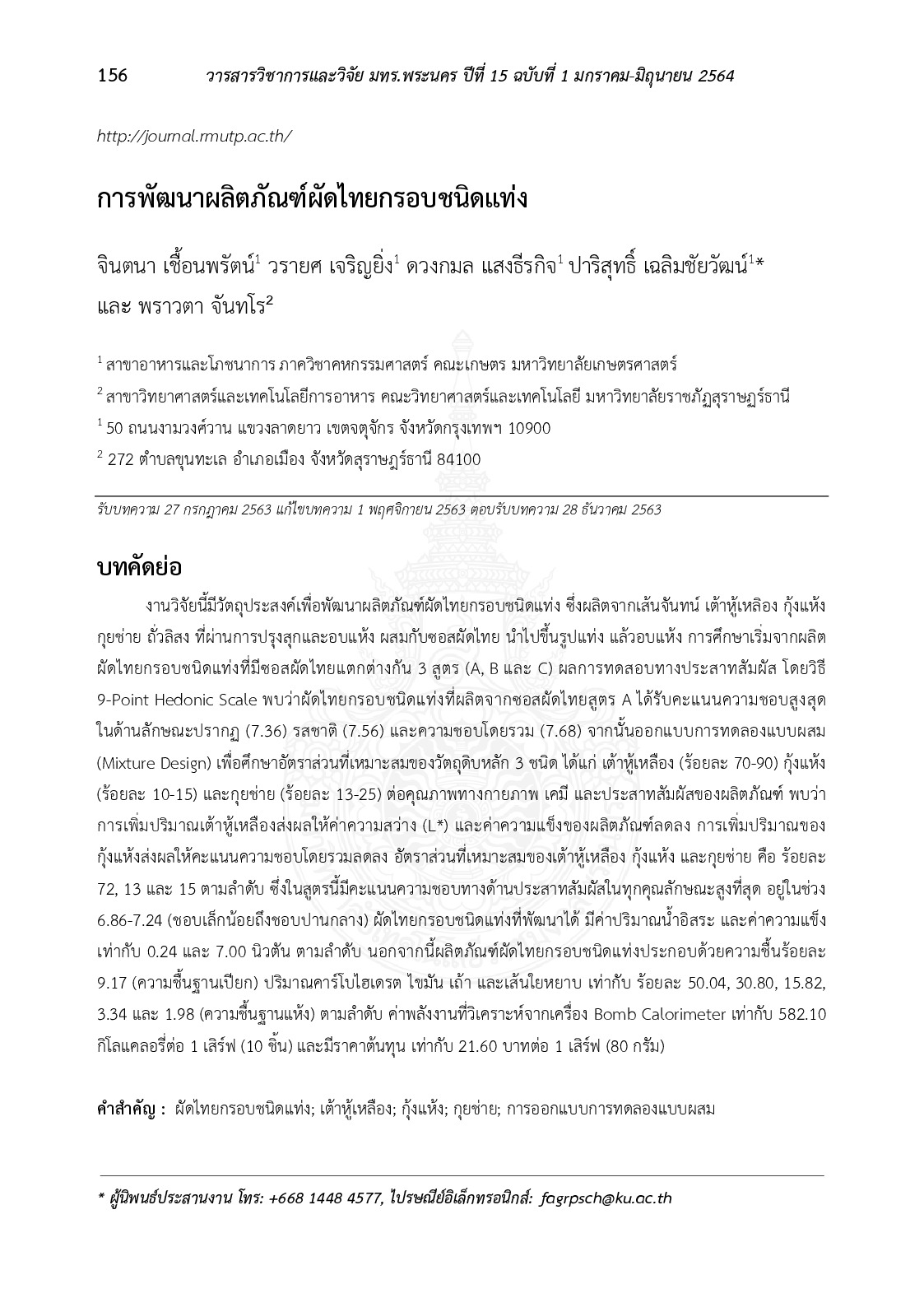
การพัฒนาผลิตภัณฑ์ผัดไทยกรอบชนิดแท่ง
The aim of this research was to develop Pad Thai crispy bar which is made from rice noodle (Chanthaburis noodle) tofu dried shrimp garlic chives and peanut that have been cooked and dried.Mixed with Pad Thai sauce then forming into a bar and dried. The study started with produced Pad Thai crispy bar made from three formula of Pad Thai sauce (A B and C). Sensory evaluation by using 9- point hedonic scale showed that the highest liking score of appearance ( 7. 36) taste ( 7. 56) and overall liking (7.68) were obtained from formula A. Mixture design was used to optimize the formula of the Pad Thai crispy bar. The effect of three variables: tofu (70-90%) dried shrimp (10-15%) and garlic chives ( 13- 25% ) on the physical chemical and sensory qualities of the product were investigated. The results showed that increasing the tofu decreased the lightness (L*) and hardness values of the product. Increasing the dried shrimp decreased the overall liking score. Optimum formula of tofu dried shrimp and garlic chives was 72% 13% and 15% respectively. At this formula had the highest score of all sensory attributes were in the range of 6. 86-7. 24 ( like slightly – like moderately) . The developed Pad Thai crispy bar had the value of aw and hardness value 0. 24 and 7.00 N respectively. In addition the developed product consisted of 9.17% moisture (wet weight basis) total carbohydrate fat ash and crude fiber which were 50.04% 30.80% 15.82% 3.34% and 1.98% (dry weight basis) respectively. The energy value determined by Bomb calorimeter which were 582.10 Kcal per serving (10 pieces) and the cost of Pad Thai crispy bar was 21.60 bath per serving (80 g).
โครงการพัฒนาขีดความสามารถด้านฐานข้อมูลเทคโนโลยีเพื่อการถ่ายทอดเผยแพร่ผ่านอินเทอร์เน็ต: ฐานข้อมูลอาหารไทยสี่ภาค
The purposes of this research were to collect the data about Thai cuisine from four regions to design and implement database about Thai cuisine and transfer on internet and to tranfer the technological database about Thai cuisine from four regions. The research process involved studying data collecting the lists of regional Thai cuisine : the North Northeast Central and Southern collecting the information about food recipes materials and tools choosing the appropriate data taking pictures materials and tools designing and implementing web database creating computer system developing computer system installing computer software in order to input data testing the system and transferring web database on internet. The result was found that regional Thai cuisine web database was divided into 4 categories21 Kinds of cooking methods 293 data of food with recipes 108 data of food without recipes 138 items of materials and 39 items of tools for perparing and serving food. Interested persons could reach our information about Thai cuisine from four regions at http://www.thaicuisinenetwork.com