จำนวน Repository ( 4 )
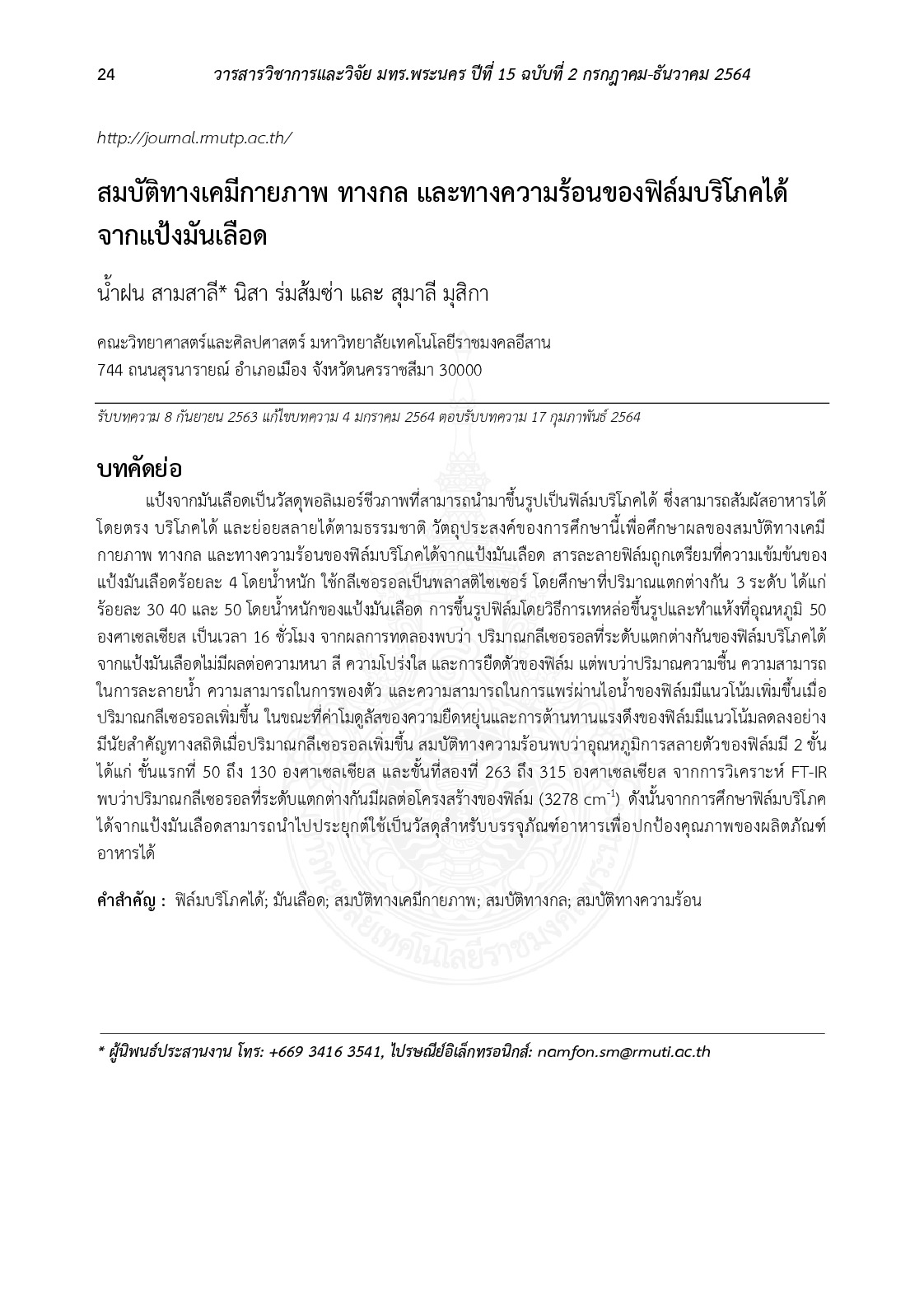
สมบัติทางเคมีกายภาพ ทางกล และทางความร้อนของฟิล์มบริโภคได้จากแป้งมันเลือด
Man Lueat (Dioscorea alata) flour is a biopolymer material that can be formed into an edible film. It can be contacted directly with food consumed and naturally biodegraded. The aims of this research were to study the effect of physicochemical mechanical and thermal properties of edible film from Man Lueat flour. The film forming solution was prepared by Man Lueat flour at 4% w/w. The glycerol was used as a plasticizer. It was studied at 3 different levels; 30 40 and 50% w/w of Man Lueat flour. The film forming solutions were formed using the solution casting method and dried at 50 °C for 16 h. Results showed that the glycerol content at different levels of the edible film from Man Lueat flour had no effect on the thickness color transparency and elongation at break. However the moisture content water solubility swelling property and water vapor permeability of the film tended to increase when increasing the glycerol content. In contrast the Young’s modulus and tensile strength of films tended to decrease significantly when the glycerol content increased. Thermal properties were found that decomposition temperature of films occurred 2 stage; the first stage occurs between 50 to 130 ° C and the second stage occurs between 263 to 315 ° C. The analysis of FT-IR showed that the different levels of glycerol affected the structure of the film (3278 cm-1). Therefore the edible film from Man Lueat flour can be applied as a food packaging material to protect the quality of food products.
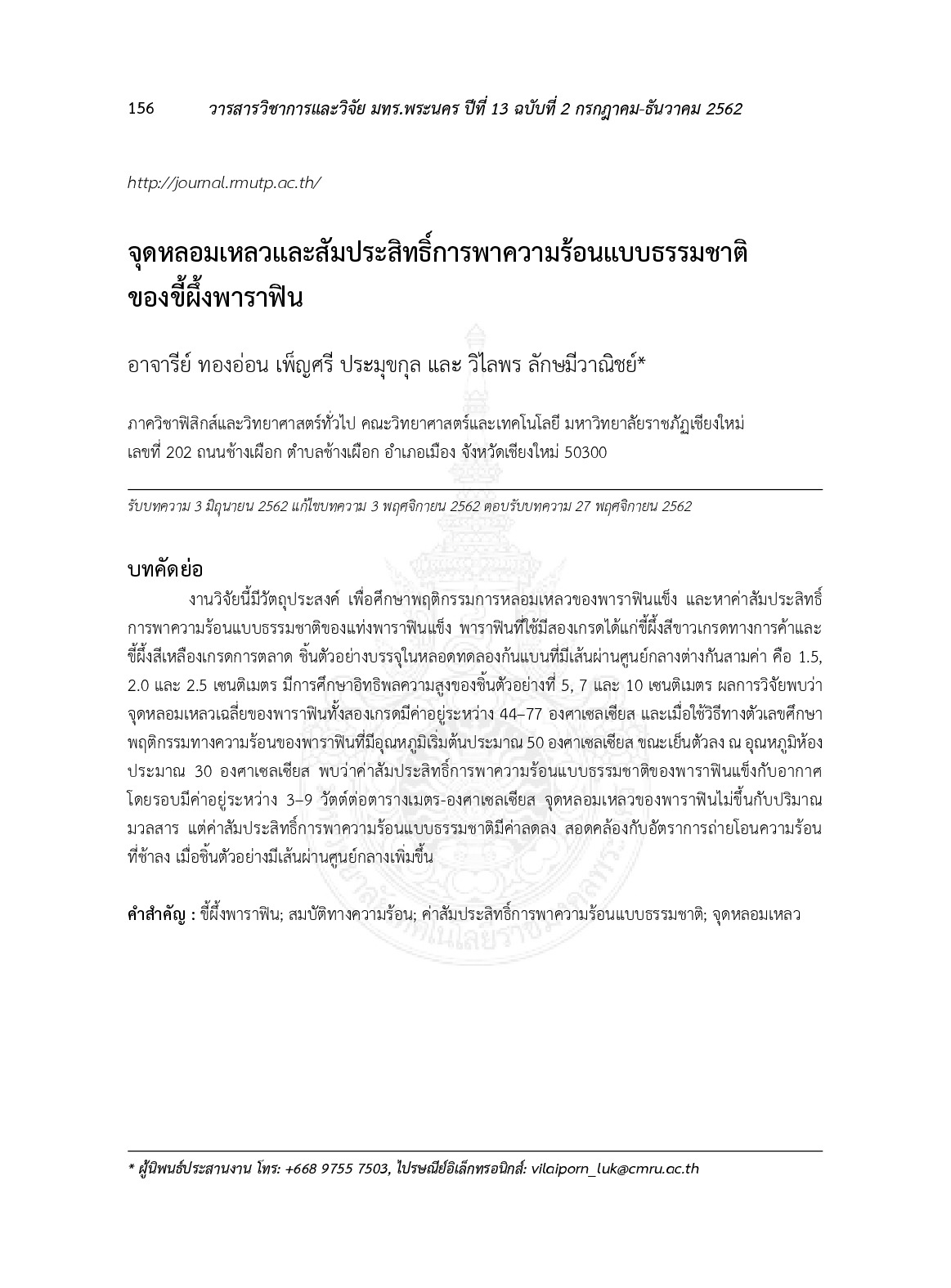
จุดหลอมเหลวและสัมประสิทธิ์การพาความร้อนแบบธรรมชาติของขี้ผึ้งพาราฟิน
This research was aimed to study melting behavior of paraffin wax and to evaluate the natural heat convection coefficient of solid cylinder paraffin wax. Two grades of solid paraffin wax; white commercial grade and yellow market grade were studied. Three sizes of flat test tube in diameter 1.5 2.0 and 2.5 centimeters were used. Three different amounts of paraffin indicated from samples’ heights of 5 7 and 10 centimeters were set. The results found the average melting point of both grade paraffin ranged from 44-77 oC. Based on the numerical analysis heat behavior of solid cylinder paraffin at the initial temperature of 50 oC to room temperature of about 30 oC found that natural convection coefficients was ranged from 3 to 9 W/m 2oC. Melting point temperature was found mass independent property while natural convection coefficient declined as the sample’s diameter size inclined

The dominant feature of khao wong glutinous rice kalasin province for geographical indications
The objective of this research was to study the dominant feature of Khao Wong glutinous rice Kalasin province for geographical indications. The effect of three cultivated areas of glutinous rice variety (RD6) consisting of Khao Wong Huai Mek and Kong Chai districts was investigated along with their physicochemical textural properties and thermal properties. For the effect of different cultivated areas on glutinous rice properties the significant effect of different cultivated areas on chemical compounds viscosity and textural properties was observed (p?0.05). There was no significant effect of cultivated areas on amylose content (p>0.05). The highest protein and ash contents and the lowest setback hardness and chewiness values were found in the sample cultivated in Khao Wong district area. The aroma compounds analysis of rice samples revealed that methanecarboxylic acid was observed in glutinous rice cultivated in all studied areas. Whereas the highest content of 122-Trimethylcyclopropylamine was found in the sample cultivated at Khao Wong and Kong Chai districts. In addition the highest content of 2-cis-9-octadecenyloxyethanol was observed in glutinous rice cultivated at Huai Mek district.
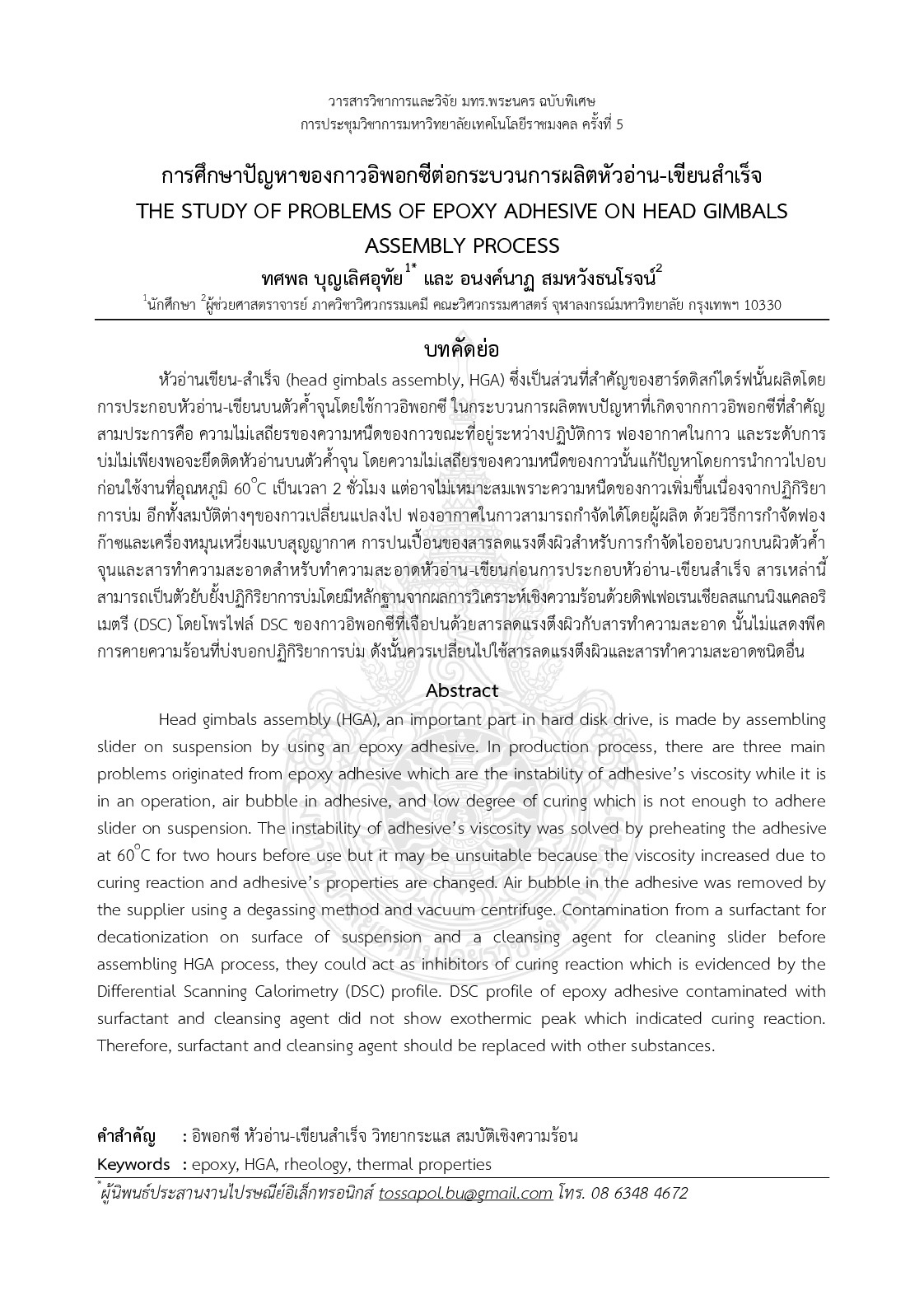
The study of problems of epoxy adhesive on head gimbals assembly process
Head gimbals assembly (HGA) an important part in hard disk drive is made by assembling slider on suspension by using an epoxy adhesive. In production process there are three main problems originated from epoxy adhesive which are the instability of adhesive’s viscosity while it is in an operation air bubble in adhesive and low degree of curing which is not enough to adhere slider on suspension. The instability of adhesive’s viscosity was solved by preheating the adhesive at 60oC for two hours before use but it may be unsuitable because the viscosity increased due to curing reaction and adhesive’s properties are changed. Air bubble in the adhesive was removed by the supplier using a degassing method and vacuum centrifuge. Contamination from a surfactant for decationization on surface of suspension and a cleansing agent for cleaning slider before assembling HGA process they could act as inhibitors of curing reaction which is evidenced by the Differential Scanning Calorimetry (DSC) pr