จำนวน Repository ( 23 )
การศึกษาการบำบัดน้ำเสียจากการย้อมผ้าแบบเคลื่อนที่โดยใช้ถ่านกัมมันต์จากกะลามะพร้าว
The dyeing industry both of business size and household size where the remaining water from the dyeing process is dumped into pipes and flows into natural water sources causing sewage problems. Therefore a column type wastewater treatment system has been developed by using a filtration system along with an adsorption system. The materials used to treat the wastewater from dyeing are gravel sand charcoal from wood and activated carbon from coconut shell. The study was conducted on the synthesis activated carbon from coconut shell using for color and molecules adsorption. The amount of activated carbon from coconut shell was varied at 200 400 600 and 800 g applying with filter media and other adsorption materials taking 1 hour to treat the wastewater from dyeing. The parameter using to measure water quality consisted of color value pH suspended solids conductivity turbidity value COD and TKN to indicate the water quality before and after treatment evaluating the efficiency of the wastewater treatment system. The best ratio that can treat the color is the formula containing 800 g of coconut shell activated carbon. It was able to treat the color equal to 5.94 SU or 99.43 percent compared to the wastewater before treatment.
การลดฟอสเฟตในน้ำทิ้งจากกระบวนการซักผ้าโดยใช้เปลือกไข่ไก่และเปลือกหอยแมลงภู่
This research studied the factors that affect the efficiency of phosphate reduction in the wastewater of the washing process with CaCO3 and CaO produced from eggshell and mussel shell. The study found that the optimum condition for adsorption when using CaCO3 from eggshell is to adjust the pH to be equal to 10 take 15 minutes to absorb and add 1 gram of sorbent which can reduce the phosphate content by 25 percent and when changing the adsorbent to CaO the optimum condition for phosphate removal is to adjust the pH to 7 take 15 minutes to absorb and add 1 gram of adsorbent which can reduce the phosphate content by 24 percent. The optimum conditions for adsorption when using CaCO3 from mussel shell were to adjust the pH to 10 take 45 minutes to absorb and add 1 gram of sorbent which can reduce the phosphate content by 25 percent and when changing adsorbents to CaO the optimum condition for phosphate removal is to adjust the pH to 10 take 15 minutes to absorb and add 3 grams of adsorbents which can reduce the phosphate content by 24 percent. In addition when studying the adsorption of impurities in the wastewater such as conductivity turbidity COD and BOD it is found that the optimum reduction conditions can reduce the impurities of the parameters that mentioned above were 19.32 2.60 54.77 and 16.67 percent respectively. CaCO3 and CaO produced from eggshell and mussel shell can be used to absorb impurities in wastewater before releasing into natural water sources.
การบำบัดน้ำเสียจากสีย้อมผ้าด้วยกระบวนการโอโซนเนชัน โดยใช้ตัวกลางพลาสติก เคลือบผิวไทเทเนียมไดออกไซด์ชนิดรูไทล์เป็นตัวเร่งปฏิกิริยา
This research is to study the efficiency of treating wastewater from dyeing fabric by the ozonation process. By using rutile TiO2 coated plastic media to catalyze. Which uses O3 generators with a capacity of 2.62 - 3.10 g/hr. By studying the factors that affect the treatment efficiency of COD and color such as the pH of the water used in the treatment at pH 3 pH 7 and pH 11 the initial COD concentration of 100% 50% and 25% which have values in the range of 100 -320 mg/L. O3 exposure time 120 min. From the study it is found that the efficiency of reducing the impurities in wastewater by the ozonation process in the pH 11 state the COD concentration at 50% can reduce the COD. And the maximum color is at 33.3% and 90% from the 550 ADMI color intensity with a COD of 180 mg/L. For the study of the efficiency of reducing the impurities of wastewater by ozonation process together with 2 g. of TiO2/1 L. of wastewater in the condition of pH 11 concentration COD Beginning at 100% with the ability to reduce COD values And the maximum color is at 40% and 80% of the 270 ADMI color intensity with a COD of 190 mg/L. The amount of O3 suitable for treatment has an average value of 0.0374 g/min./10.5 L. of wastewater. The duration of O3 exposure in both processes has a similar approach to the efficiency of COD and color treatment when increasing the duration of O3 exposure.
การวิเคราะห์ปัญหาน้ำเสียที่มาจากกากการเผาไหม้ของเหง้าทลายปาล์มที่โรงไฟฟ้าพลังงานชีวมวลและพลังงานก๊าซชีวภาพเพื่อหาแนวทางควบคุมคุณภาพน้ำด้วยระบบไฟฟ้าแรงดันสูง
This research study analyzes the problem of waste water from the burning of palm trees which are used as fuel for power generation of palm ash. It is used to ferment biogas as a fuel for power generation where a large amount of wastewater from the gas digester is completed. The wastewater is then pumped out of the gas digester. Biological in large quantities Therefore to study the analysis of wastewater to find a method for designing a wastewater treatment system from high voltage systems from the corona discharge principle when adding ozone it is necessary to analyze the chemical effects of the wastewater according to the standard values of the Department of Industrial Works.
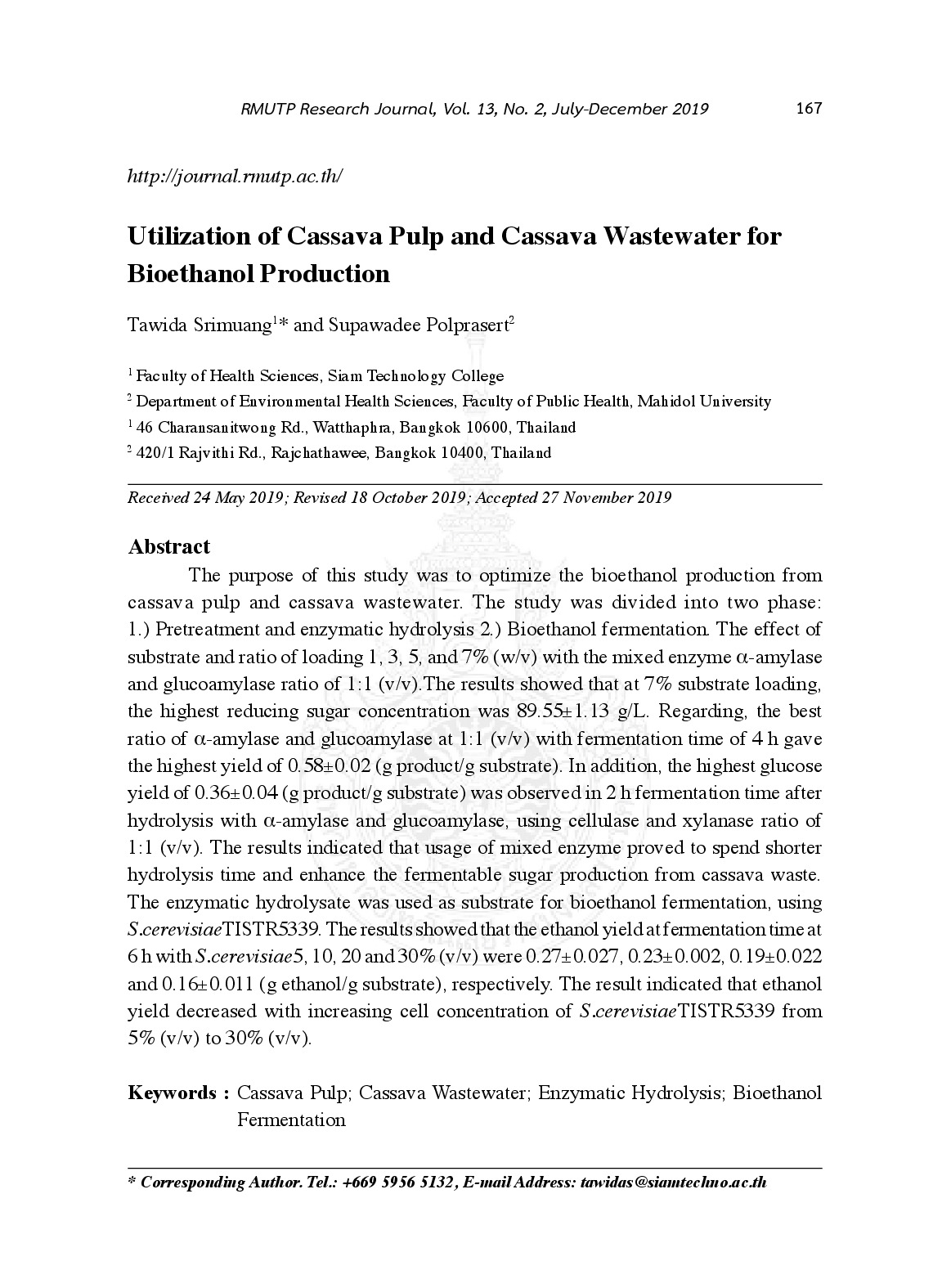
Utilization of cassava pulp and cassava wastewater for bioethanol production
The purpose of this study was to optimize the bioethanol production from cassava pulp and cassava wastewater. The study was divided into two phase: 1.) Pretreatment and enzymatic hydrolysis 2.) Bioethanol fermentation. The effect of substrate and ratio of loading 1 3 5 and 7% (w/v) with the mixed enzyme α-amylase and glucoamylase ratio of 1:1 (v/v).The results showed that at 7% substrate loading the highest reducing sugar concentration was 89.55±1.13 g/L. Regarding the best ratio of α-amylase and glucoamylase at 1:1 (v/v) with fermentation time of 4 h gave the highest yield of 0.58±0.02 (g product/g substrate). In addition the highest glucose yield of 0.36±0.04 (g product/g substrate) was observed in 2 h fermentation time after hydrolysis with α-amylase and glucoamylase using cellulase and xylanase ratio of 1:1 (v/v). The results indicated that usage of mixed enzyme proved to spend shorter hydrolysis time and enhance the fermentable sugar production from cassava waste. The enzymatic hydrolysate was used as substrate for bioethanol fermentation using S.cerevisiaeTISTR5339. The results showed that the ethanol yield at fermentation time at 6 h with S.cerevisiae5 10 20 and 30% (v/v) were 0.27±0.027 0.23±0.002 0.19±0.022 and 0.16±0.011 (g ethanol/g substrate) respectively. The result indicated that ethanol yield decreased with increasing cell concentration of S.cerevisiaeTISTR5339 from 5% (v/v) to 30% (v/v).