จำนวน Repository ( 5 )
การศึกษาอุณหภูมิการหล่อต้นแบบแว็กซ์ชนิด EC 500 เพื่อลดของเสียจากกระบวนการผลิตเครื่องประดับเงิน
This research is a study of the optimum heat temperature for baking sintered castings for burnout removal of EC 500 type ash wax from cast mortar. Improving jewelry casting process to reduce waste from silver jewelry production process. By studying the temperature of the mortar. To burn remove wax from the mortar and clean the gaps. Then try to bring silver water instead of metal casting. The results of a baked casing study using the EC500 housing prototype from the study showed that the EC500 wax material is melted from all solids to ash wax by heating at 850 ° C to burn. Remove ash wax which makes the cavity clean. When the casting was casted with 925 sterling silver the most complete workpiece after the improvement of the waste jewelry casting process was found to be 1 piece 1 percent 99 pieces or 99 percent.
การศึกษาอุณหภูมิการหล่อต้นแบบแว็กซ์ชนิด EC 500 เพื่อลดของเสียจากกระบวนการผลิตเครื่องประดับเงิน
The purpose of this research was to investigate the optimum heat temperature for the EC500 wax cured basecoat extrusion from all castings without waxing in the mortar. To reduce waste when the casting mortar through the casting process Silver Sterling 925 silver jewelry company Muang District Chiang Mai where the waste is caused by waxing outflow. The imperfections and leave waxing inside. Experiment with high temperature heat in mortar. And analyze the quality of work surface after casting with microscope. To find defects such as droplets and porosities caused by a range of temperatures. Temperature of baking mortar There is a difference from the conventional waxing mortar temperature. That is outflow of EC500 type wax. In the mortar to live. High heat The results of the 100 sample EC500 wax samples were tested at a temperature of 25 ° C. The mortar temperature was 700 ° C. 60 percent of waste was found the mortar was laid at 750 ° C 54 percent of waste was found. The mortar temperature was 800 ° C 32 percent waste was found the mortar temperature was 850° C Detecting 1 percent waste. The results of the study show that heat temperatures of up to 850 ° C can solve the problem of casting sterling silver alloys from the EC500 wax model. Finds the least waste.
จุดหลอมเหลวและสัมประสิทธิ์การพาความร้อนแบบธรรมชาติของขี้ผึ้งพาราฟิน
This research was aimed to study melting behavior of paraffin wax and to evaluate the natural heat convection coefficient of solid cylinder paraffin wax. Two grades of solid paraffin wax; white commercial grade and yellow market grade were studied. Three sizes of flat test tube in diameter 1.5 2.0 and 2.5 centimeters were used. Three different amounts of paraffin indicated from samples’ heights of 5 7 and 10 centimeters were set. The results found the average melting point of both grade paraffin ranged from 44-77 oC. Based on the numerical analysis heat behavior of solid cylinder paraffin at the initial temperature of 50 oC to room temperature of about 30 oC found that natural convection coefficients was ranged from 3 to 9 W/m 2oC. Melting point temperature was found mass independent property while natural convection coefficient declined as the sample’s diameter size inclined
ผลของการใช้สารควบคุมการเจริญเติบโตร่วมกันต่อความเป็นพิษของเฮกซะคลอโรไซโคลเฮกเซนในข้าวโพดข้าวเหนียว
The effects of plant growth regulators alone or in combination on Hexachlorocyclohexane (HCH) phytotoxicity were studied. Waxy corn seeds were immersed in different plant growth regulators that are 1) 2 mg/l Indolebutyric acid (IBA) 2) 2 mg/l Thidiazuron (TDZ) 3) 2 mg/l Gibberellic acid (GA3) 4) 1 mg/l IBA + 1 mg/l TDZ 5) 1 mg/l TDZ + 1 mg/l GA3 and 6) 1 mg/l IBA + 1 mg/l GA3 then sawn in 30 mg/kg HCH-contaminated soil or non-contaminated soil for 10 days. All plant growth regulators could enhance shoot and root dried weight of waxy corn seedlings in non-contaminated soil. Only 2 mg/l GA3 could enhance root length of waxy corn seedlings in non-contaminated soil. In HCH-contaminated soil only 2 mg/l TDZ could increase shoot dried weight of waxy corn seedlings. Also 2 mg/l IBA or 1 mg/l IBA and1 mg/l GA3 could increase root fresh weight of waxy corn seedlings. The exposure with HCH in soil did not affect to shoot and root tissue even though the growth of shoot and root were inhibited. However the exposure with HCH and receive exogenous plant growth regulator induced aerenchyma formation in cortex and pith of waxy corn root.
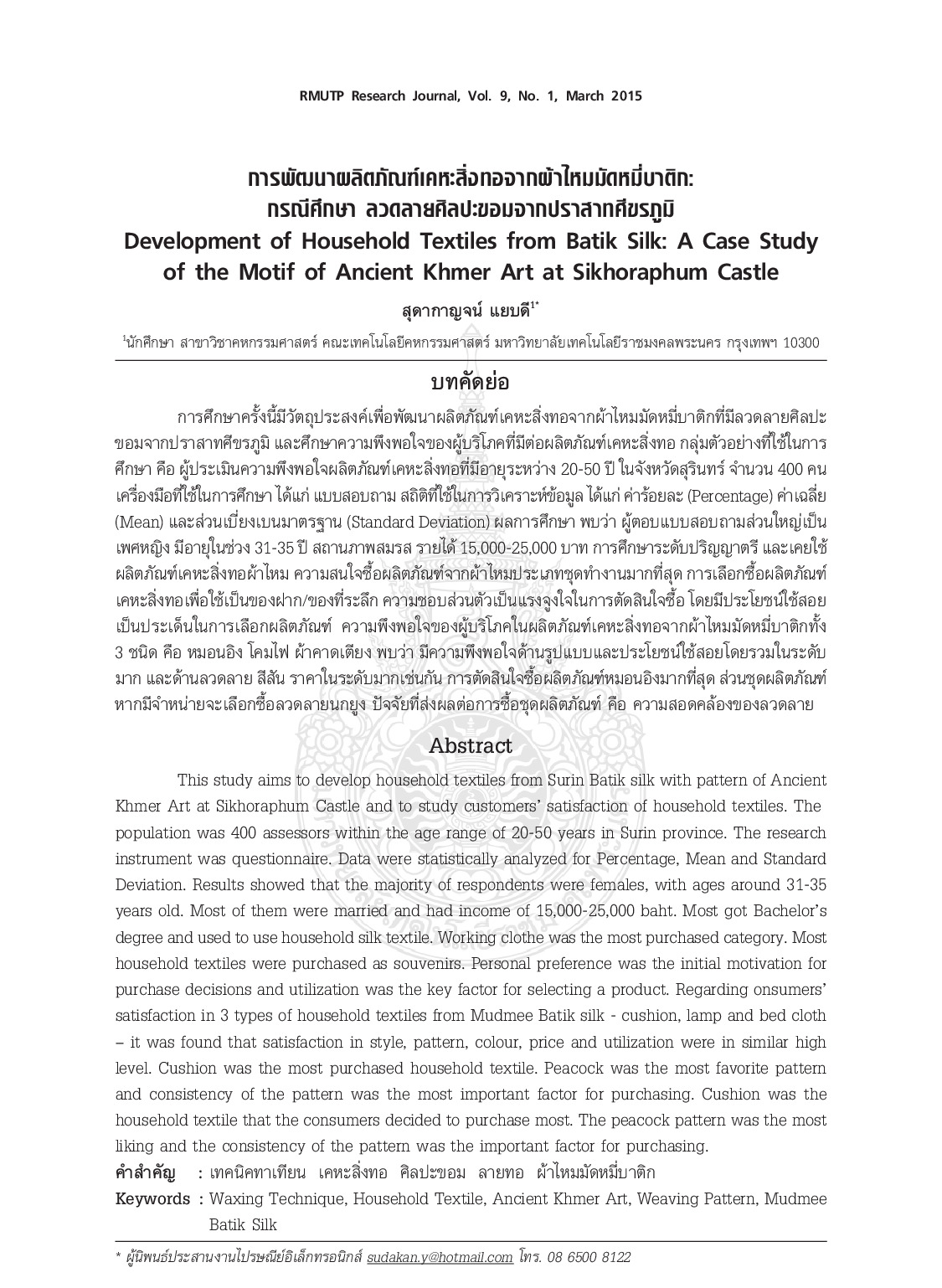
Development of household textiles from batik silk: a case study of the motif of ancient khmer art at sikhoraphum castle
This study aims to develop household textiles from Surin Batik silk with pattern of Ancient Khmer Art at Sikhoraphum Castle and to study customers’ satisfaction of household textiles. The population was 400 assessors within the age range of 20 - 50 years in Surin province. The research instrument was questionnaire. Data were statistically analyzed for Percentage Mean and Standard Deviation. Results showed that the majority of respondents were females with ages around 31 - 35 years old. Most of them were married and had income of 15000 – 25000 baht. Most got Bachelor’s degree and used to use household silk textile. Working clothe was the most purchased category. Most household textiles were purchased as souvenirs. Personal preference was the initial motivation for purchase decisions and utilization was the key factor for selecting a product. Regarding onsumers’ satisfaction in 3 types of household textiles from Mudmee Batik silk - cushion lamp and bed cloth – it was found that satisfaction in style pattern colour price and utilization were in similar high level. Cushion was the most purchased household textile. Peacock was the most favorite pattern and consistency of the pattern was the most important factor for purchasing.