จำนวน Repository ( 10 )
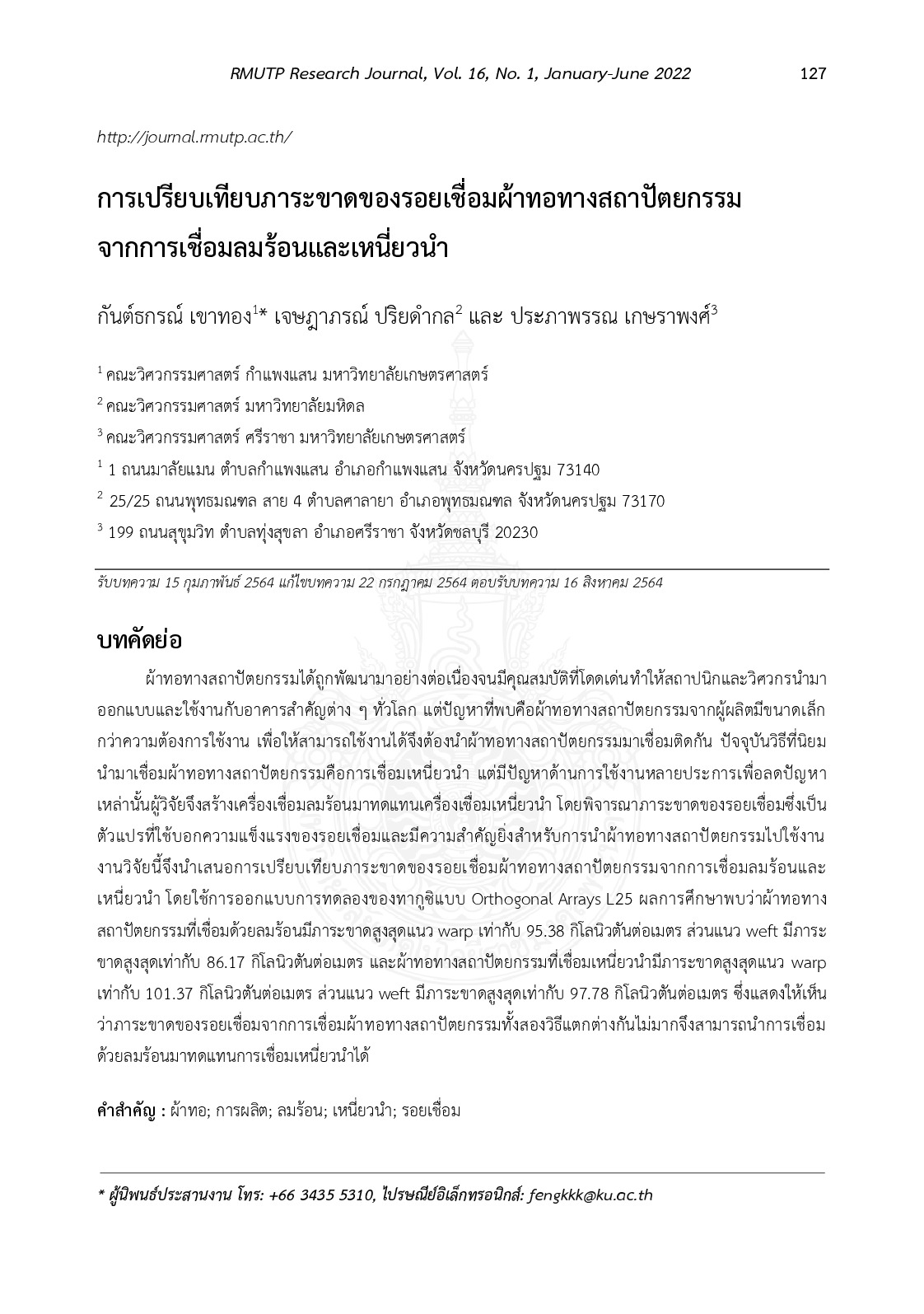
การเปรียบเทียบภาระขาดของรอยเชื่อมผ้าทอทางสถาปัตยกรรมจากการเชื่อมลมร้อนและเหนี่ยวนำ
Architectural fabrics were continuously developed on their unique performance. Architects and Engineers designed them for the application of important buildings around the world despite the symptom that Architectural fabric sizes from manufactures are smaller than the application sizes. Recently although the well-known method used to weld Architectural fabrics to enlarge their size is the high frequency welding there were some application issues. To mitigate those issues the researcher created the hot air welding to replace the high frequency welding in consideration on the failing loads of welded seams which are variable factors of the failing loads to indicate the weld strength and it is crucial for the Architectural fabric application. This research presents the comparison of failing load of weld seams between the hot air welding and high frequency welding by the test of Taguchis Orthogonal arrays L25 method. The test results demonstrated that Architectural fabrics welded by the hot air welding has the highest failing loads of wrap equal to 95.38 kN/m and the highest failing loads of weft at 86.17 kN/m. Conversely Architectural fabrics welded by the high frequency welding has the highest failing loads of wrap equal to 101.37 kN/m and the highest failing loads of weft at 97.78 kN/m. Based on a forementioned results there is no significant difference from both welding methods and thus concluded that the hot air welding could be used to replace the high frequency welding method.
การศึกษาพัฒนาเครื่องเชื่อมประสานชิ้นส่วนเครื่องประดับเงินสเตอร์ลิงด้วยระบบอาร์คไฟฟ้า
Case Study Development of Welding Machine for Sterling Silver Jewelry Parts With 500-amp electrical arc system for welding closing porous jewelry after casting. The problem can be solved by welding closing porous or by the jewelry. It is an alternative to repairing the work piece. The efficiency of electrical arc welding equipment can be repaired to a certain extent. Based on the results of the experiments the welding and repairing porous porcelain parts were rated at 500 amperes by random sampling of 4 time slots 5 seconds 10 seconds 15 seconds and 20 seconds. Examine the most appropriate porous or porous workpiece for 20 seconds with 18 complete workpieces capable of sealing or milling. A good percentage of 90 percent of the performance of an electrical arc welding machine for welding sealing or cutting.
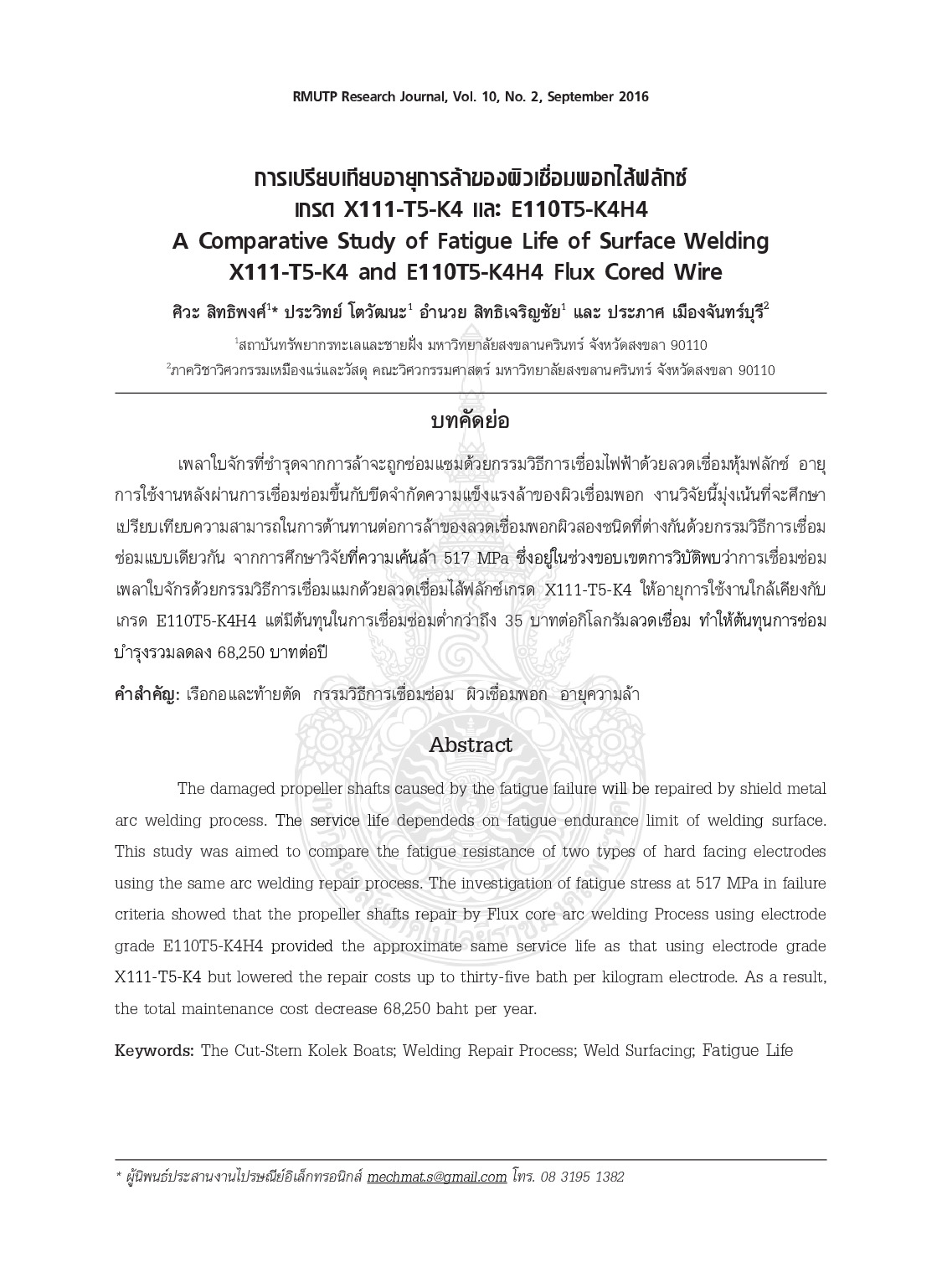
การเปรียบเทียบอายุการล้าของผิวเชื่อมพอกไส้ฟลักซ์ เกรด X111-T5-K4 และ E110T5-K4H4
The damaged propeller shafts caused by the fatigue failure will be repaired by shield metal arc welding process. The service life dependeds on fatigue endurance limit of welding surface. This study was aimed to compare the fatigue resistance of two types of hard facing electrodes using the same arc welding repair process. The investigation of fatigue stress at 517 MPa in failure criteria showed that the propeller shafts repair by Flux core arc welding Process using electrode grade E110T5-K4H4 provided the approximate same service life as that using electrode grade X111-T5-K4 but lowered the repair costs up to thirty-five bath per kilogram electrode. As a result the total maintenance cost decrease 68250 baht per year.

อิทธิพลของความเร็วรอบที่ส่งผลต่อสมบัติทางกลของการเชื่อมอะลูมิเนียมต่างชนิด ระหว่าง SSM7075 กับ SSM356 ด้วยการเชื่อมเสียดทาน
The objective of this research is to study how rotation speeds affect mechanical properties with friction welding between semi-solid metal 7075 aluminum alloys and semi-solid metal 356 aluminum alloys. The factor of interest is rotation speeds with different conditions at 800 1000 1200 1400 and 1600 rpm respectively. 1.8 millimeter for burn of length 30 seconds for welding time and clockwise rotation are set as a control constant condition for the entire experiment. After friction welding we found that different rotation speeds significantly affected mechanical properties of these alloys. At rotation speed 1400 rpm the maximum tensile strength is 122.24 MPa and the maximum hardness in welded zone is 140.5 HV. The microstructure size is 2.250 µm long and 2.144 µm wide. Its size in welded zone is practically small because of friction force. Moreover this friction force causes the mixture of MgZn2 and Mg2Si in welded zone.

Permanent-magnetic-field, bean sprout, neodymium welding process
The objective of this research is to investigate microstructure and mechanical properties of brass welded by diffusion welding process. The diffusion welding (DW) of brass welded over lap joints bonding parameters were pressure at temperature 500 650 and 800 0C contact pressure of 12 MPa and holding time for 60 minutes respectively. The microstructure mechanical properties and behaviour during bonding were investigated. The results show that in weld zone (Bond Line) diffusion of atom the brass significantly. The mechanical properties after diffusion welding process increased higher temperature