จำนวน Repository ( 14 )
แนวทางการพัฒนากิจกรรมเพื่อสร้างจิตสำนึกการแยกขยะในครัวเรือน
This research aimed to 1) To analyze the basic understanding and awareness of household waste separation. 2) To study the guidelines for the development of activities to raise awareness of waste separation in the household and 3) To practically benefit to raising social awareness from group activities. The sample used for this research was school students with education level lower than bachelor’s degree in Bangkok and vicinity. In-depth Interviews were used to collect data from 35 students. The research found that Attitude – According to comments from students during group activities they had the attitude towards the household waste separation at the highest level because the waste separation behavior reduces pollution and makes the environment cleaner. Personal Norm to follow all the survey questions was at a moderate level as 1) parents expected them to engage in waste separation behavior 2) friends expected them to engage in waste separation behavior and 3) friends placed importance on engaging in waste separation behavior. Perceived behavioral control to put into practice was at a high level due to 1) waste separation is easy and 2) being confident that waste can be separated on a regular basis. Intention – Students had a high level of intention to practice 1) Students were willing to separate the waste if there is an appropriate waste separation spot. 2) Students planned to separate the waste if appropriate waste separation spots are available. 3) Intended to separate their household waste on a regular basis. The results were used as a guideline for the development of activities activity development creating interest in activities. All of which were necessary to be environmentally focused and to lead to the storytelling to create continuity of activity. Recommendations – If possible the development of activities to raise awareness in the household for students and for parents should be integrated because parents have a significant influence in setting an example for target students.

การพัฒนาตัวชี้วัดความตระหนักรู้ต่อการเตรียมความพร้อมรับมือภัยพิบัติทางธรรมชาติของประชาชนในเขตกรุงเทพและปริมณฑล
การวิจัยเรื่อง “การพัฒนาตัวชี้วัดความตระหนักรู้ต่อการเตรียมความพร้อมรับมือภัยพิบัติทางธรรมชาติของประชาชนในเขตกรุงเทพและปริมณฑล ”มีวัตถุประสงค์ เพื่อวิเคราะห์องค์ประกอบความตระหนักรู้ต่อการเตรียมความพร้อมรับมือภัยพิบัติทางธรรมชาติของประชาชนในเขตกรุงเทพมหานครและปริมณฑล และเพื่อพัฒนาตัวชี้วัดทางด้านความตระหนักรู้ต่อการเตรียมความพร้อมรับมือภัยพิบัติทางธรรมชาติของประชาชนในเขตกรุงเทพมหานครและปริมณฑล ซึ่งเป็นงานวิจัยเชิงวิจัยและพัฒนา (Research and Development) ที่ประกอบด้วยการวิจัยเชิงคุณภาพ (Qualitative Research) โดยทำการวิเคราะห์ข้อมูลจากเอกสารและงานวิจัยที่เกี่ยวข้อง (Documentary Analysis) และการวิจัยเชิงปริมาณ (Quantitative Research) ด้วยวิธีการวิเคราะห์องค์ประกอบเชิงสำรวจและเชิงยืนยัน เพื่อให้ได้มาซึ่งองค์ประกอบและตัวชี้วัดทางด้านความตระหนักรู้ต่อการเตรียมความพร้อมรับมือภัยพิบัติทางธรรมชาติ ผลการศึกษาพบว่า มีองค์ประกอบที่สำคัญที่เกี่ยวข้องกับการสร้างความตระหนักรู้ต่อการเตรียมความพร้อมรับมือภัยพิบัติทางธรรมชาติ ทั้งหมด 4 องค์ประกอบด้วยกัน ได้แก่องค์ประกอบที่ 1 มีค่า Eigenvalue 22.270 มีค่า Factor Loadings 0.626 - 0.760 อยู่ระหว่าง ประกอบด้วยตัวแปรทั้งหมด 11 ตัวแปร สามารถกำหนดชื่อองค์ประกอบได้เป็น ความรู้และทัศนคติเกี่ยวกับความเตรียมพร้อมรับมือภัยพิบัติ ซึ่งประกอบด้วยองค์ประกอบย่อยหรือตัวชี้วัด 2 ตัว ได้แก่ ความรู้ และ ทัศนคติ องค์ประกอบที่ 2 มีค่า Eigenvalue 2.491 มีค่า Factor Loading 0.596 - 0.696 ประกอบด้วยตัวแปรทั้งหมด 12 ตัวแปร สามารถกำหนดชื่อองค์ประกอบได้เป็น การฝึกอบรมและพัฒนา ซึ่งประกอบด้วยองค์ประกอบย่อยหรือตัวชี้วัด 3 ตัว องค์ประกอบที่ 3 มีค่า Eigenvalue 1.821 มีค่า Factor Loadings 0.643 - 0.777 ประกอบด้วยตัวแปรทั้งหมด 9 ตัวแปร สามารถกำหนดชื่อองค์ประกอบได้เป็น การสร้างประสบการณ์เกี่ยวกับการเตรียมความพร้อมรับมือภัยพิบัติ ซึ่งประกอบด้วยองค์ประกอบย่อยหรือตัวชี้วัด 5 ตัว ได้แก่ การทำป้ายประชาสัมพันธ์ การเล่าเรื่อง การใช้เกม การใช้สถานการณ์เสมือนจริง และ การได้รับประสบการณ์ตรง องค์ประกอบที่ 4 มีค่า Eigenvalue 1.365 มีค่า Factor Loadings 0.657 - 0.760 ประกอบด้วยตัวแปรทั้งหมด 8 ตัวแปร สามารถกำหนดชื่อองค์ประกอบได้เป็น ครอบครัวและชุมชน ซึ่งประกอบด้วยองค์ประกอบย่อยหรือตัวชี้วัด 3 ตัว ได้แก่ การทำการพูดคุยแลกเปลี่ยนในครอบครัว และ ความผูกพันกับชุมชนกิจกรรมที่เกี่ยวข้อง ซึ่งสอดคล้องกับงานวิจัยของ
ระดับการรับรู้ของบุคลากรคณะบริหารธุรกิจต่อการเผยแพร่ข่าวสารบนโลกอินเตอร์เน็ตกับการกระทำความผิดตาม พ.ร.บ.คอมพิวเตอร์ พ.ศ. 2550
This research has a purpose. To study the perception level of the Faculty of Business Administration personnel on Internet news dissemination. This may affect the offense under the Computer-Related Crime ACT B.E. 2550 (2007). This research is quantitative research with the questionnaire. (Questionnaire) The samples were staffs of the Faculty of Business Administration. Rajamangala University of Technology Phra Nakhon Bangkok. The researcher conducted several statistical analyzes including Frequency Percentage and Mean. The sample consisted of 60 people 22 men and 38 women 36.7% and 63.3% respectively. The age group was between 18-45 years. There were 30 and 25 respectively and there were 83 graduates in the masters degree 83.3 followed by doctoral degree and bachelors degree. Concluding that the 36-40 age group had the highest level of knowledge the average was 3.571429 followed by the 31-35 age group 41-45.46-50 51-55 respectively and the smallest group. In the age range of 21-25 the mean is 2.809524 and the level of separation is based on the degree. Masters degree has the highest cognitive level of 3.425714 followed by undergraduate level. And the lowest degree is the diploma level.
การรับรู้เรื่องสิทธิแรงงานเพื่อเตรียมตัวเข้าสู่โลกอาชีพของนักศึกษาคณะศิลปศาสตร์ มหาวิทยาลัยเทคโนโลยีราชมงคลพระนคร
This research aims to study and to promote labor right awareness in career preparation for Liberal Arts Students University Technology of Phra Nakhon. Interview and group discussion were used in this qualitative research. The sample was 12 of senior students from Faculty of Liberal Arts University of Technology Phra Nakhon in second semester of academic year 2016. The research instrument was a structured interview. The results were as follows: 1. All students were aware of labor right awareness in working time 8 hours a day and 1 hour of breaking time on weekdays. 2. Most students were aware of a weekly holiday at least once a week. 3. Most students were aware of the right to sick leave and to go for private business. If their leaves were 3 or more a medical certificate was required. 4. All students were aware of the wages paid to employees were not less than the legal minimum wage. Most students were aware of the payroll calculation that can be calculated by the length of the work and paid per hourly daily or weekly wages. 5. Most students were aware of the need for employers to provide welfare benefits as required by law. It is legal to place an announcement at the workplace of the employees. 6. Most students lacked awareness of the right to compensation in all cases; definition and conditions of compensation to be paid by the employer to the employee in case of termination of employment without offense under Section 119 other than that of other types of payers paid by the employer to the employee. Including normal and special compensation rates. 7. Guidelines to promote labor right awareness were through various media of universities faculties and branches such as websites announcement and including teaching on labor right in relevant fields.
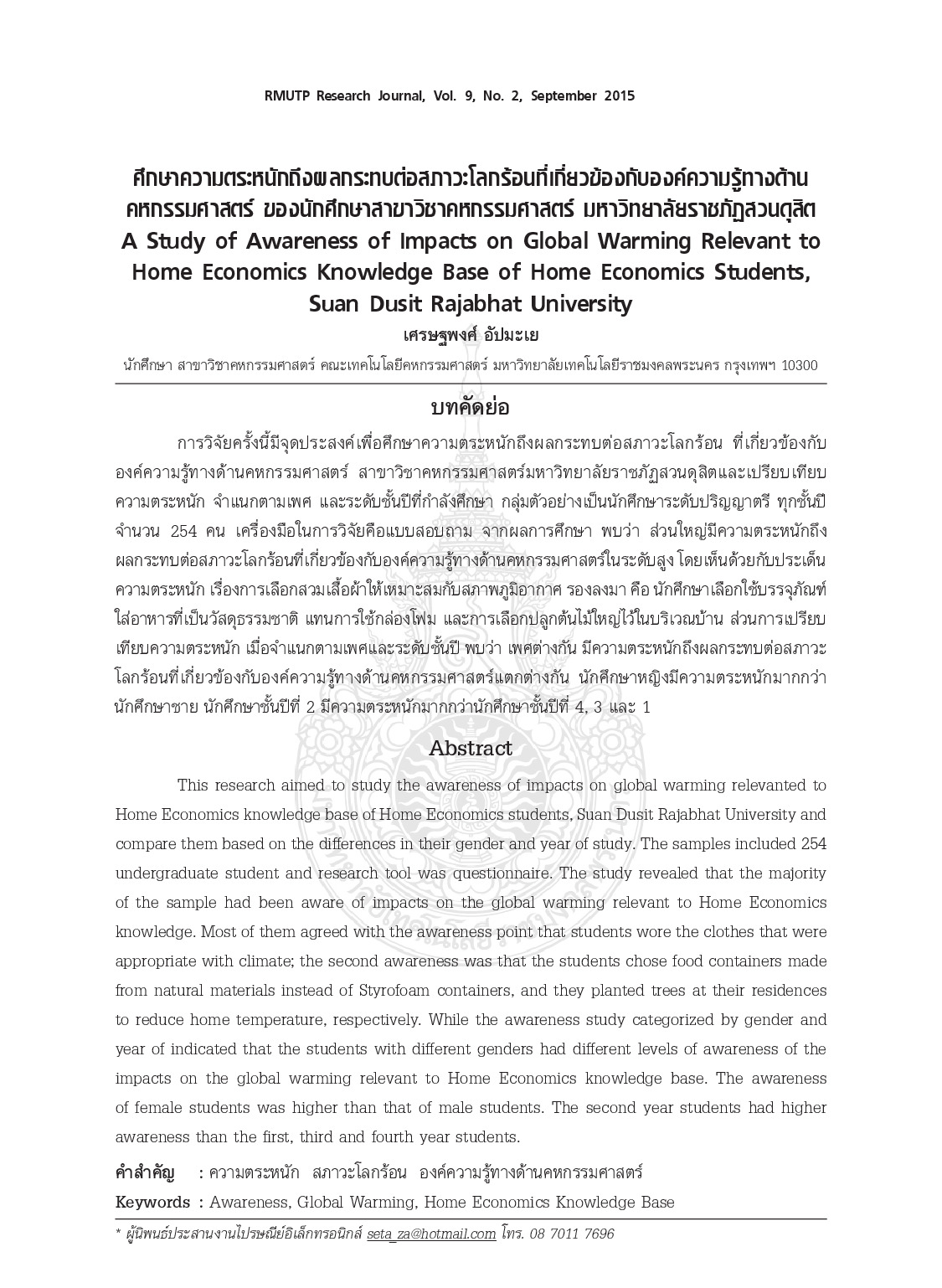
ศึกษาความตระหนักถึงผลกระทบต่อสภาวะโลกร้อนที่เกี่ยวข้องกับองค์ความรู้ทางด้านคหกรรมศาสตร์ ของนักศึกษาสาขาวิชาคหกรรมศาสตร์ มหาวิทยาลัยราชภัฏสวนดุสิต
This research aimed to study the awareness of impacts on global warming that is relevant to Home Economics knowledge base of Home Economics students Suan Dusit Rajabhat University and compare their awareness of impacts on global warming relevant to the Home Economics knowledge base considering their gender and year of study. The sample was 254 undergraduate students from Home Economics of Suan Dusit Rajabhat University. The research tool was questionnaire. The study revealed that the majority of the sample had been aware of impacts on the global warming relevant to Home Economics knowledge base in a high level. Most of them agreed with the awareness point that students wore the clothes that were appropriate with climate; for example they chose to wear light and thin clothes to reduce workload of air conditioners the students chose food containers made from natural materials instead of Styrofoam containers to reduce waste that took long time to decompose and they planted trees at their residences to reduce home temperature respectively. Comparing the awareness categorized by gender and year of study it was found that the students of Suan Dusit Rajabhat University of different genders had different levels of awareness of the impacts on the global warming relevant to Home Economics knowledge base. The awareness of female students was higher than that of male students and as for year of study the students of Suan Dusit Rajabhat University had different levels of the awareness of the impacts on the global warming relevant to Home Economics knowledge base. The second year students had higher awareness than the first third and fourth year students.