จำนวน Repository ( 2 )
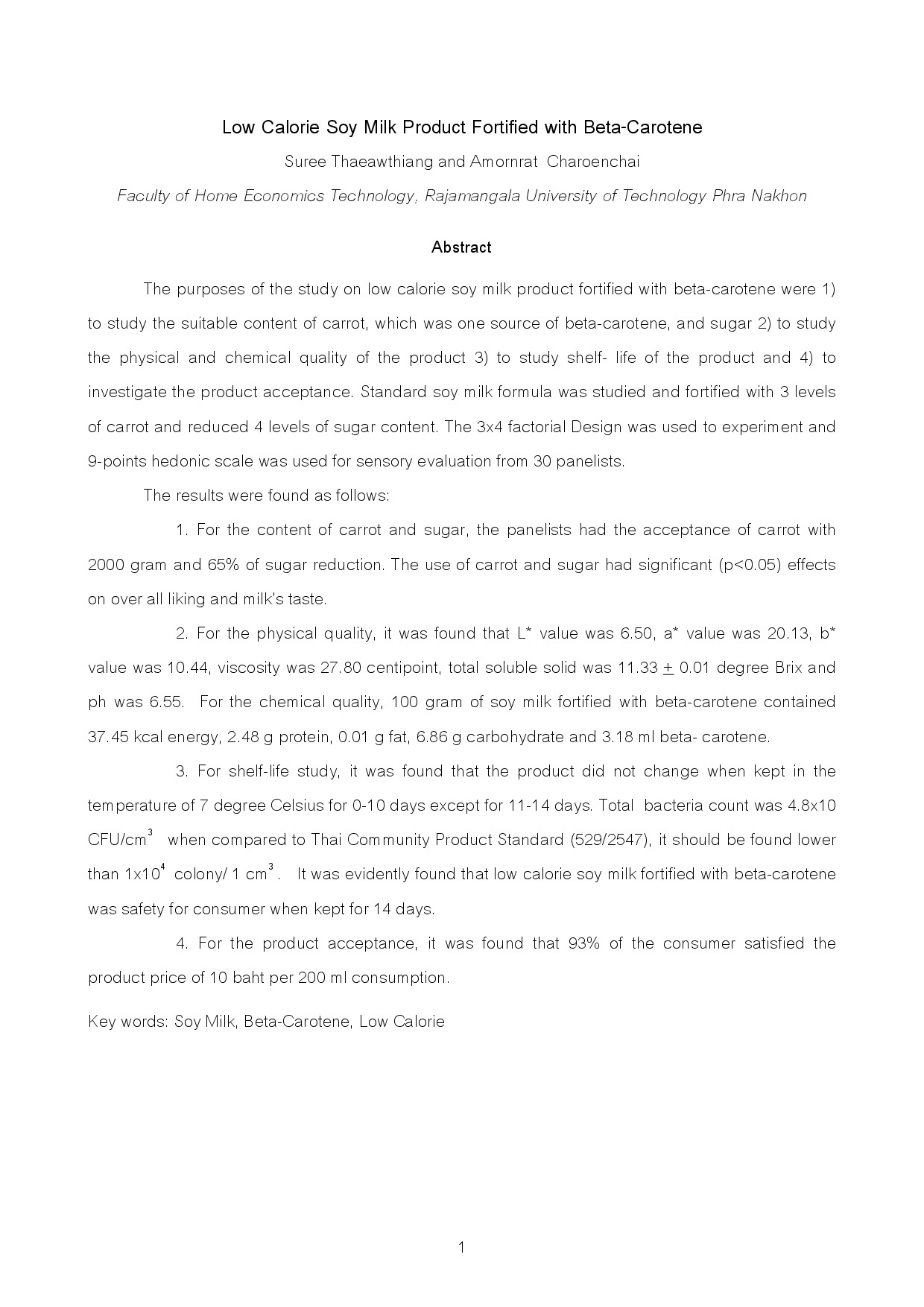
Low Calorie Soy Milk Product Fortified with Beta-Carotene
The purposes of the study on low calorie soy milk product fortified with beta-carotene were 1) to study the suitable content of carrot which was one source of beta-carotene and sugar 2) to study the physical and chemical quality of the product 3) to study shelf- life of the product and 4) to investigate the product acceptance. Standard soy milk formula was studied and fortified with 3 levels of carrot and reduced 4 levels of sugar content. The 3x4 factorial Design was used to experiment and 9-points hedonic scale was used for sensory evaluation from 30 panelists. The results were found as follows: 1. For the content of carrot and sugar the panelists had the acceptance of carrot with 2000 gram and 65% of sugar reduction. The use of carrot and sugar had significant (p<0.05) effects on over all liking and milk’s taste. 2. For the physical quality it was found that L* value was 6.50 a* value was 20.13 b* value was 10.44 viscosity was 27.80 centipoint total soluble solid was 11.33 + 0.01 degree Brix and ph was 6.55. For the chemical quality 100 gram of soy milk fortified with beta-carotene contained 37.45 kcal energy 2.48 g protein 0.01 g fat 6.86 g carbohydrate and 3.18 ml beta- carotene. 3. For shelf-life study it was found that the product did not change when kept in the temperature of 7 degree Celsius for 0-10 days except for 11-14 days. Total bacteria count was 4.8x10 CFU/cm3 when compared to Thai Community Product Standard (529/2547) it should be found lower than 1x10⁴ colony/ 1 cm3 . It was evidently found that low calorie soy milk fortified with beta-carotene was safety for consumer when kept for 14 days. 4. For the product acceptance it was found that 93% of the consumer satisfied the product price of 10 baht per 200 ml consumption.

Consumer acceptance and quality of ready to drink mahajanaka mango juice
Mahajanaka mango juice was health benefits and was a source of vitamins especially vitamin A in the form of beta carotene which a potent antioxidant. The purpose of this study was to consumer acceptance and quality of ready to drink mahajanaka mango juice the optimum ratio of mango pulp and water at 1:2 and 1:2.5 to 1:3. Result showed that the optimum ratio of mango pulp to water was 1:2. The mango juice contain of malic tartaric citric succinic and ascorbic acid at 0.005 0.053 0.180 0.005 and 0.138% respectively. The selected juice had 3.49 12.20oBrix 62.25 7.71 59.24 and 5.26 micrograms per gram of pH total soluble solids L * a * b * color values and beta-carotene content respectively. Sensory evaluation result revealed that the selected mango juice was accepted by 30 panelists which was medium like in color appearance odor taste and overall acceptability. Result of consumer test had shown that 97 % of 100 consumers from Lampang province were accepted and 65 % decided to buy the product.