จำนวน Repository ( 4 )

A study of sawdust-produced fiberboards using lac as binder for furniture industry
There has been an extensive use of fiberboards in the furniture industry. Therefore materials containing glue are applied to develop these fiberboards. This research investigated sawdust-produced fiberboards using lac as the binder and aimed to; (1) study the appropriate mixture proportions of sawdust and lac as the binder and; (2) explore the physical and mechanical properties of different mixture proportions of sawdust and lac at 5 wt% 10 wt% 15 wt% 20 wt% 30 wt% and 40 wt%. The research methods involved selecting sizes of dried sawdust and grinding with lac and alcohol. Then the mixture was pressed in a hot-pressing machine. After that the produced fiberboards were tested using medium-density fibreboards Thai Industrial Standard (TIS 966-2547) in a laboratory. The results showed that the appropriate proportions was 15 wt% which met the standard defined in Thai Industrial Standard (TIS 966-2547). The fiberboards could replace medium-density plywood and could be used in furniture and the home decorative product industry.
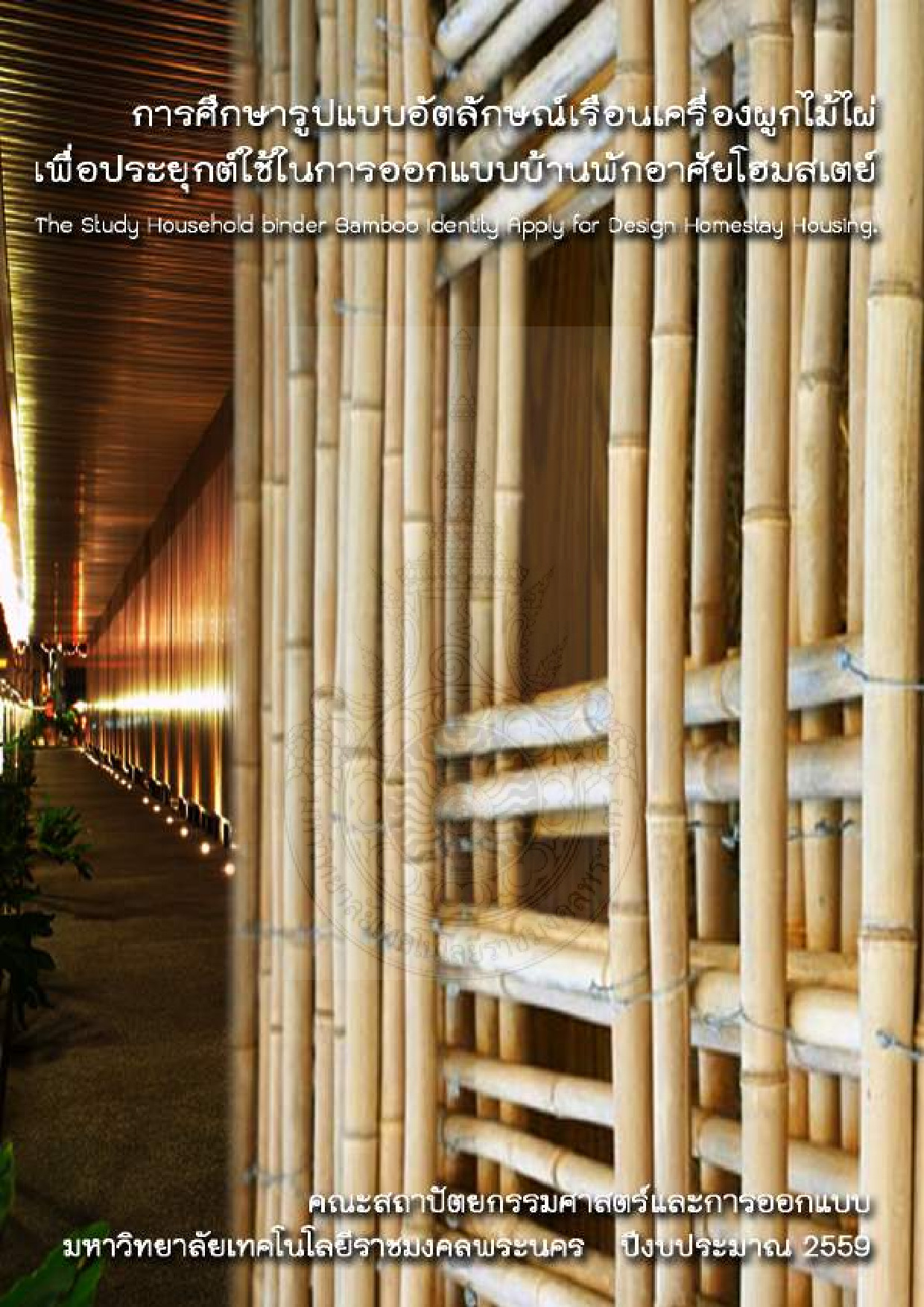
การศึกษารูปแบบอัตลักษณ์เรือนเครื่องผูกไม้ไผ่เพื่อประยุกต์ใช้ในการออกแบบบ้านพักอาศัยโฮมสเตย์
This study aims to improve the living legacy. Oriented architecture which combines the wisdom Household binder Bamboo Thailands ancient and unique materials that are readily available in local bamboo. Wisdom of Wooden Household binder the seized material to knit weave of bamboo in the community be a part of any home. Adding amenities to the residents as well as design use of the disabled as well. The resulting homestay used to guide the design of housing to increase or improve the existing house to form a pattern in the same direction by a local stable. cultural identity for them to add value and generate revenue for the community in harmony with the heritage of wisdom. The design proposes a model Household binder Bamboo 3 and then tested for the sun visor in crisis. The shape and function to the satisfaction of the community. And choose the most satisfaction to improve a final comment from the evaluation to prototyping home Household binder Bamboo homestay interested parties to continue to benefit the community most.
Effect of binders on shrinkage cracking behavior of concrete
This research was aimed to study the effect of binders on cracking behavior of high strength concrete under restrained shrinkage condition. The cracking behaviors of concrete that study were cracking age in uniaxially restrained shrinkage test shrinkage rate free shrinkage crack propagation and strength of concrete. The binders used in this study were fly ash and limestone powder. The weight percentage of replacement of cement by fly ash and limestone powder were 30 and 10% respectively. The water to binder ratios was 0.35. The results indicated that the influence parameters of shrinkage cracking were type of binder amount of free shrinkage shrinkage rate and tensile creep of concrete. The use of fly ash and limestone powder could reduce free shrinkage and shrinkage rate of concrete and result in the longer cracking age than cement-only concrete. The tensile creep of cement-only concrete was higher than that of limestone powder concrete and fly ash concrete respectively
การพัฒนาชิ้นงานความแข็งสูงพิเศษทังสเตนคาร์ไบด์ผสม TaC, TiC, NbC และ Co
The objective of this study was to investigate mechanical properties namely hardness of cemented tungsten carbide workpieces which were the mixture of 75 wt% tungsten carbide (WC) and 8 wt% -10 wt% cobalt (Co) as the binder . Other composites used included 0.5 wt% tantalum carbide (Tac) 14 wt% - 17 wt% titanium carbide (TiC) and 0.5 wt% - 1 wt% niobium carbide (NbC). The workpieces were then formed and sintered at 1450 °C. After the forming and sintering processes were completed the workpieces with different composites were obtained. The results showed that there were the differences in green density and hardness between recycled tungsten carbide powder and commercial tungsten carbide powder workpieces. Different particle characteristics and chemical components of tungsten carbide powder resulted in poor flow between the particles affecting density and hardness. Besides the compression of the metal powder before sintering could reduce the porosity because low porosity led to less shrinkage during sintering as shrinkage during sintering varies with the workpiece density after forming