จำนวน Repository ( 2 )
Utilization of cassava pulp and cassava wastewater for bioethanol production
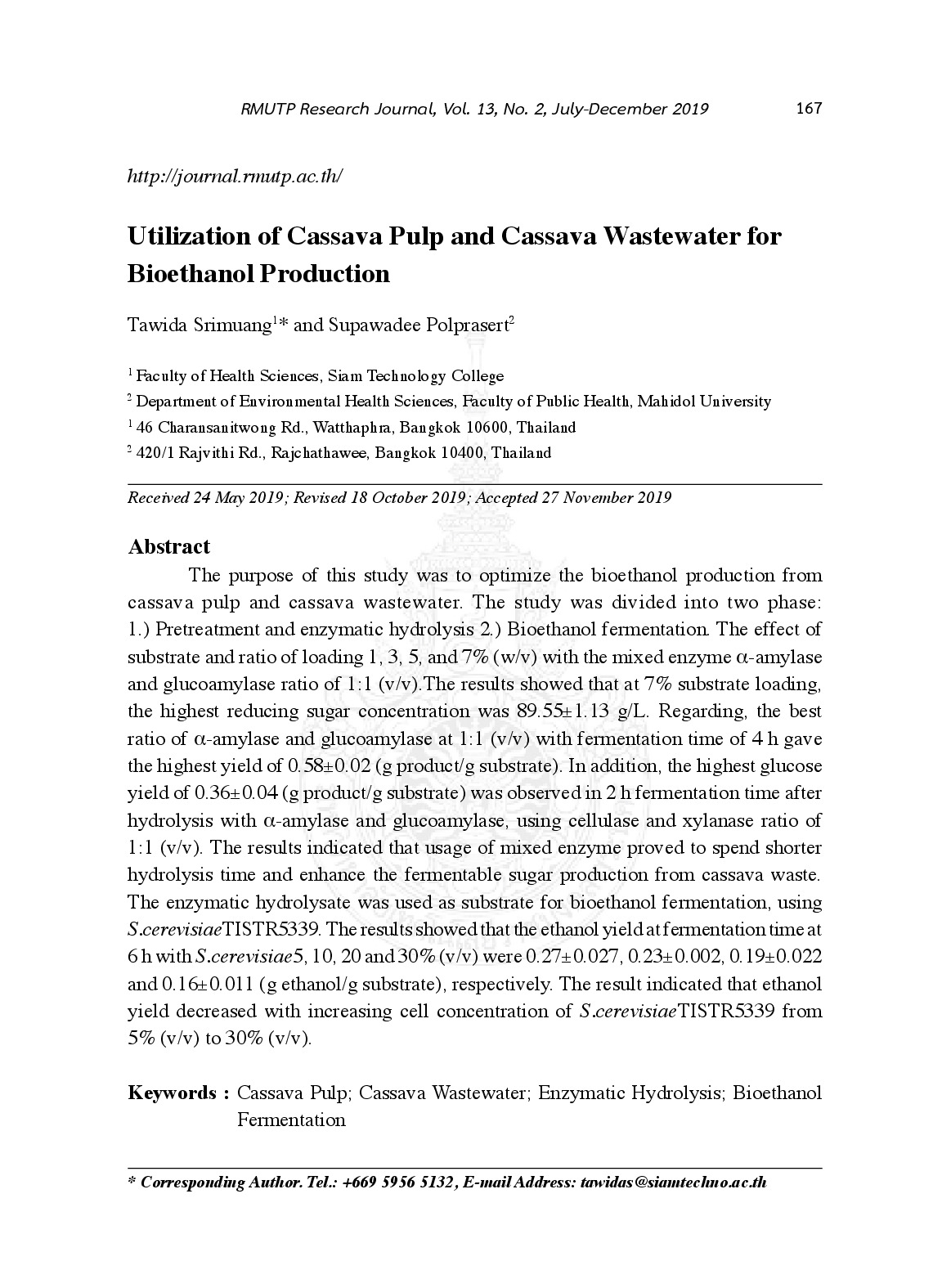
The purpose of this study was to optimize the bioethanol production from cassava pulp and cassava wastewater. The study was divided into two phase: 1.) Pretreatment and enzymatic hydrolysis 2.) Bioethanol fermentation. The effect of substrate and ratio of loading 1 3 5 and 7% (w/v) with the mixed enzyme α-amylase and glucoamylase ratio of 1:1 (v/v).The results showed that at 7% substrate loading the highest reducing sugar concentration was 89.55±1.13 g/L. Regarding the best ratio of α-amylase and glucoamylase at 1:1 (v/v) with fermentation time of 4 h gave the highest yield of 0.58±0.02 (g product/g substrate). In addition the highest glucose yield of 0.36±0.04 (g product/g substrate) was observed in 2 h fermentation time after hydrolysis with α-amylase and glucoamylase using cellulase and xylanase ratio of 1:1 (v/v). The results indicated that usage of mixed enzyme proved to spend shorter hydrolysis time and enhance the fermentable sugar production from cassava waste. The enzymatic hydrolysate was used as substrate for bioethanol fermentation using S.cerevisiaeTISTR5339. The results showed that the ethanol yield at fermentation time at 6 h with S.cerevisiae5 10 20 and 30% (v/v) were 0.27±0.027 0.23±0.002 0.19±0.022 and 0.16±0.011 (g ethanol/g substrate) respectively. The result indicated that ethanol yield decreased with increasing cell concentration of S.cerevisiaeTISTR5339 from 5% (v/v) to 30% (v/v).

A semi-solid state fermentatiom of bioethanol using durian fruit - hull as nutrien source
จากการวิจัยเรื่องการหมักเปลือกทุเรียนแบบกึ่งแห้งเพื่อผลิตไบโอเอทานอล เป็นการอนุรักษ์ทรัพยากรธรรมชาติ และประยุกต์ใช้ของเสีย (Residue/waste) ที่ได้จากการเกษตร เป็นจุดเริ่มต้นของความจำเป็นเร่งด่วนในการพัฒนาเพื่อให้ทรัพยากรที่มีอยู่ให้เกิดประโยชน์สูงสุด โดยการนำประโยชน์ของเปลือกทุเรียนที่เป็นของเหลือ ทิ้งทางการเกษตรที่มีในท้องถิ่น เพื่อนำมาแปรรูปหมักเพื่อให้ได้แอลกอฮอล์เพื่อใช้ประโยชน์เป็นพลังงานเชื้อเพลิงทดแทนน้ำมัน อันก่อให้มีมูลค่าเพิ่มสูงขึ้น เพื่อลดปริมาณสารที่จะต้อง กำจัดก่อนปล่อยออกจากโรงงานอุตสาหกรรม