จำนวน Repository ( 12 )
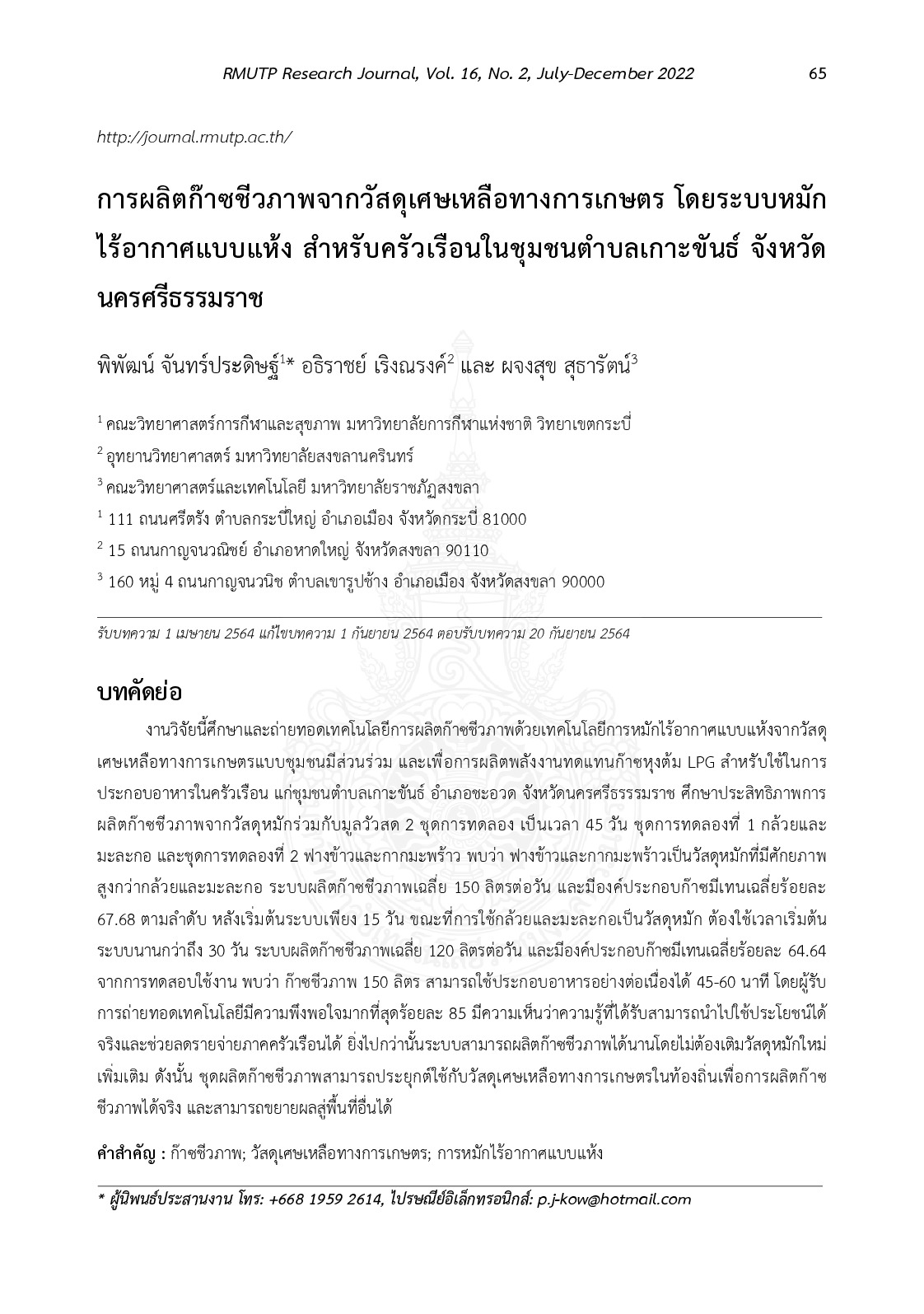
การผลิตก๊าซชีวภาพจากวัสดุเศษเหลือทางการเกษตร โดยระบบหมักไร้อากาศแบบแห้ง สำหรับครัวเรือนในชุมชนตำบลเกาะขันธ์ จังหวัดนครศรีธรรมราช
This research was studied and transferred the biogas production technology with the community participation using anaerobic dry fermentation system from agricultural residues. The production of renewable energy for replacing LPG in household cooking of Koh Khan Sub-district community Cha-Uat District Nakhon Si Thammarat Province was carried out. The efficiency of the biogas production from different co-digestion material with fresh cow manure was studied for 45 days. The experiment 1 bananas and papaya and the experiment 2 rice straw and coconut meal were used for fermented materials. It was found that the system using rice straw and coconut meal as a fermented material had a higher potential than using bananas and papaya. The system produced averaged biogas of 150 L/d and an average methane content of 67.68% respectively within just 15 days after start-up. While bananas and papaya as fermented materials took more time with more than 30 days after start-up the system. The system produced averaged biogas of 120 L/d and an average methane content of 64.64%. For usability test It was found that 150 L of biogas could continuously cook for 45-60 minutes. The 85% of the technology transfer recipients regarded that the knowledge gained as practical and reduced household expenditures. Additionally the system can produce biogas for a long time without adding new fermented materials. Therefore this biogas system could be applied to local agricultural waste for biogas production which can be expanded to other areas.
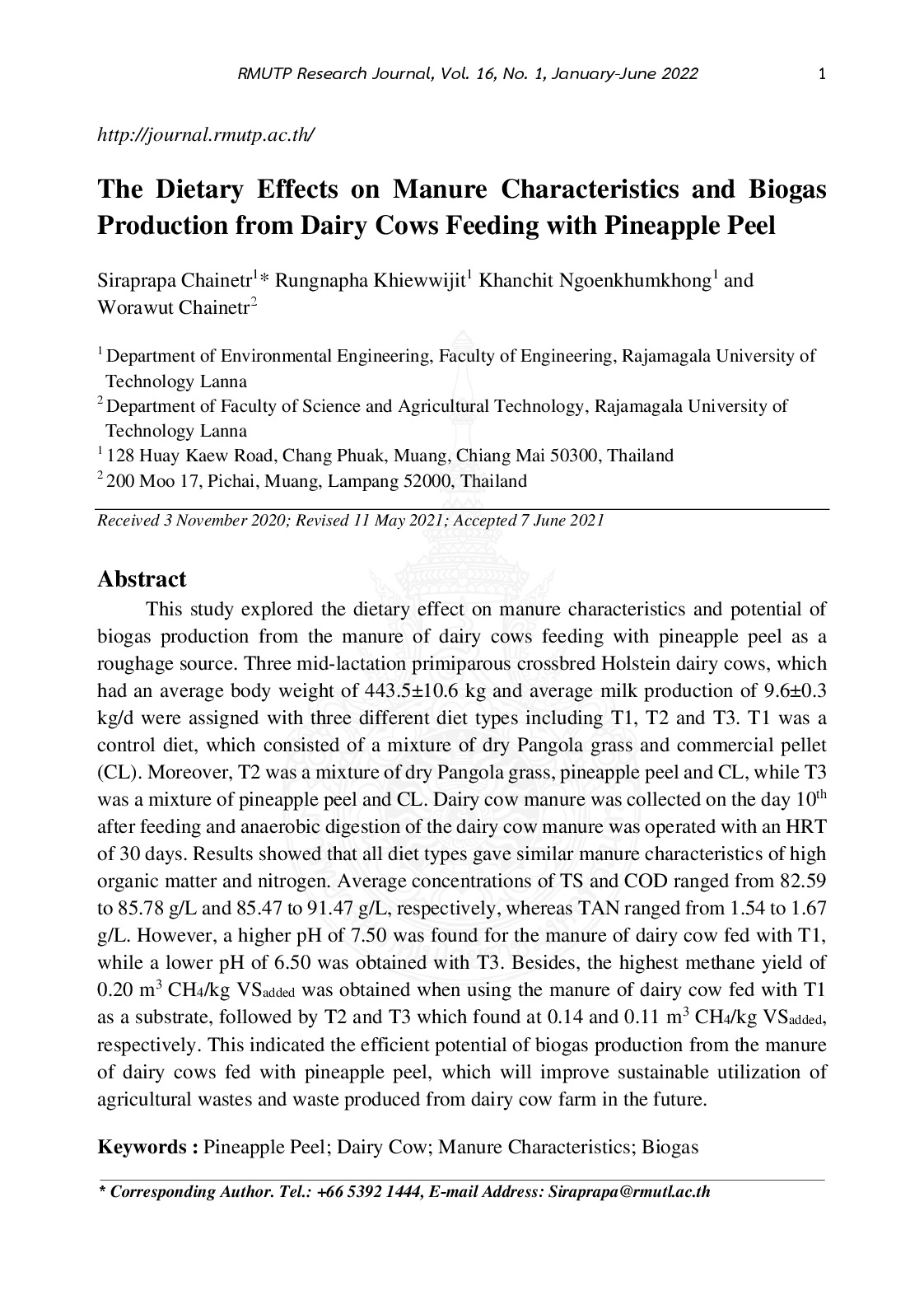
The Dietary effects on manure characteristics and biogas production from dairy cows feeding with pineapple peel
This study explored the dietary effect on manure characteristics and potential of biogas production from the manure of dairy cows feeding with pineapple peel as a roughage source. Three mid-lactation primiparous crossbred Holstein dairy cows which had an average body weight of 443.5±10.6 kg and average milk production of 9.6±0.3 kg/d were assigned with three different diet types including T1 T2 and T3. T1 was a control diet which consisted of a mixture of dry Pangola grass and commercial pellet (CL). Moreover T2 was a mixture of dry Pangola grass pineapple peel and CL while T3 was a mixture of pineapple peel and CL. Dairy cow manure was collected on the day 10th after feeding and anaerobic digestion of the dairy cow manure was operated with an HRT of 30 days. Results showed that all diet types gave similar manure characteristics of high organic matter and nitrogen. Average concentrations of TS and COD ranged from 82.59 to 85.78 g/L and 85.47 to 91.47 g/L respectively whereas TAN ranged from 1.54 to 1.67 g/L. However a higher pH of 7.50 was found for the manure of dairy cow fed with T1 while a lower pH of 6.50 was obtained with T3. Besides the highest methane yield of 0.20 m3 CH4/kg VSadded was obtained when using the manure of dairy cow fed with T1 as a substrate followed by T2 and T3 which found at 0.14 and 0.11 m3 CH4/kg VSadded respectively. This indicated the efficient potential of biogas production from the manure of dairy cows fed with pineapple peel which will improve sustainable utilization of agricultural wastes and waste produced from dairy cow farm in the future.
การวิเคราะห์ปัญหาน้ำเสียที่มาจากกากการเผาไหม้ของเหง้าทลายปาล์มที่โรงไฟฟ้าพลังงานชีวมวลและพลังงานก๊าซชีวภาพเพื่อหาแนวทางควบคุมคุณภาพน้ำด้วยระบบไฟฟ้าแรงดันสูง
This research study analyzes the problem of waste water from the burning of palm trees which are used as fuel for power generation of palm ash. It is used to ferment biogas as a fuel for power generation where a large amount of wastewater from the gas digester is completed. The wastewater is then pumped out of the gas digester. Biological in large quantities Therefore to study the analysis of wastewater to find a method for designing a wastewater treatment system from high voltage systems from the corona discharge principle when adding ozone it is necessary to analyze the chemical effects of the wastewater according to the standard values of the Department of Industrial Works.
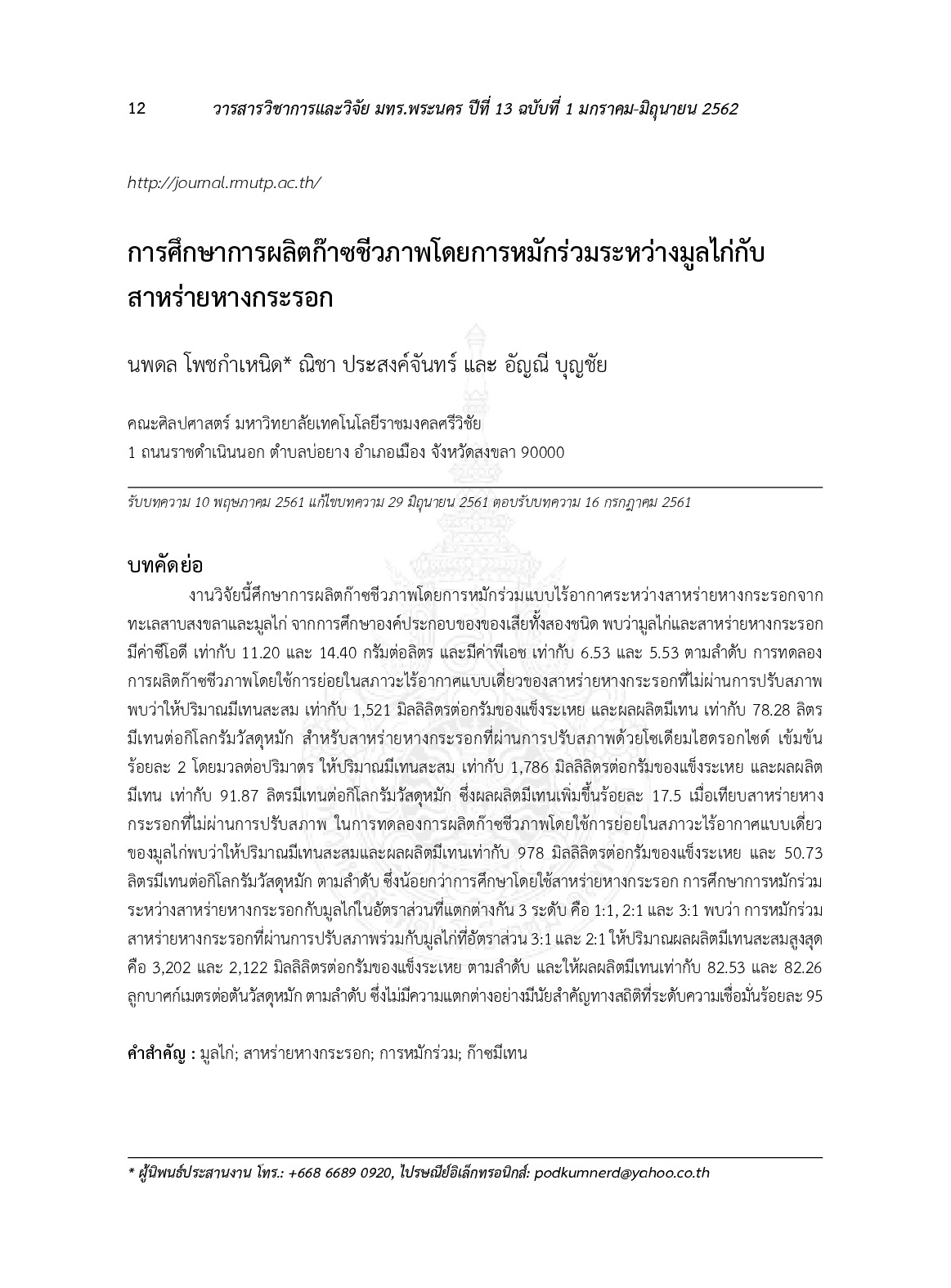
การศึกษาการผลิตก๊าซชีวภาพโดยการหมักร่วมระหว่างมูลไก่กับสาหร่ายหางกระรอก
This work presented the production of biogas using anaerobic co-digestion between hydrilla verticillata (HV) from Songkhla Lake Basin and chicken manure (CM). From the study of compositions of both wastes it was found that the COD of CM and HV were 11200 and 14400 mg/l and pH were 6.5 and 5.5 respectively. The biogas production using anaerobic single-digestion of untreated hydrilla verticillata (UHV) gave accumulative methane of 1251 ml-CH4/g-VS and methane production of 78.28 L-CH4/kg-substrate was obtained. For hydrilla treated with 2% w/v NaOH (THV) the accumulative methane was 1786 ml-CH4/g-VS and the obtained methane production was 91.87 L- CH4/kg-substrate which was 17.5 % increase when compared to the UHV. For the biogas production using anaerobic single-digestion of CM it was found that the accumulative methane and methane production were 978 ml-CH4/g-VS and 78.28 L- CH4/kgsubstrate respectively. These were lower than the studies using HV. The study of anaerobic co-digestion of HV and CM at three different ratios; 1:1 2:1 and 3:1 was studied. It was found that the anaerobic co-digestion using THV and CM at ratio 3:1 and 2:1 gave the highest potential for biogas production. The accumulate methane of 3202.20 and 2079.19 ml- CH4/g-VS were obtained respectively. The methane productions were 2.53 and 82.26 L-CH4/ton-substrate for ratio 3:1 and 2:1 respectively which is no significant different at 95 % confidence interval.

การย่อยสลายภายใต้สภาวะไร้อากาศของสารอินทรีย์ประเภทเศษอาหารเข้มข้นในกระบวนการผลิตแก๊สชีวภาพ
The purposes of this research were to investigate anaerobic digestion of concentrated food waste in biogas production system at mesophilic temperature (37 C). The effect of grinding and pH controlled at 6.20 and 7.00 on methane production were also studied. It was found that the ability of mix bacteria which had initial concentration of 2100 mg/l for digesting concentrated food waste with grinding was higher than that without grinding because of the increase in surface area (about 1.37 time). In this system the optimum condition for bacteria growth was found at pH 7.00. Under optimal condition the digestion efficiency in term of chemical oxygen demand (COD) removal was 18.81% higher corresponding to an increase in methane production rate (19.10%) than other conditions