จำนวน Repository ( 3 )

การผลิตถ่านอัดแท่งจากวัสดุเหลือทิ้งทางการเกษตรโดยใช้เปลือกทุเรียนผสมเปลือกลูกจาก
This research focuses on the production of charcoal briquettes from agricultural residues by using durian and nypa palm peel mixtures. The objectives of this study are to study the combustion efficiency of charcoal briquettes; study the suitable ratio for the production of briquettes with the ratios of durian : nypa palm peel mixtures as 100:0 50:50 25:75 and 0:100; recycle the agricultural residues as the renewable energy sources and analyze the fuel characteristics; moisture content ash content volatile matters fixed carbon and heating value. The results showed that the best ratio for the combustion efficiency of charcoal briquettes is 50:50 with the minimum moisture content of 4.68% the minimum ash content of 2.70% the volatile matters of 10.33% ; the maximum fixed carbon of 25.56% and all characteristics are met with the standard of charcoal briquettes from the local community products. In the ratio of 100:0 it showed the maximum heating value as 5399 calories per gram. Therefore the 50:50 charcoal briquettes are suitable as the renewable energy source. Besides the capacity of odor adsorption was analyzed by adding the odor substances (mothball) in two bottles with three mothballs for each bottle for two consecutive days before removal. Then sic of 50:50 charcoal briquettes were added into one bottle. Ten testers smelled the bottle every two days for six days. The result showed that the bottle with the charcoal briquettes had odor less than the bottle without briquettes. Hence the charcoal briquettes from durian and nyla palm peel mixtures have the best odor adsorption capacity and are suitable for household uses.
ผลของระดับอุณหภูมิในการอบแห้งถ่านอัดแท่งด้วยเครื่องอบแห้งพลังงานแสงอาทิตย์ร่วมกับรังสีอินฟราเรดไกล และเครื่องอบแห้งรังสีอินฟราเรดไกล
This research aims to study the effect of drying temperature on the changes in the moisture content of charcoal briquettes undergoing drying of solar energy and far-infrared radiation (Solar+FIR) and far-infrared radiation (FIR). The electricity consumption and the specific energy consumption were also investigated. The coconut shell charcoal briquettes with the initial moisture content of about 41-43% MW were dried at 55 60 and 65oC until the final moisture content of 8% MW was obtained. Based on the experimental results it was found that the drying temperatures and the drying methods had effects on the changes in the moisture content of charcoal briquettes. Drying at high temperature could reduce the moisture content of charcoal briquettes faster than that at low temperature. Drying using FIR could reduce the moisture content of charcoal briquettes faster than that using Solar+FIR. Moreover the electricity consumption and the specific energy consumption decreased with an increase in the drying temperature. Drying using Solar+FIR had lower electricity consumption but had higher specific energy consumption than drying using FIR. In this study the charcoal briquettes had the average heating value of about 6667.05 cal/g.
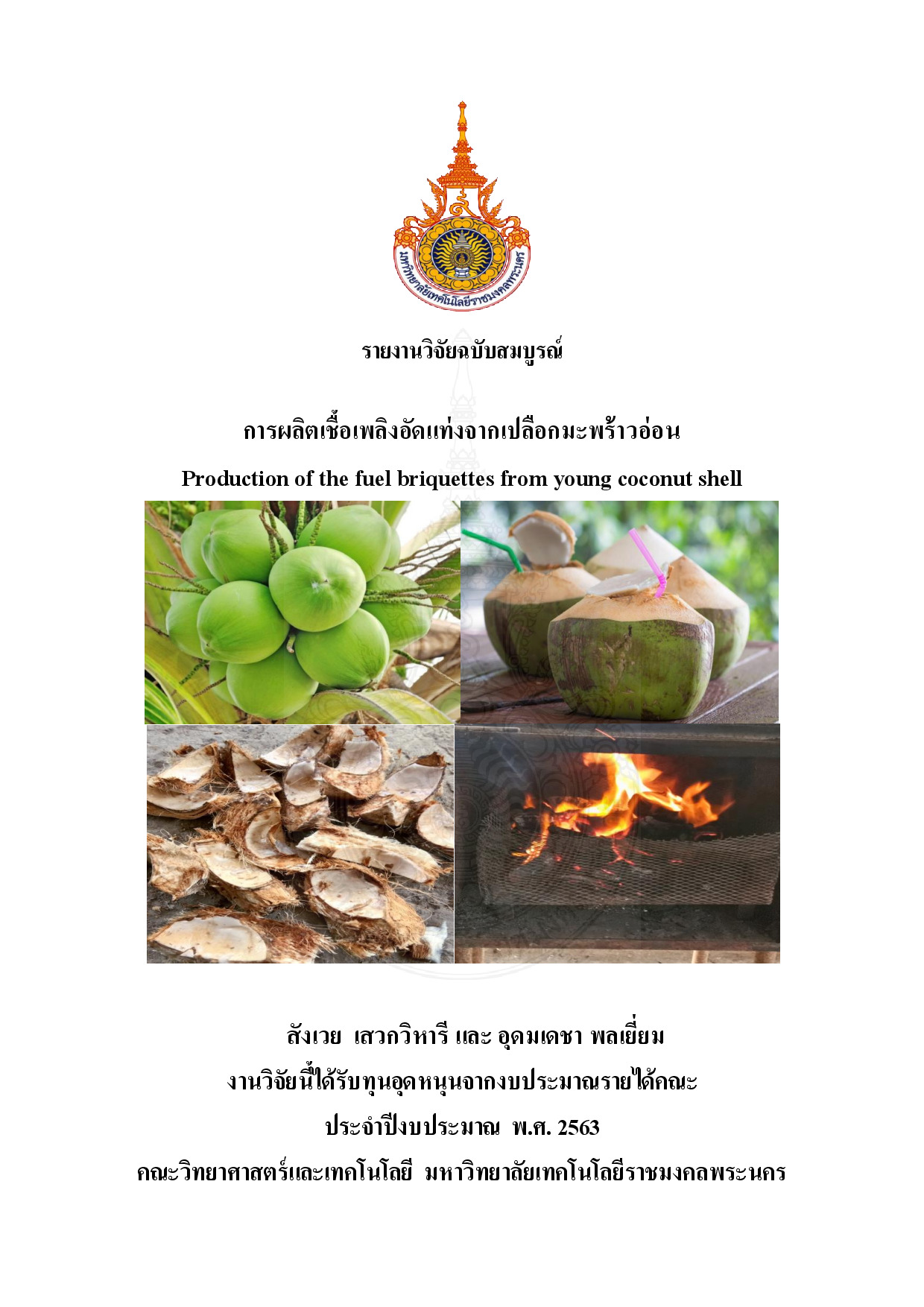
การผลิตเชื้อเพลิงอัดแท่งจากเปลือกมะพร้าวอ่อน
Young coconut shells are a byproduct after processing coconut juice which can be used to produce a solid-fuel. This fuel from the coconut shell is an alternative source instead of using firewood or charcoal made of timber in the natural forest. The solid-fuel from young coconut shells was prepared by using a wet glue powder as a binder then was compressed by using a briquette machine. The black coconut briquette was stable after exposure to the sun. The average of the briquette combustion rate was at 11.24 g /min. There is no eruption smut smoke and odor by using the young coconut shell briquette yo start a fire. To sum up a young coconut shell has a high potential as an alternative biomass material for producing a briquette especially for commercial. This solution can increase the reduction of haze weather in the sight of solid waste incineration and also global warming.