จำนวน Repository ( 2 )
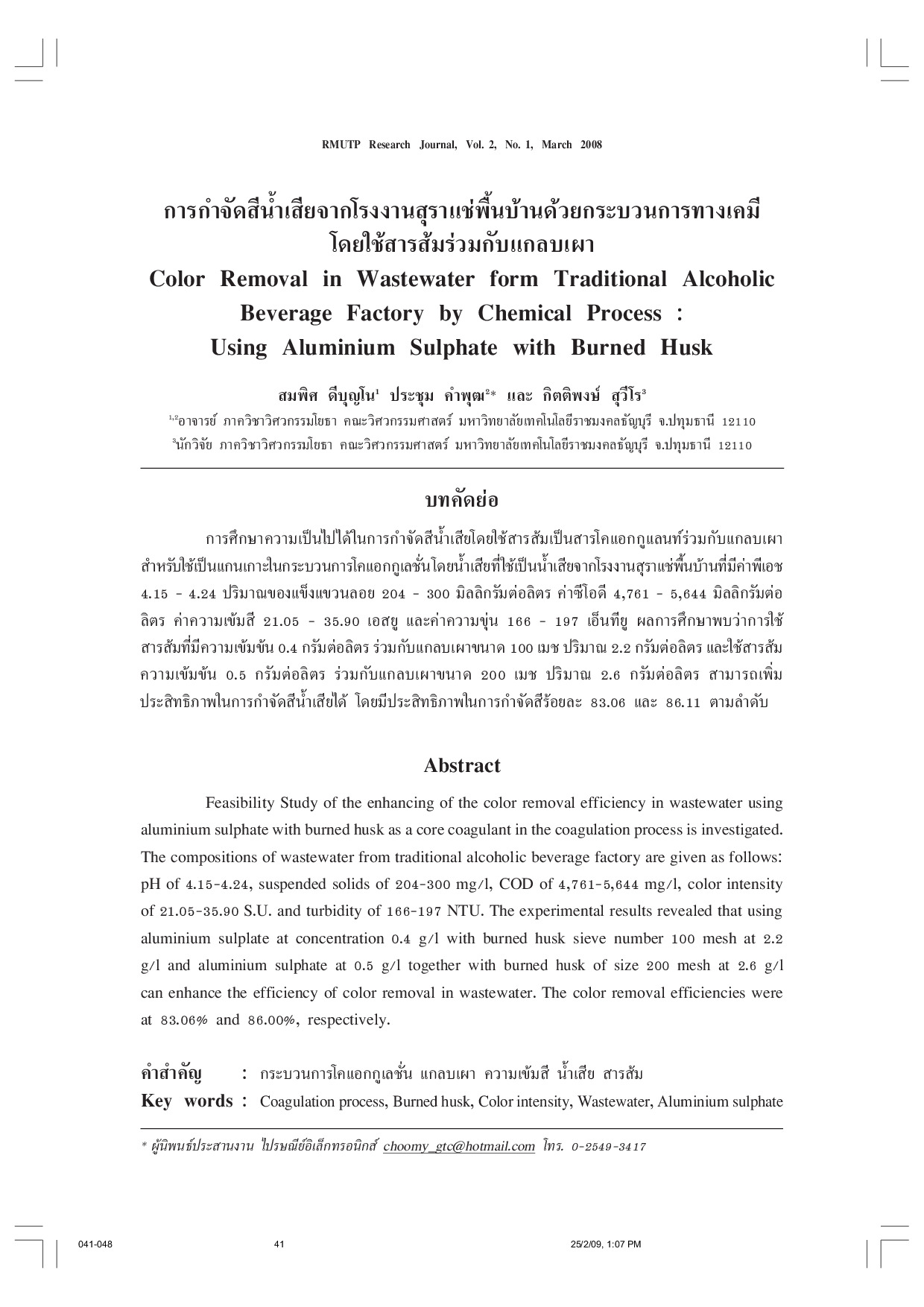
Color Removal in Wastewater form Traditional Alcoholic Beverage Factory by Chemical Process : Using Aluminium Sulphate with Burned Husk
Feasibility Study of the enhancing of the color removal efficiency in wastewater using aluminium sulphate with burned husk as a core coagulant in the coagulation process is investigated. The compositions of wastewater from traditional alcoholic beverage factory are given as follows: pH of 4.15-4.24 suspended solids of 204-300 mg/l COD of 4761-5644 mg/l color intensity of 21.05-35.90 S.U. and turbidity of 166-197 NTU. The experimental results revealed that using aluminium sulplate at concentration 0.4 g/l with burned husk sieve number 100 mesh at 2.2 g/l and aluminium sulphate at 0.5 g/l together with burned husk of size 200 mesh at 2.6 g/l can enhance the efficiency of color removal in wastewater. The color removal efficiencies were at 83.06% and 86.00% respectively.

การดูดซับทางชีวภาพสีย้อมโรดามีน บีด้วยรากผักตบชวาดัดแปร
The biosorption of Rhodamine B using modified water hyacinth roots was studied. The adsorption experiments were conducted in a batch setup. Parameters affecting the adsorption of Rhodamine B including pH of a solution adsorption time adsorbent dose and dyes concentration were investigated. With the 80 mg/L Rhodamine B solution of pH 6.0 adsorption time of 60 min and 0.10 g of modified water hyacinth roots the kinetic models pseudo-first order and pseudo-second order kinetic model were applied to examine the kinetic adsorption. The adsorption kinetic data correlates with pseudo-second order kinetic model. The Langmuir and Freundlich adsorption models were applied to describe the isotherms and isotherm constants. Adsorption isotherm data correlates with Langmuir adsorption model. The maximum adsorption capacity of modified water hyacinth roots for Rhodamine B was found to be 63 mg/g