จำนวน Repository ( 3 )
การพัฒนาผลิตภัณฑ์จากเปลือกนอกของก้านเผือกเหลือใช้ ในกลุ่มผู้ทานาเผือกอำเภอบ้านหมอจังหวัดสระบุรี เพื่อส่งเสริมเศรษฐกิจชุมชน
This research aims to produce paper and strands from taro fiber in order to develop into craft products and to transfer the body of knowledge and technology to community. The research consisted of 5 main steps: 1) development of paper – study concentration level of sodium hydroxide duration of pulp boiling suitable condition for breaching and softening reactive dyeing paper setting and physical testing of paper; 2) development of strand – stranding with machine strand spinning fiber combining and carding drawing reducing size of fiber and yarn spinning; 3) fiber property testing – cross-sectional test length crimp and fiber fineness; 4) product development – making evaluating and improving draft models of rubber-coated artificial flowers hanging clocks multipurpose boxes and product prototype development; and 5) transfer of technology to members of Talad Noi Agricultural Community Enterprise as well as nearby communities in Ban Moh district Saraburi province. Results of the study showed that the most suitable condition in separating fiber was boiling in 15 grams-per-liter sodium hydroxide solution at 100 Degree Celcius for 1 hour. Then breach with 9 grams-per-liter hydrogen peroxide solution at 100 Degree Celcius for 20 minutes. Next soften the fiber with 6 grams-per-liter anion softener at 60 Degree Celcius for 20 minutes. The use the fiber to set 40x40 centimeter piece of paper by spreading 20 grams of fiber equally. The resulting 0.237mg thick piece of paper was fairly resistance to piercing pressure and tearing force and was suitable to make craft products. In addition development of strands by yarn spinning method was suitable to produce strands which had more strength than strands from other plants. The strands were also suitable for further industrial production. The prototypes of utility and furnishing products were evaluated by consumers as highly suitable in 3 aspects - uniqueness of local product attractive design and size shape and weight – with mean values of 3.72 3.96 and 3.94 respectively. Price was evaluated as averagely suitable at a mean value of 3.12. Results of technology transfer showed that overall trainees were highly satisfied with the technology transfer process at a mean value of 4.55. Assessment of satisfaction and data for course improvement were both in the highest level with mean values of 4.60 and 4.51 respectively.

Eco-product development from rice stubble for community economy
In this research it was investigated in detail about the physical and specific characteristics of rice stubble to develop eco-product for the community economy. The amounts of heavy metals and volatile organic compounds (VOCs) in rice stubble spread thinly by variety of wood finishes and paints were examined for selection of the most appropriate materials which reduced the environmental impacts. Finishes were used in this study such as lacquer vanish wood preservative polyurethane shellac aerosol paint oil color natural dye and synthetic dye. This research was divided into two parts; the first part of this study consisted of analysis of seven heavy metals such as lead cadmium chromium cobalt tin arsenic and mercury (product criteria of green label Green Label Thailand and Eco-labeling 2009/894/EC) the second part consisted of analysis of volatile organic compounds and Environmental Impact Assessment for analyzing product life cycle through choices about materials and energy. Finally the respondents’ perception of the factors affecting product design were examined by measuring the satisfaction toward the designed products. The subjects were classified into three categories such as producer group designer group and consumer group. The experimental results showed that the standardized finishes of rice stubble were shellac lacquer wood preservative vanish and polyurethane respectively. Basket Weaving Techniques were the appropriate ones for the processing of the finished rice stubble because of less waste reducing urea formaldehyde usage man-based method less energy intensive less transportation energy and less adjusted procedure. The examples of designed products were desk lamp tablemat and hand bag. Producer group and designer group had a different opinion about the use of low-impact materials and the avoidance of hazardous substances. Producer group had significant differences of opinion with designer group and consumer group about the appropriate proportion of product design and the color making a product aesthetic. Among three groups of respondents there were not different opinions about the product aesthetic the ergonomically designed products the environmentally conscious products the friendly processed products the natural processed products and the easily end-of-life treatments.
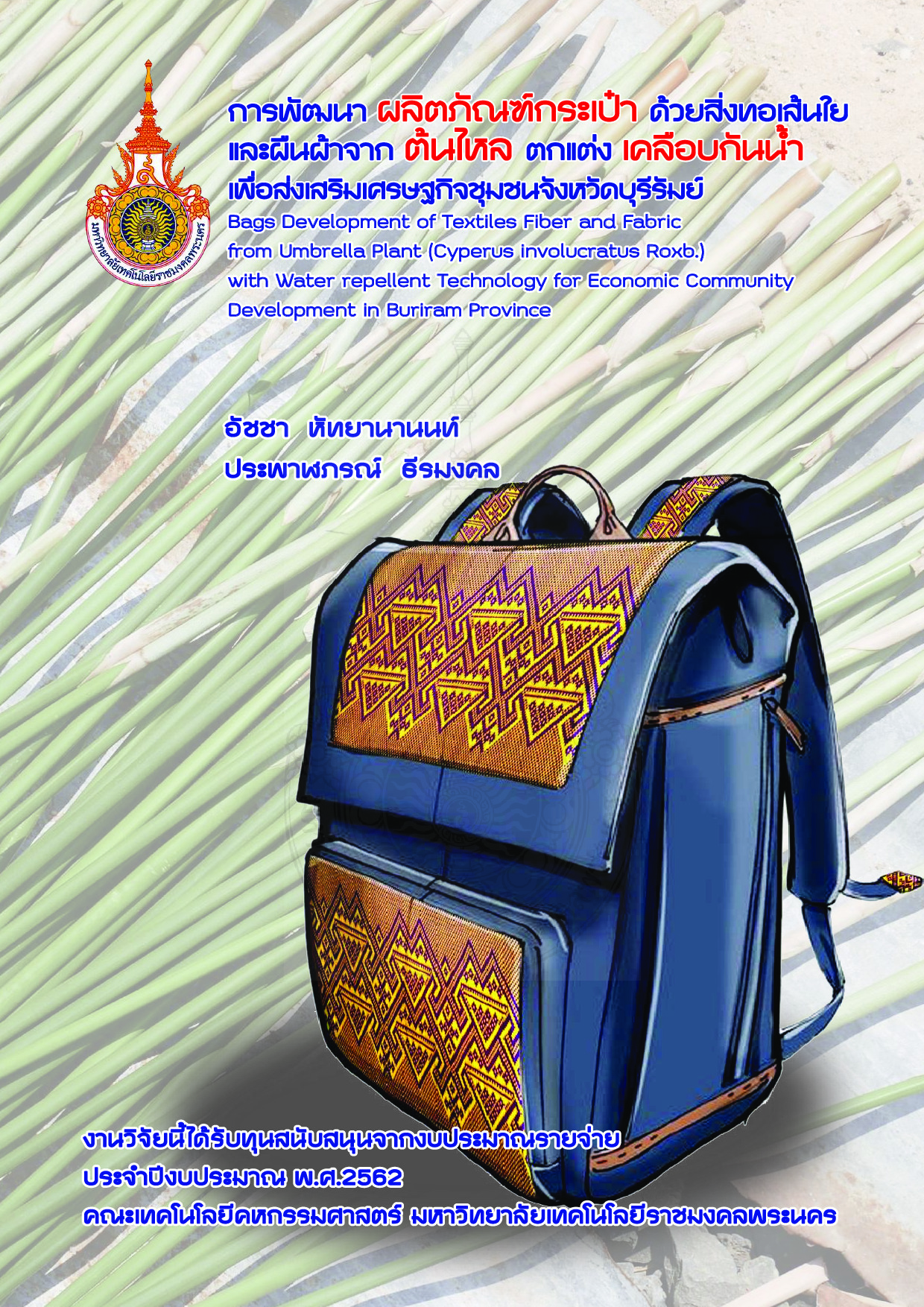
การพัฒนาผลิตภัณฑ์กระเป๋าด้วยสิ่งทอเส้นใยและผืนผ้า จากต้นไหลตกแต่งเคลือบกันน้ำ เพื่อส่งเสริมเศรษฐกิจชุมชนจังหวัดบุรีรัมย์
The proposes of this research were to study the development of bag products with textiles fibers and fabrics from decorative flowing water-resistant coating to promote community economy in Buri Ram Province. With the objective To study the process of producing yarn from fibers from the flow source To design and develop textile and bag products from yarn from the Lai Ton To study the effect of coating with waterproofing on bag products using textiles fibers and fabric from the flow. And to transfer knowledge and technology for utilization to community groups and interested people in next fiscal year This research can be summarized as follows: 1. The study of Ton Lai found that most villagers grow Lai Ton and make products as a supplementary career. In using this flow source in this research the researcher used a large flow source with a diameter of about 1 hour and can be separated into 4 small strands for research and production. The dyes used are synthetic because they will get fresh colors save time and be consistent. 2. The researcher designed 2 designs of weaving designs with the idea of using the original pattern to add edit and then create the pattern that the community groups like and can actually produce it as a product. After getting the fabric pattern then design into 10 bags of women and men bags using leather as an ingredient Decorate the bag to look interesting increase the price and increase the target audience. Which will be different from the original. That uses colored fabric and striped fabric as decorative items. 3. Coating with waterproofing on the bag products with textiles fibers and fabrics from the flow found that the fabric that has been coated with water repellent. When pouring water on the water surface there is a clumping together. No water penetration through fibers. When wiping clean the fibers are still dry not wet. Which is different from fabric that has not been coated namely water is able to penetrate immediately and create moisture on the fabric surface. If stored for a long time it can cause mold. 4. Schedule of technology transfer with the plan to transfer the research in the budget year 2020. For 3 day knowledge transfer and workshop was 30 participants. The group consisted of weaving mats from Ban Bu community Chorakhe Mak Subdistrict Prakhon Chai District. Buriram province