จำนวน Repository ( 2 )
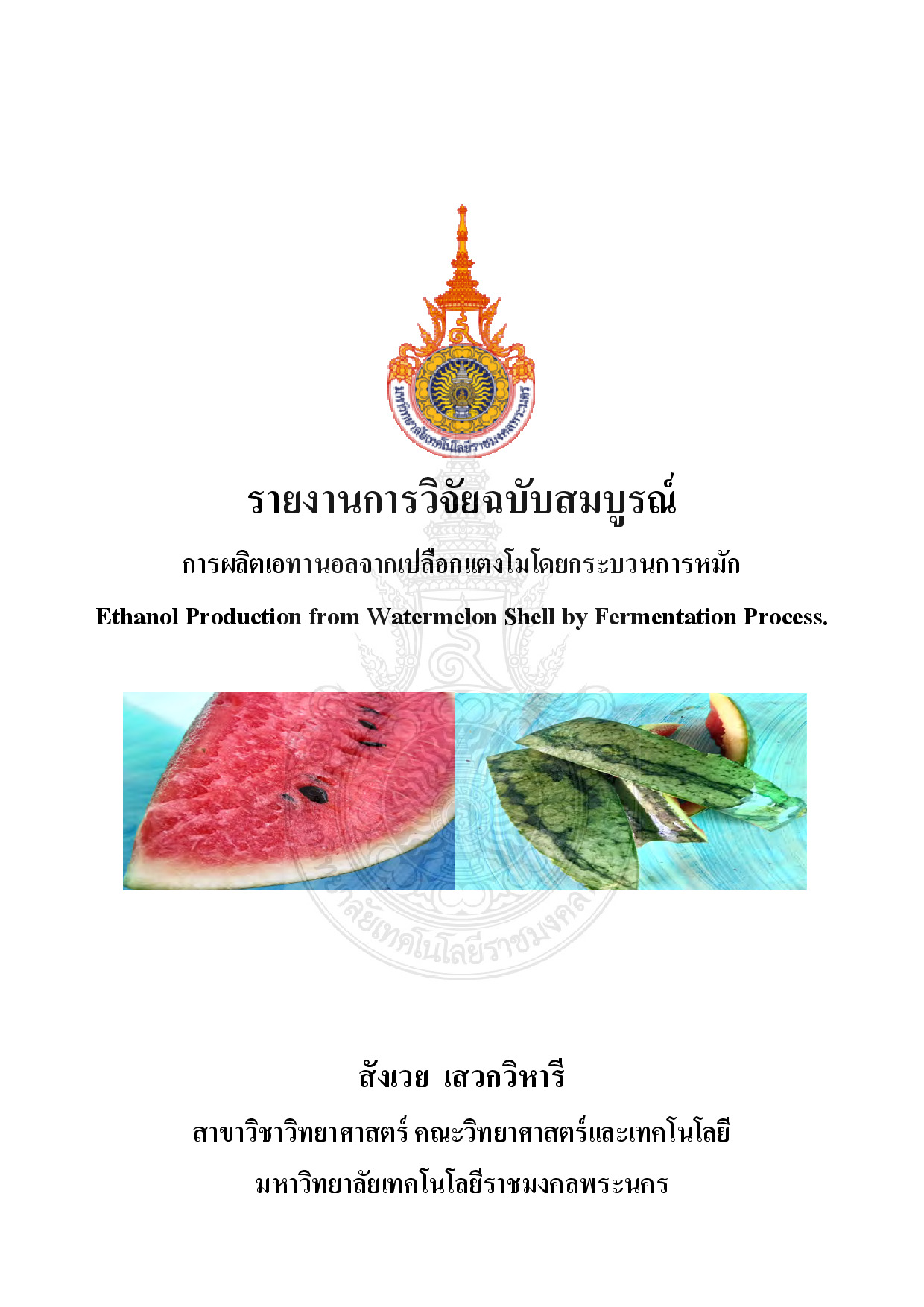
การผลิตเอทานอลจากเปลือกแตงโมโดยกระบวนการหมัก
Ethanol is a form of renewable energy. That can be used as fuel. Can replace gasoline or diesel. Fuel is an important factor driving the countrys economy. Ethanol can be produced from agricultural products garbage and various waste. his research uses watermelon rind. Which is waste from the community as a raw material for the production of ethanol by the fermentation process the microorganisms used in the fermentation process are ball flour. After fermentation for 6 hours it was found that the watermelon rind weighing 10 grams measured the concentration of alcohol. The concentration was 9.3 % VOL 18 Brix %. 20 grams of watermelon rind measuring the concentration of alcohol The concentration of 8.1 % VOL 16 Brix % of watermelon rind at 30 grams measured the concentration of alcohol. Get the concentration 8 % VOL 16 Brix % watermelon rind at 40 grams measure the concentration of alcohol get the concentration of 7.9 % VOL 15.1 Brix % and watermelon rind at 50 grams measure the concentration of alcohol the concentration of 7 % VOL 15 Brix %. Therefore it can be said that the watermelon rind which is waste from the community. Is a raw material with high potential for ethanol production to be used as a renewable energy source Instead of using raw materials from food plants and other energy crops.

Development of a hydrogen gas purifier for improving the quality of biogas in fermentation process
Hydrogen sulfide (H25 cheap materials activated carbon scraped iron sand cement and rice husks applied to the small scale biogas production at 30 ppm within 6 hours. The filter materials with highest to lowest H48.18 percent respectively. In the medium scale biogas production (20 L) at 30 ppm. Scraped iron and sand mixed with activated carbon filter had the best H(200 L) production of the biogas fermentation (30 ppm biogas product) sand mixed with activated carbon filter at the ratio 60:40 displayed the best performances in removing H2(3 day). It is the most environmental friendliness as well as cost-effective filter for biogas fermentation at scale up sizes at least 20 L. S) is found to be one major serious contaminant to biogas production system. In this research the team aimed to develop a high efficient filter for removing H2S from the biogas reaction. From all 2S absorptivity were activated carbon sand scraped iron and rice husks those accounted for 88.02 76.06 55 50 and 2S absorptivity (100 percent) and sand showed its H2S removal efficiency lower at 65 percent respectively. In larger scale S after incubated for 4.5 hours while scraped iron filter as well as activated carbon filter functioned in H2S removal longer time (2 and 3 days respectively). In order to be able to practically apply for continuous filtering H2S from the continuous biogas production sand mixed with activated carbon filter exhibited long last filtration