จำนวน Repository ( 3 )

The effects of pulp and fiber crops that affect the printing surface through for packaging
The study researches the effects of pulp and fiber crops that affect the printing surface through For packaging. The purpose of the study of plant fiber pulp.Compare the quality of the pulp fiber of plants that affect the printing surface throughThe data can be used in the design of appropriate packaging. And to compare the effects of the packaging structure of plant fiber pulp. Population and sample used in the study include the printing surface through Pulp and paper plants 5 types of equipment used in fiber research. The pulp and fiber crops. By manufacturers or those with knowledge of print. A uniform test. Clarity and completeness of the printing sector. Spec with a photometer in a satisfactory printing on pulp fibers through the plant by the manufacturers or those with knowledge of print. And the satisfaction of the pulp fiber packaging plant. By manufacturers or those with knowledge of the packaging. The research concluded that. Comparison of pulp fibers from plant samples 40 of them are featured on pulp paper suitable for printing in the most average of 4.6. The analysis compared the print quality of the pulp through a fiber plant. The test is simple and consistent. Clarity and completeness of the printing sector. The colors that appear on printed material including five kinds of color have always been smooth with differences not exceeding 5 shows the results in a value that can be seen as well. Comparison of satisfaction on the pulp paper and printing through the most appropriate. Is satisfactory in most average 4.65. Comparison of satisfaction packaging pulp paper plant fiber 5 and found that the packaging 1 and Type 3 are the scores remained level. The packaging is an average of 4.08 and packaging Type 3 has an average of 4.04. This research concluded that Pulp paper and print quality on the most appropriate.Is satisfactory in most The properties of the pulp. Print quality. As well as satisfaction with the quality printing. While pulp and pineapple pulp the elephant has a surface that is not strong. I withdrew the paper fibers of the time. Should improve the quality of pre-printed paper surface. While pulp and pulp of banana skin healthy grass.
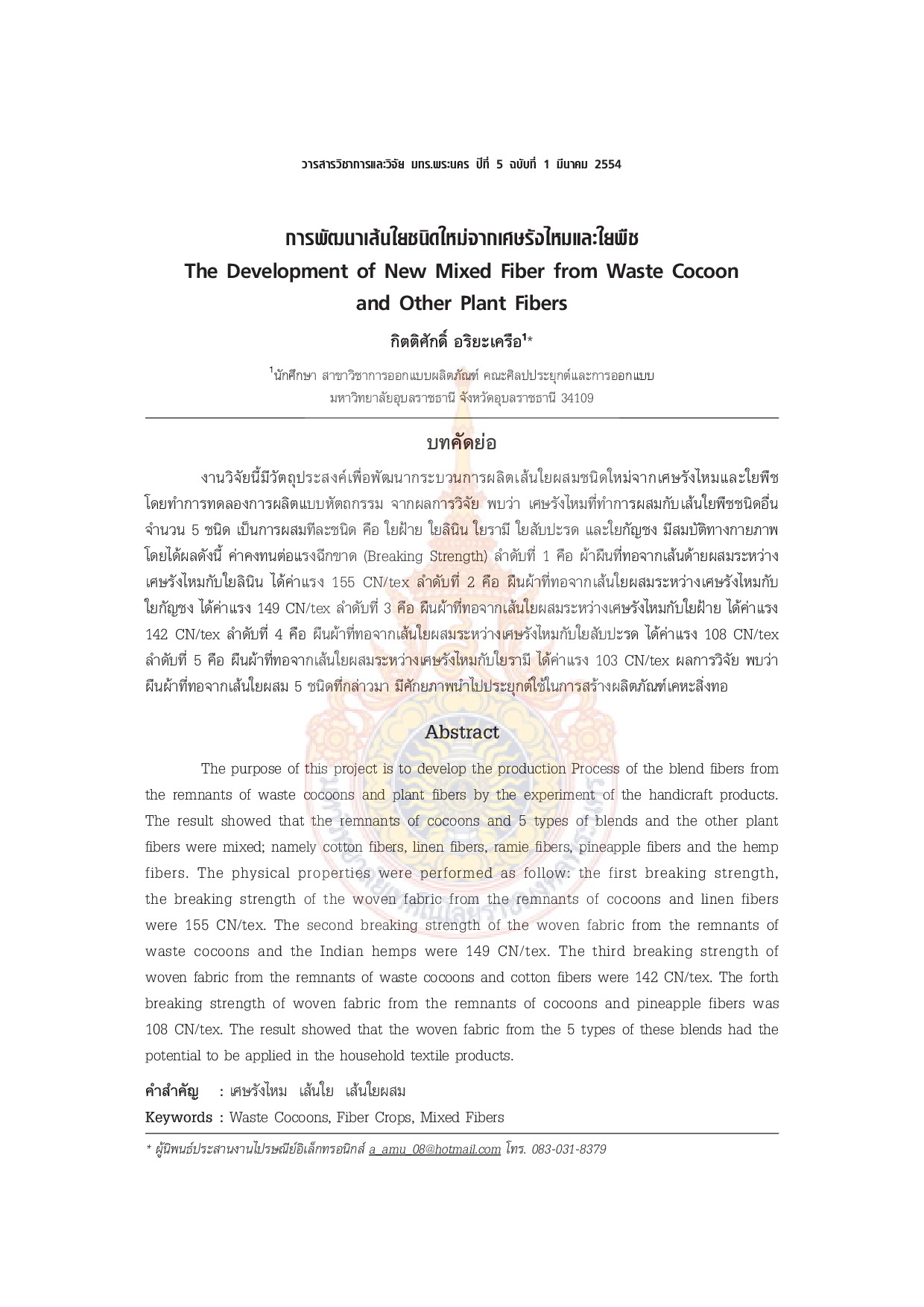
The Development of New Mixed Fiber from Waste Cocoon and Other Plant Fibers
The purpose of this project is to develop the production Process of the blend fibers from the remnants of waste cocoons and plant fibers by the experiment of the handicraft products. The result showed that the remnants of cocoons and 5 types of blends and the other plant fibers were mixed; namely cotton fibers linen fibers ramie fibers pineapple fibers and the hemp fibers. The physical properties were performed as follow: the first breaking strength the breaking strength of the woven fabric from the remnants of cocoons and linen fibers were 155 CN/tex. The second breaking strength of the woven fabric from the remnants of waste cocoons and the Indian hemps were 149 CN/tex. The third breaking strength of woven fabric from the remnants of waste cocoons and cotton fibers were 142 CN/tex. The forth breaking strength of woven fabric from the remnants of cocoons and pineapple fibers was 108 CN/tex. The result showed that the woven fabric from the 5 types of these blends had the potential to be applied in the household textile products
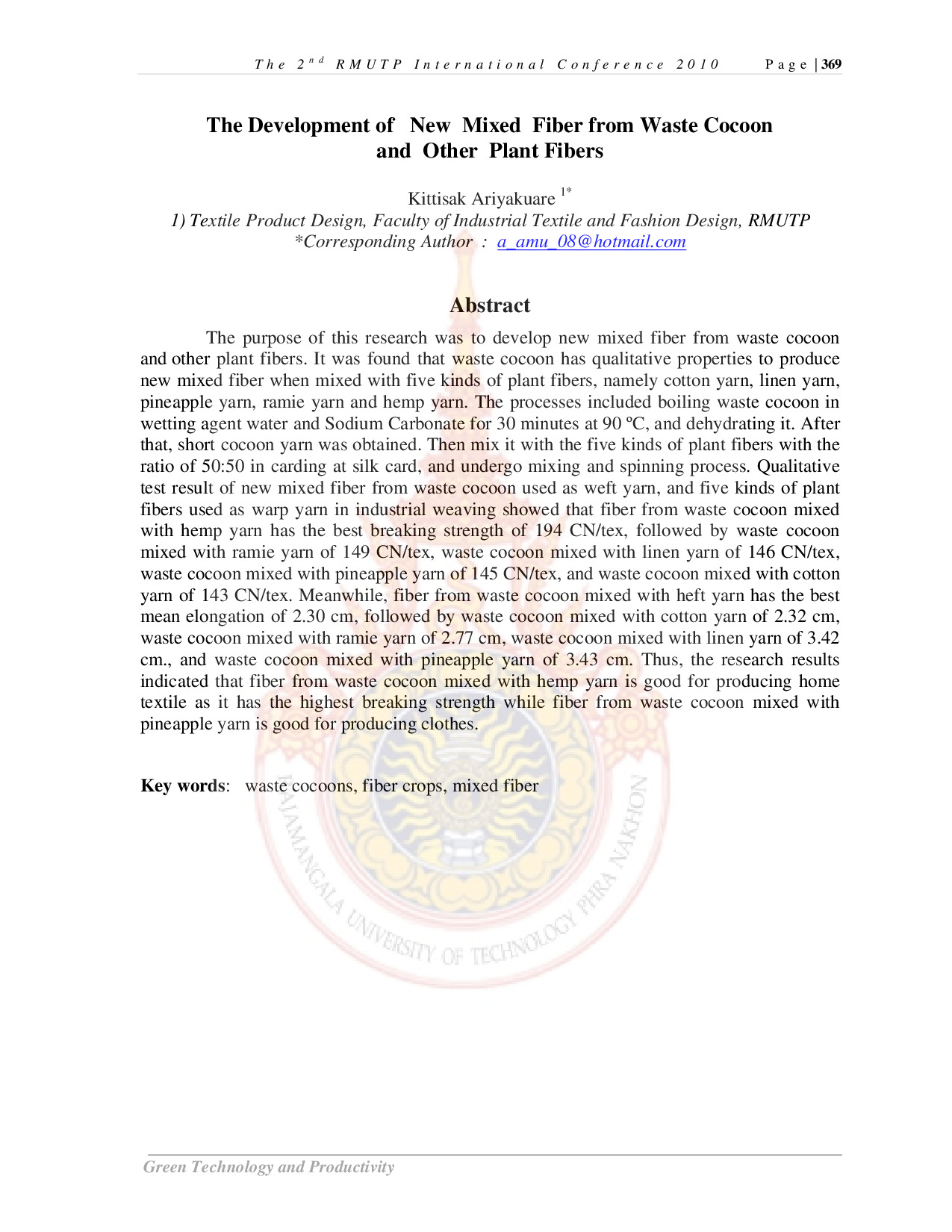
The Development of New Mixed Fiber from Waste Cocoon and Other Plant Fibers
The purpose of this research was to develop new mixed fiber from waste cocoon and other plant fibers. It was found that waste cocoon has qualitative properties to produce new mixed fiber when mixed with five kinds of plant fibers namely cotton yarn linen yarn pineapple yarn ramie yarn and hemp yarn. The processes included boiling waste cocoon in wetting agent water and Sodium Carbonate for 30 minutes at 90 ºC and dehydrating it. After that short cocoon yarn was obtained. Then mix it with the five kinds of plant fibers with the ratio of 50:50 in carding at silk card and undergo mixing and spinning process. Qualitative test result of new mixed fiber from waste cocoon used as weft yarn and five kinds of plant fibers used as warp yarn in industrial weaving showed that fiber from waste cocoon mixed with hemp yarn has the best breaking strength of 194 CN/tex followed by waste cocoon mixed with ramie yarn of 149 CN/tex waste cocoon mixed with linen yarn of 146 CN/tex waste cocoon mixed with pineapple yarn of 145 CN/tex and waste cocoon mixed with cotton yarn of 143 CN/tex. Meanwhile fiber from waste cocoon mixed with heft yarn has the best mean elongation of 2.30 cm followed by waste cocoon mixed with cotton yarn of 2.32 cm waste cocoon mixed with ramie yarn of 2.77 cm waste cocoon mixed with linen yarn of 3.42 cm. and waste cocoon mixed with pineapple yarn of 3.43 cm. Thus the research results indicated that fiber from waste cocoon mixed with hemp yarn is good for producing home textile as it has the highest breaking strength while fiber from waste cocoon mixed with pineapple yarn is good for producing clothes.