จำนวน Repository ( 3 )
การบำบัดน้ำสีย้อมผ้าโดยกระบวนการแอดวานซ์ออกซิเดชันด้วยโอโซน ร่วมกับสารไฮโดรเจนเปอร์ออกไซด์
This research is a study on treatment of Water Dyes from textile dyeing industry by Advance oxidation process with Ozone and hydrogen peroxide (H2O2). In this study Ozone generators with a capacity of 1.0 - 3.0 mg/ hr. were used to study the appropriate factors for treatment with adjusting wastewater conditions (pH 3 pH 7 and pH 11) Ozone exposure distance 120 minute the initial COD concentration is 250 - 1000 mg/l. and adding hydrogen peroxide at 4 8 and 12 ml/l. For the study found that above mentioned factors have an effect on the efficacy of color and COD treatment which the experiment at pH 11 used to Ozone treatment and added 4 ml/l. of H2O2. It makes the highest COD treatment efficiency when compared to pH 3 pH 7 and added more H2O2. it doesn’t affect to the higher of treatment efficiency. In addition it was found that higher initial COD concentration decreased treatment efficiency which the experimental ability for COD treatment has highest value was 46 percent and the COD concentration was 250 ml/l In order that when COD concentration in synthetic color water was increased to 500 ml/l and 1000 ml/l. it was found that the COD efficiency decreased to 31% and 40% respectively. For the treatment of Water Dyes from textile dyeing industry by oxidation process with Ozone together with hydrogen peroxide (H2O2) at pH 7 will has the highest of treatment efficiency. However the consideration of suitability for pH configuration used to treat both color and COD should choose pH 11 because it can treat both color and COD that makes the waste water quality meet the standards required by law. In addition if we consider the effectiveness of turbidity and BOD found that the decrease of dirtiness tends to be in the same direction with COD both 2 parameters.
Study of Ozone Generator with Electric Fields Distribution on Water Surface
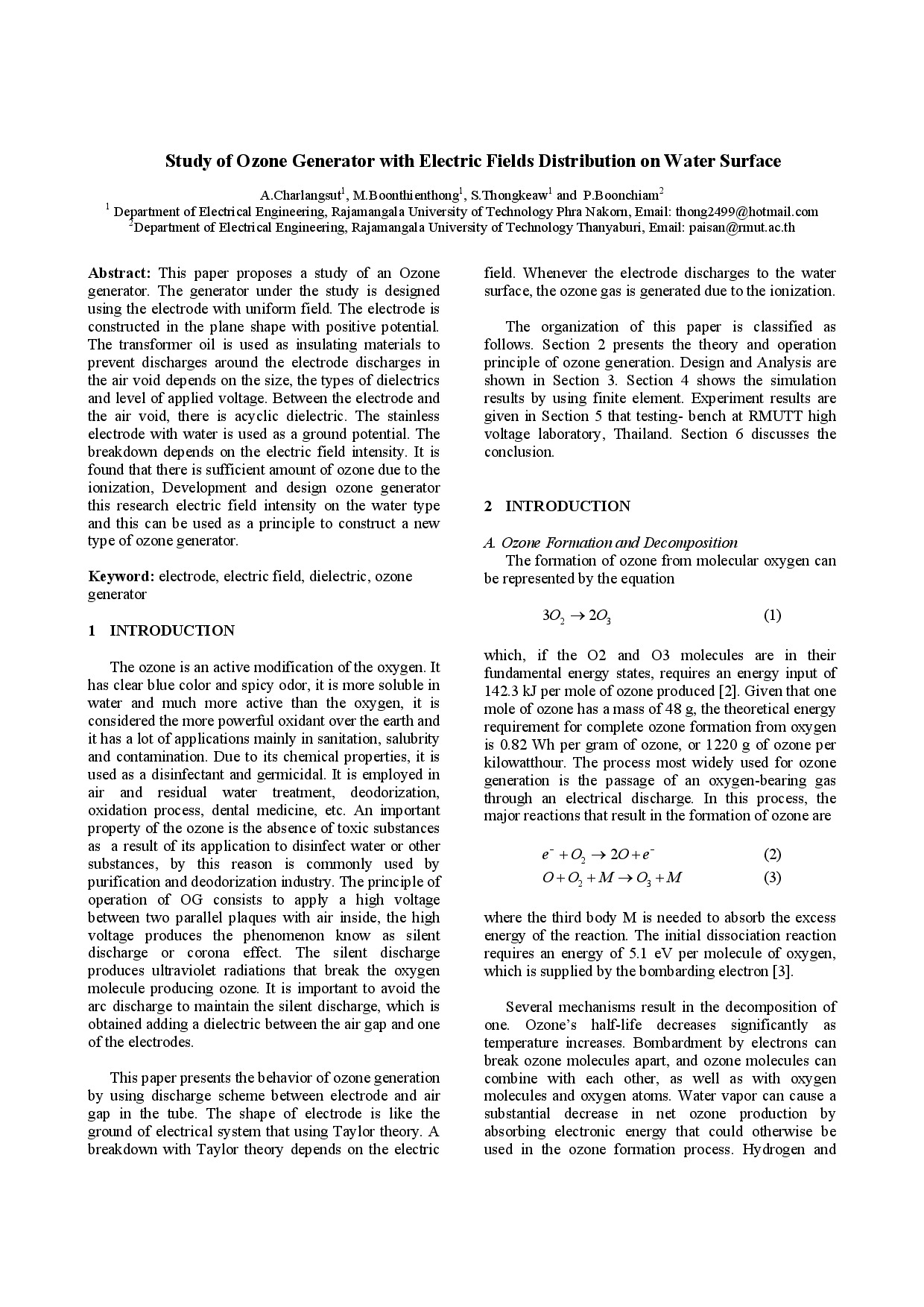
This paper proposes a study of an Ozone generator. The generator under the study is designed using the electrode with uniform field. The electrode is constructed in the plane shape with positive potential. The transformer oil is used as insulating materials to prevent discharges around the electrode discharges in the air void depends on the size the types of dielectrics and level of applied voltage. Between the electrode and the air void there is acyclic dielectric. The stainless electrode with water is used as a ground potential. The breakdown depends on the electric field intensity. It is found that there is sufficient amount of ozone due to the ionization Development and design ozone generator this research electric field intensity on the water type and this can be used as a principle to construct a new type of ozone generator.
Insulator testing set for finding the efficiency in Ozone generator design
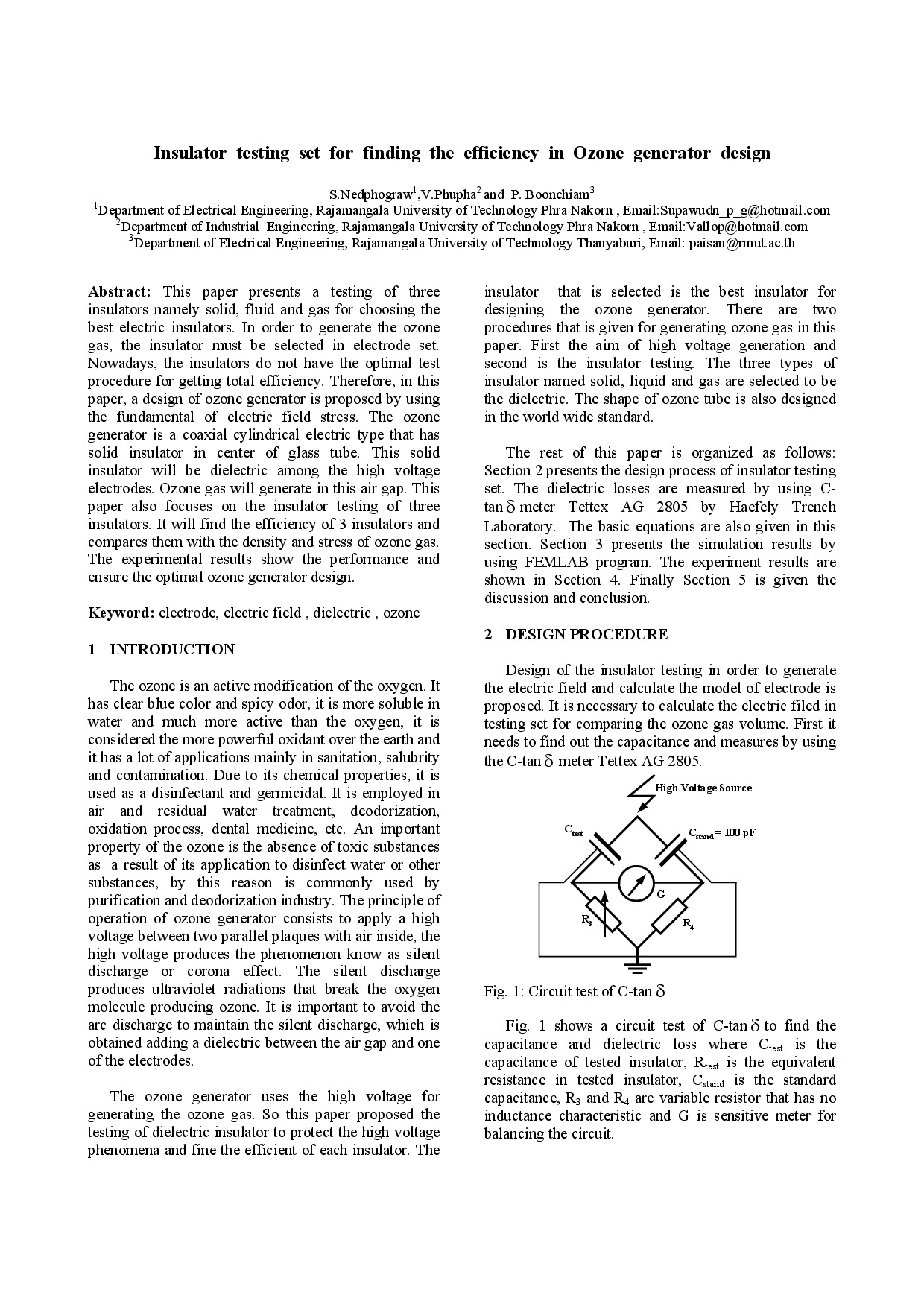
This paper presents a testing of three insulators namely solid fluid and gas for choosing the best electric insulators. In order to generate the ozone gas the insulator must be selected in electrode set. Nowadays the insulators do not have the optimal test procedure for getting total efficiency. Therefore in this paper a design of ozone generator is proposed by using the fundamental of electric field stress. The ozone generator is a coaxial cylindrical electric type that has solid insulator in center of glass tube. This solid insulator will be dielectric among the high voltage electrodes. Ozone gas will generate in this air gap. This paper also focuses on the insulator testing of three insulators. It will find the efficiency of 3 insulators and compares them with the density and stress of ozone gas. The experimental results show the performance and ensure the optimal ozone generator design.