จำนวน Repository ( 25 )
การพัฒนาผลิตภัณฑ์พานาคอตต้าน้ำนมธัญพืชเสริมซอสสับปะรดภูเก็ต
The objectives of this research were to 1) select a basic cereal formula suitable for milk production from cereals. 2) Study the appropriate amount of sugar used in the development of panna cotta formula from cereal milk. 3) Study the appropriate amount of sweetener (erythritol) in the Phuket pineapple sauce recipe. 4) Study the proper ratio of Phuket pineapple sauce for topping on cereal milk panna cotta. 5) Study the nutritional value of panna cotta Topped with Phuket pineapple sauce. The sensory quality was assessed using a 9-point liking score (9 - Point Hedonic Scale) tasting method. It was found that 1) the tasters accepted the grain ingredients used in the production of cereal milk formula containing 500 g of corn. and millet soybean mung bean black bean red bean and white bean using the same amount of 50 g of each type. 2) The tasters accepted the ratio of 10% sugar to the ingredients in the cereal milk panna cotta recipe. 3) The tasters recognized the use of 6% erythritol of pineapple in the Phuket pineapple sauce recipe. 4) The tasters recognized the ratio of Phuket pineapple sauce in the cereal milk panna cotta recipe of 1: 2 or the amount of 10g of sauce for topping 20g of panna cotta per cup. The scores of liking for appearance color smell taste texture and overall liking were 8.2 8.07 7.77 8.27 8.00 and 8.30 respectively which were in a high level of liking. 5) The nutritional value of basic panna cotta panna cotta from cereal milk formula and panna cotta from cereal milk with Phuket pineapple sauce formula had protein content of 3.17% 2.54% and 2.79 % respectively. Carbohydrates were found to be 27.44% 16.03% and 21.63% respectively. Fat content were 8.17% 0.44% and 0.27% respectively and fiber were 0.00% 0.55% and 0.71% respectively. Therefore cereal milk panna cotta topped with Phuket pineapple sauce recipe is suitable for the health-conscious consumers due to its reduced fat content and in Phuket pineapple sauce using erythritol as a sweetener grammar the energy of nutrients. It is also suitable for consumers who are allergic to milk as it does not contain cows milk and also has good nutritional value.
The Dietary effects on manure characteristics and biogas production from dairy cows feeding with pineapple peel
This study explored the dietary effect on manure characteristics and potential of biogas production from the manure of dairy cows feeding with pineapple peel as a roughage source. Three mid-lactation primiparous crossbred Holstein dairy cows which had an average body weight of 443.5±10.6 kg and average milk production of 9.6±0.3 kg/d were assigned with three different diet types including T1 T2 and T3. T1 was a control diet which consisted of a mixture of dry Pangola grass and commercial pellet (CL). Moreover T2 was a mixture of dry Pangola grass pineapple peel and CL while T3 was a mixture of pineapple peel and CL. Dairy cow manure was collected on the day 10th after feeding and anaerobic digestion of the dairy cow manure was operated with an HRT of 30 days. Results showed that all diet types gave similar manure characteristics of high organic matter and nitrogen. Average concentrations of TS and COD ranged from 82.59 to 85.78 g/L and 85.47 to 91.47 g/L respectively whereas TAN ranged from 1.54 to 1.67 g/L. However a higher pH of 7.50 was found for the manure of dairy cow fed with T1 while a lower pH of 6.50 was obtained with T3. Besides the highest methane yield of 0.20 m3 CH4/kg VSadded was obtained when using the manure of dairy cow fed with T1 as a substrate followed by T2 and T3 which found at 0.14 and 0.11 m3 CH4/kg VSadded respectively. This indicated the efficient potential of biogas production from the manure of dairy cows fed with pineapple peel which will improve sustainable utilization of agricultural wastes and waste produced from dairy cow farm in the future.
การศึกษาแป้งถั่วขาวทดแทนแป้งสาลีในทาร์ตสับปะรดไต้หวัน
Study on white bean flour in place of wheat flour in Taiwan pineapple tart The objective is to study the basic recipe of Taiwanese pineapple tart. And study the amount of white bean flour in place of wheat flour in Taiwan pineapple tart. By studying the 3 basic recipes of Taiwanese pineapple tart flour. To get the recipe that the tastemakers accept the most And to study the amount of white bean flour instead of wheat flour in 5 levels of Taiwanese pineapple which are 0 percent (control formula) white bean flour instead of wheat flour in 25 percent Taiwanese pineapple tart 50 percent 75 percent and 100 percent. of all wheat flour. The randomized complete block design (RCBD) was used to plan the sensory qualities of appearance color smell taste texture and overall liking. With a 9-point Hedonic Scale tasting method using 40 tasting participants 2 repeated. Who is a teacher and students in the food and nutrition program Faculty of Home Economics Technology Rajamangala University of Technology Phra Nakhon Take the result to find the mean 𝑥̅ Analysis of Variance (ANOVA) and compare the difference of the mean by the method (Least Significant Difference (LSD). The results of white bean flour instead of wheat flour in Taiwan pineapple tart. The tasters accept 25 percent of the taste texture and overall liking. With an average 7.50 7.40 and 7.43 respectively At a moderate level. Regarding appearance and color tasters accepted 0 percent with an average of 7.30 and 7.35 respectively. At a moderate level. As for the smell The tasters accepted 50% with an average of 7.45. Ata moderate level. When used to analyze the variance compare the differences. Found that the appearance color smell taste texture and overall liking. There is a statistically significant difference at the level of 0.05.
การพัฒนาศักยภาพผลิตภัณฑ์เนื้อสัตว์แปรรูปเสริมกากสับปะรด ที่เหลือจากการคั้นน้ำ
The potential development the of processed meat products enhancing pineapple pulp left by juicing. Pattawia pineapple pulp used in research. Boil to extract the acid and sugar. The pulp looks like fresh pulp light yellow. The processed meat products used include coarse ground pork sausage pork ball and Moo Yor. Pineapple pulp supplementation in coarse ground pork sausages could be supplemented by up to 15 percent. Pork balls can be supplemented up to 20 percent and Moo Yor can be added up to 10 percent. The addition of pineapple pulp to processed meat products resulted in an increase in crude fiber content in all 3 processed meat products. At the same time resulting in light processed meat products and has a reduced texture characteristics score which affects acceptance. Consumer acceptance test in The potential development the of processed meat products enhancing pineapple pulp left by juicing for 100 tester found that most testers are more than 95 percent acceptance in the product of The potential development the of processed meat products enhancing pineapple pulp left by juicing. For the technology propagation of the potential development the of processed meat products enhancing pineapple pulp left by juicing in faculty of Homes Economocs Technology the participants were most satisfied with all aspects of the technology propagation.
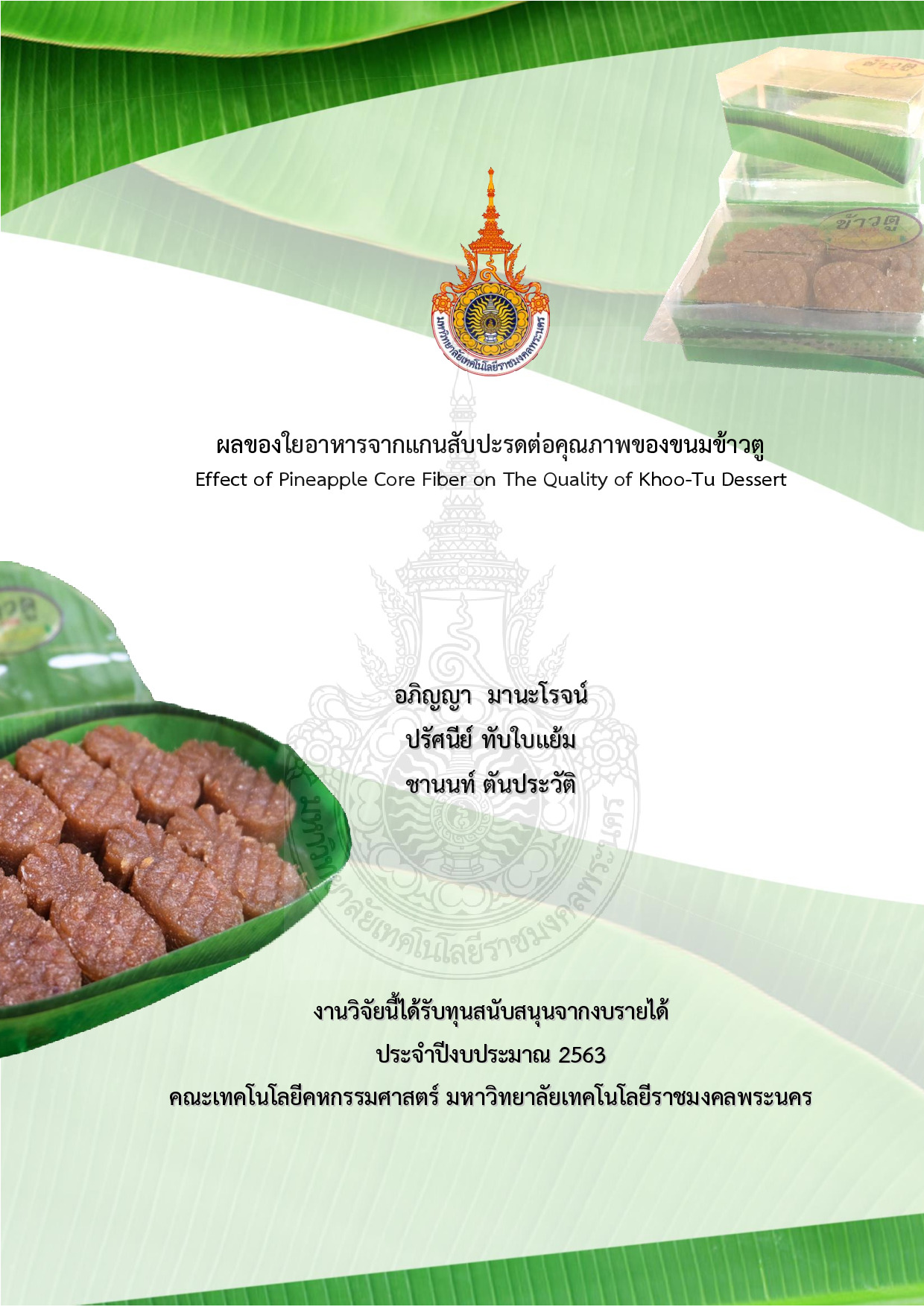
ผลของใยอาหารจากแกนสับปะรดต่อคุณภาพของขนมข้าวตู
These research objectives are to study the basic formulas of Khoo-Tu dessert (dried rice balls made from rice and coconut) and to study the volume of pineapple cores instead of coconut in Khoo-Tu. The test of Khoo-Tu dessert basic formulas by 9 - point hedonic scale method of 50 examiner laboratory the results show acceptance rated on a moderate scale (7). After that substituting coconut with pineapple core the amount of 0 25 50 75 and 100 of the weight coconuts.It was found that at 75% of the substitution level the tasters evaluated the greatest acceptance (p> 0.05). The basic formulas had a pH of 6.24 the Pineapple core formulas 5.94 (p> 0.05). Water Activity (aw)of Khoo-Tu the basic formula was 0.85 and the pineapple core formula was 0.90 (p> 0.05). The color value of the pineapple core Khoo-Tu was L * (brightness value) (37.31) b * (yellowness value) (9.45) rather than the basic formula Khoo-Tu (p> 0.05). The nutritional value of the pineapple core Khoo-Tu was 316 Kcals protein 2.71 % fat 8.86 % ash 0.52 % carbohydrates 56.3 % dietary fiber 3.99 % insoluble fiber 3.60 % and 0.39% of water-soluble dietary fiber that was found in the pineapple core Khoo-Tu to provide lower nutritional value than basic formula Khoo-Tu. The microbiological quality of basic formula and pineapple core formula was found that the total variable count fungi and bacillus serous were less than 10 colonies / 1 g sample and staphylococcus aurias were not found in both samples. The shelf life of rice (Room temperature) found that the basic recipe was 12 days and the pineapple core recipe It has a shelf life of 6 days. At chilled temperature (4 degrees Celsius) it was found that the basic formula and pineapple core formula had a shelf life of 25 days with all microorganisms less than 1 x 10⁴ colonies/sample 1 gram fungus less than 100 colonies /1 gram sample and All microorganisms and fungi exceeded the standard on the 28th day.