จำนวน Repository ( 580 )
การพัฒนาผลิตภัณฑ์ขนมกลีบลำดวนปราศจากกลูเตนจากแป้งลูกเดือย
The purposes of this study were 1) to study the basic recipe of Khanom Gleeb- Lamduan. 2) To study the types of Job’s Tears flour used as a substitute for wheat flour in the recipe of Khanom Gleeb-Lamduan. 3) To study the quantity of supplemented xanthan gum was studied in the recipe of Khanom Gleeb-Lamduan from Job’s Tears flour to improve texture. 4) To study the chemical composition of Khanom Gleeb-Lamduan from Job’s Tears flour. The results of the sensory quality evaluation with a 9-point Hedonic scale favorability score by 30 taste panelists found that the basic formula of Khanom Gleeb-Lamduan that was selected contained 55% of the ingredients including wheat flour soybean oil and icing sugar 27.50% and 17.50% respectively. The results of a study on the type of Job’s Tears flour suitable for substitute for wheat flour for the development of gluten-free Khanom Gleeb- Lamduan recipe. It was found that Khanom Gleeb-Lamduan made from dried milled job’s Tears flour had a higher score on the tasters favor than that made from commercial milled Job’s Tears flour and boiled Job’s Tears flour (p≤0.05). Tasters rated their preference for Khanom Gleeb-Lamduan from Jobs Tears flour with added xanthan gum to improve texture characteristics in the amount of 1% of millet flour preferring it over Khanom Gleeb-Lamduan with Jobs Tears flour added at the rate. 0.5% and at a rate of 2%. Khanom Gleeb-Lamduan had average liking scores in terms of appearance color smell taste texture (crusty) and overall liking was 7.33 7.40 7.86 7.53 7.76 and 8.10 respectively which were in moderate to high liking level. The approximate chemical composition of 100 g of Khanom Gleeb-Lamduan from JobsbTears flour contains 6.75 g of protein 27.46 g of fat 2.64 g of moisture 62.21 g of carbohydrates 0.94 g of ash and 522.98 kcal of energy which is similar to that of the basic recipe of Khanom Gleeb-Lamduan using wheat flour but it has a higher ash content than the basic formula. This is because Jobs Tears contains high amounts of many minerals. Khanom Gleeb-Lamduan from Jobs Tears flour is therefore a healthy snack for general consumers. In particular consumers with gluten intolerance can also eat it.
การพัฒนาผลิตภัณฑ์พานาคอตต้าน้ำนมธัญพืชเสริมซอสสับปะรดภูเก็ต
The objectives of this research were to 1) select a basic cereal formula suitable for milk production from cereals. 2) Study the appropriate amount of sugar used in the development of panna cotta formula from cereal milk. 3) Study the appropriate amount of sweetener (erythritol) in the Phuket pineapple sauce recipe. 4) Study the proper ratio of Phuket pineapple sauce for topping on cereal milk panna cotta. 5) Study the nutritional value of panna cotta Topped with Phuket pineapple sauce. The sensory quality was assessed using a 9-point liking score (9 - Point Hedonic Scale) tasting method. It was found that 1) the tasters accepted the grain ingredients used in the production of cereal milk formula containing 500 g of corn. and millet soybean mung bean black bean red bean and white bean using the same amount of 50 g of each type. 2) The tasters accepted the ratio of 10% sugar to the ingredients in the cereal milk panna cotta recipe. 3) The tasters recognized the use of 6% erythritol of pineapple in the Phuket pineapple sauce recipe. 4) The tasters recognized the ratio of Phuket pineapple sauce in the cereal milk panna cotta recipe of 1: 2 or the amount of 10g of sauce for topping 20g of panna cotta per cup. The scores of liking for appearance color smell taste texture and overall liking were 8.2 8.07 7.77 8.27 8.00 and 8.30 respectively which were in a high level of liking. 5) The nutritional value of basic panna cotta panna cotta from cereal milk formula and panna cotta from cereal milk with Phuket pineapple sauce formula had protein content of 3.17% 2.54% and 2.79 % respectively. Carbohydrates were found to be 27.44% 16.03% and 21.63% respectively. Fat content were 8.17% 0.44% and 0.27% respectively and fiber were 0.00% 0.55% and 0.71% respectively. Therefore cereal milk panna cotta topped with Phuket pineapple sauce recipe is suitable for the health-conscious consumers due to its reduced fat content and in Phuket pineapple sauce using erythritol as a sweetener grammar the energy of nutrients. It is also suitable for consumers who are allergic to milk as it does not contain cows milk and also has good nutritional value.
การพัฒนาผลิตภัณฑ์เนื้อสัตว์เทียมจากถั่วเสริมรากบัว
The objectives of this study were 1) to study the basic formula of Bean-Based Meat Analogue Products Supplemented. 2) To study the appropriate amount of lotus root utilization as supplementation in bean-based meat analogue products and to study the nutritional value of bean-based meat analogue products supplemented with lotus root. 3) To study the acceptance of bean-based meat analogue products supplemented with lotus root. 4) To study the consumer acceptance of bean-based meat analogue products recipes supplemented with lotus root. The results showed that the basic formulation of bean-based meat analogue in the recipe 2 which contains 50 grams of soybeans 60 grams of green peas 40 grams of white beans 10 grams of shiitake mushrooms and 5 grams of beetroot was the most accepted by 5 experts. The results of sensory evaluation showed that lotus root supplementation in a 10% bean-based meat analogue formulation was statistically significantly higher than that of 5% 15% and 20% lotus root supplementation (p≤.05). The results of the calculation by software package showed that the amount of dietary fiber in the basic formula was 15.56 gram which was lower than the formula that supplemented with lotus root. The amount of protein in the basic formula was 41.40 grams which was lower than the lotus root fortified formula. The results of a consumer acceptance test of 30 people using the 9-Point Hedonic Scale rating method showed that the majority of consumers liked the shape and color. As for the taste smell texture and overall liking it was at a moderate level of acceptance and 93.33% accepted the bean-based
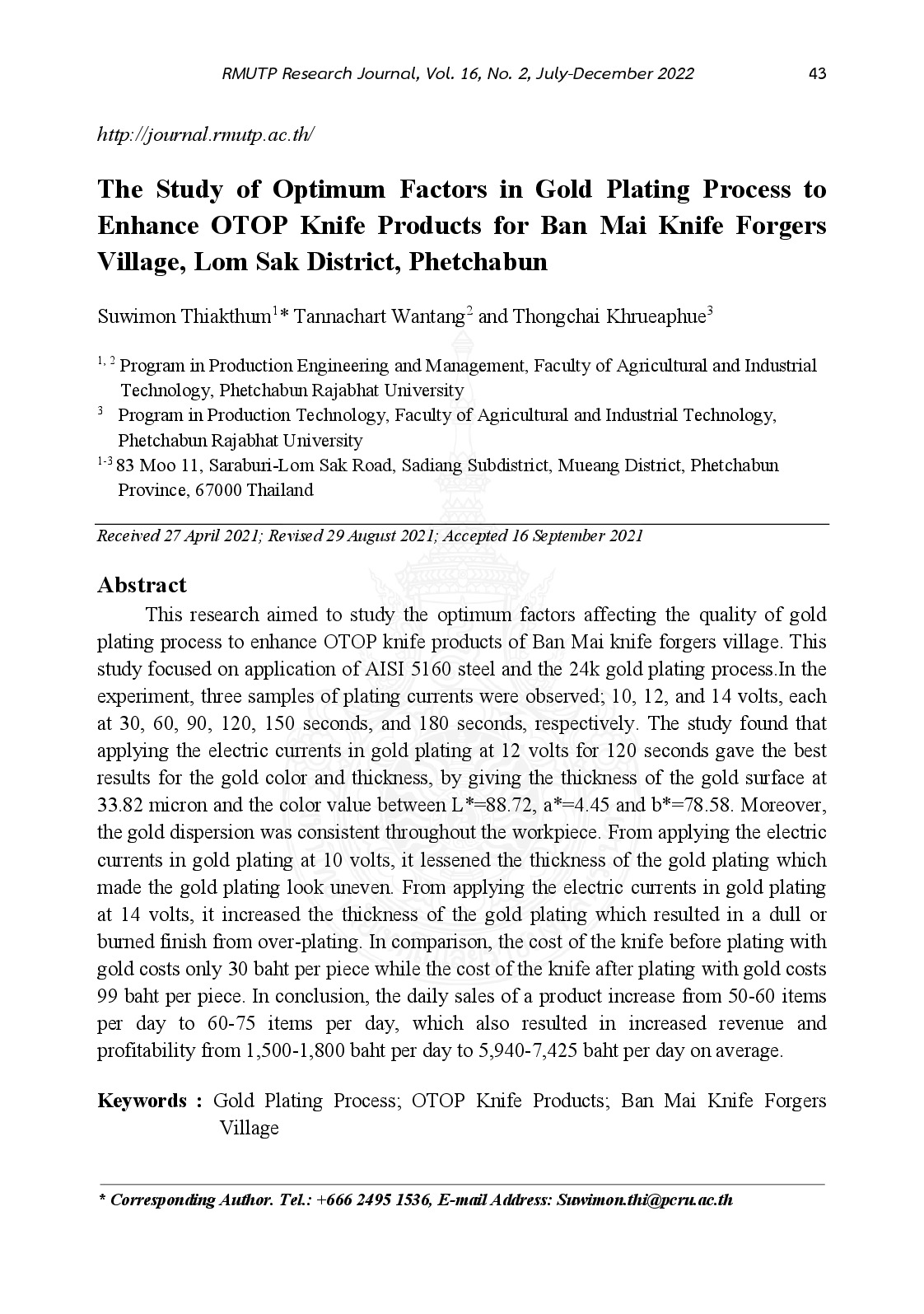
The study of optimum factors in gold plating process to enhance OTOP knife products for ban mai knife forgers village, Lom Sak district, Phetchabun
This research aimed to study the optimum factors affecting the quality of gold plating process to enhance OTOP knife products of Ban Mai knife forgers village. This study focused on application of AISI 5160 steel and the 24k gold plating process.In the experiment three samples of plating currents were observed; 10 12 and 14 volts each at 30 60 90 120 150 seconds and 180 seconds respectively. The study found that applying the electric currents in gold plating at 12 volts for 120 seconds gave the best results for the gold color and thickness by giving the thickness of the gold surface at 33.82 micron and the color value between L*=88.72 a*=4.45 and b*=78.58. Moreover the gold dispersion was consistent throughout the workpiece. From applying the electric currents in gold plating at 10 volts it lessened the thickness of the gold plating which made the gold plating look uneven. From applying the electric currents in gold plating at 14 volts it increased the thickness of the gold plating which resulted in a dull or burned finish from over-plating. In comparison the cost of the knife before plating with gold costs only 30 baht per piece while the cost of the knife after plating with gold costs 99 baht per piece. In conclusion the daily sales of a product increase from 50-60 items per day to 60-75 items per day which also resulted in increased revenue and profitability from 1500-1800 baht per day to 5940-7425 baht per day on average.
การผลิตก๊าซชีวภาพจากวัสดุเศษเหลือทางการเกษตร โดยระบบหมักไร้อากาศแบบแห้ง สำหรับครัวเรือนในชุมชนตำบลเกาะขันธ์ จังหวัดนครศรีธรรมราช
This research was studied and transferred the biogas production technology with the community participation using anaerobic dry fermentation system from agricultural residues. The production of renewable energy for replacing LPG in household cooking of Koh Khan Sub-district community Cha-Uat District Nakhon Si Thammarat Province was carried out. The efficiency of the biogas production from different co-digestion material with fresh cow manure was studied for 45 days. The experiment 1 bananas and papaya and the experiment 2 rice straw and coconut meal were used for fermented materials. It was found that the system using rice straw and coconut meal as a fermented material had a higher potential than using bananas and papaya. The system produced averaged biogas of 150 L/d and an average methane content of 67.68% respectively within just 15 days after start-up. While bananas and papaya as fermented materials took more time with more than 30 days after start-up the system. The system produced averaged biogas of 120 L/d and an average methane content of 64.64%. For usability test It was found that 150 L of biogas could continuously cook for 45-60 minutes. The 85% of the technology transfer recipients regarded that the knowledge gained as practical and reduced household expenditures. Additionally the system can produce biogas for a long time without adding new fermented materials. Therefore this biogas system could be applied to local agricultural waste for biogas production which can be expanded to other areas.