จำนวน Repository ( 126 )
การผลิตก๊าซชีวภาพจากวัสดุเศษเหลือทางการเกษตร โดยระบบหมักไร้อากาศแบบแห้ง สำหรับครัวเรือนในชุมชนตำบลเกาะขันธ์ จังหวัดนครศรีธรรมราช
This research was studied and transferred the biogas production technology with the community participation using anaerobic dry fermentation system from agricultural residues. The production of renewable energy for replacing LPG in household cooking of Koh Khan Sub-district community Cha-Uat District Nakhon Si Thammarat Province was carried out. The efficiency of the biogas production from different co-digestion material with fresh cow manure was studied for 45 days. The experiment 1 bananas and papaya and the experiment 2 rice straw and coconut meal were used for fermented materials. It was found that the system using rice straw and coconut meal as a fermented material had a higher potential than using bananas and papaya. The system produced averaged biogas of 150 L/d and an average methane content of 67.68% respectively within just 15 days after start-up. While bananas and papaya as fermented materials took more time with more than 30 days after start-up the system. The system produced averaged biogas of 120 L/d and an average methane content of 64.64%. For usability test It was found that 150 L of biogas could continuously cook for 45-60 minutes. The 85% of the technology transfer recipients regarded that the knowledge gained as practical and reduced household expenditures. Additionally the system can produce biogas for a long time without adding new fermented materials. Therefore this biogas system could be applied to local agricultural waste for biogas production which can be expanded to other areas.
The Dietary effects on manure characteristics and biogas production from dairy cows feeding with pineapple peel
This study explored the dietary effect on manure characteristics and potential of biogas production from the manure of dairy cows feeding with pineapple peel as a roughage source. Three mid-lactation primiparous crossbred Holstein dairy cows which had an average body weight of 443.5±10.6 kg and average milk production of 9.6±0.3 kg/d were assigned with three different diet types including T1 T2 and T3. T1 was a control diet which consisted of a mixture of dry Pangola grass and commercial pellet (CL). Moreover T2 was a mixture of dry Pangola grass pineapple peel and CL while T3 was a mixture of pineapple peel and CL. Dairy cow manure was collected on the day 10th after feeding and anaerobic digestion of the dairy cow manure was operated with an HRT of 30 days. Results showed that all diet types gave similar manure characteristics of high organic matter and nitrogen. Average concentrations of TS and COD ranged from 82.59 to 85.78 g/L and 85.47 to 91.47 g/L respectively whereas TAN ranged from 1.54 to 1.67 g/L. However a higher pH of 7.50 was found for the manure of dairy cow fed with T1 while a lower pH of 6.50 was obtained with T3. Besides the highest methane yield of 0.20 m3 CH4/kg VSadded was obtained when using the manure of dairy cow fed with T1 as a substrate followed by T2 and T3 which found at 0.14 and 0.11 m3 CH4/kg VSadded respectively. This indicated the efficient potential of biogas production from the manure of dairy cows fed with pineapple peel which will improve sustainable utilization of agricultural wastes and waste produced from dairy cow farm in the future.
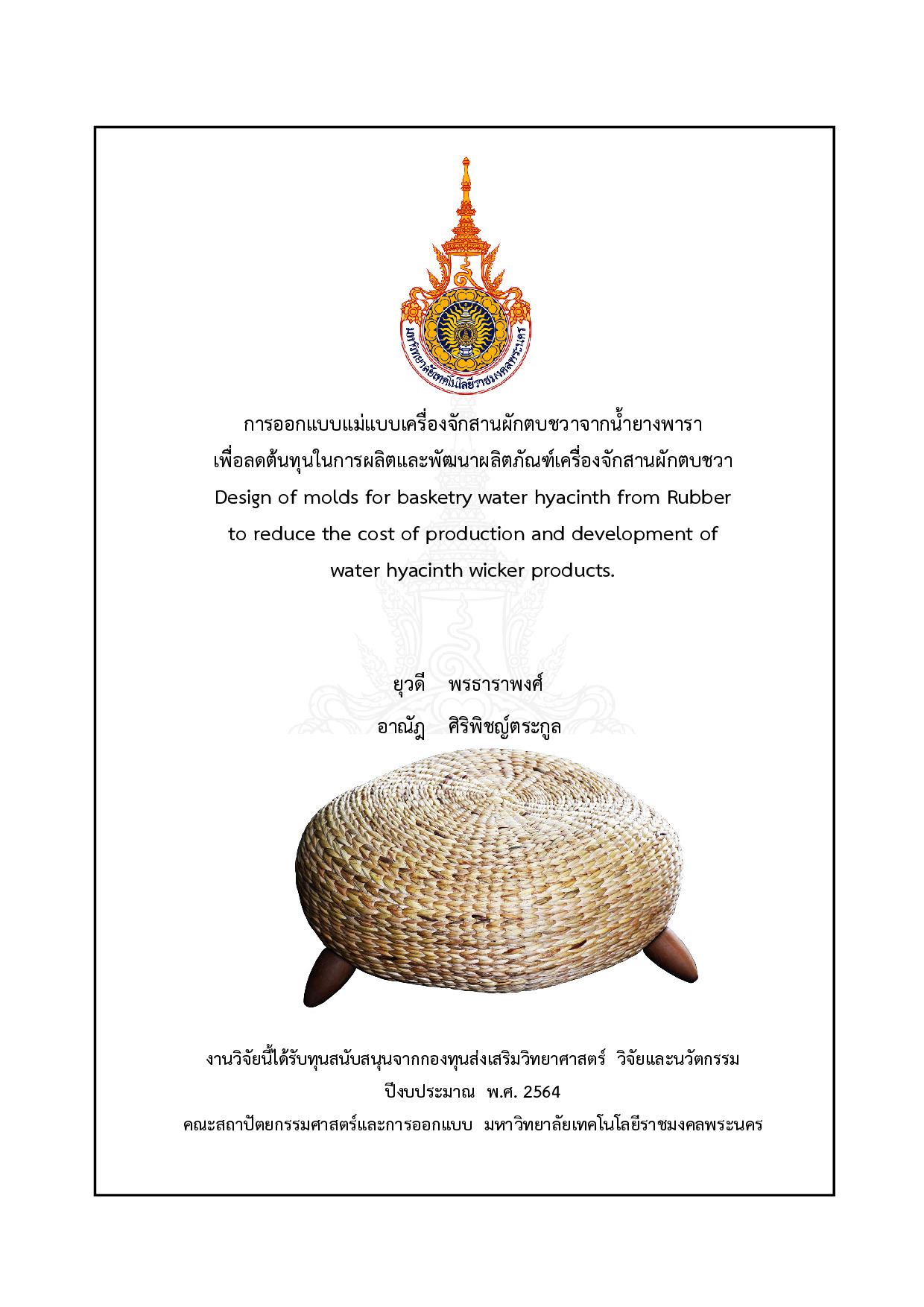
การออกแบบแม่แบบเครื่องจักสานผักตบชวาจากน้ำยางพาราเพื่อลดต้นทุนในการผลิตและพัฒนาผลิตภัณฑ์เครื่องจักสานผักตบชวา
The objectives of this research were 1) to study the design and experiment of materials for producing water hyacinth basketry templates from para rubber 2) to test the water hyacinth basketry templates from para rubber 3) to create a body of knowledge in the development of water hyacinth basketry templates. from rubber latex to the community The process of operation is to design the shape of a water hyacinth basketry to suit the use of the product first after that create a water hyacinth basketry template from para rubber by experimenting with a formula mixed with natural rubber latex and experiment with weaving vegetables. water hyacinths to find the best techniques and styles Results from research on the design of water hyacinth wicker templates from rubber latex and testing of water hyacinth wicker template designs from rubber latex. The aim is to invent materials to solve the problem of replacing the old wicker template. From the research it was found that the water hyacinth basketry model was made from rubber latex. There are two techniques for creating new templates: removable templates and removable templates. and non-removable templates Removable latex coated wicker template can produce many pieces easy to weave The wicker template part is coated with rubber latex. Non-removable or weave cover It can be used to weave as a furniture product with the properties that were discovered that it has a long service life. It is durable strong and durable. Flexibility to reduce shock during weaving. and can be a tool in the profession Can reduce the cost of producing water hyacinth handicrafts Model development part There is a design template for water hyacinth basketry which is a water hyacinth wicker product that has a shape that is exotic modern beautiful and useful according to the products unique characteristics and is a valuable work that can decorate the house beautifully.
ทิศทางการพัฒนาศักยภาพชุมชนผลิตขนมหวานไปสู่แหล่งท่องเที่ยวอย่างยั่งยืนในจังหวัดเพชรบุรี
The study of Direction of the Potential Development Community of a Confectionery Production into the Sustainable Tourism in Phetchaburi Province aimed to study: The study of Direction of the Potential Development Community of a Confectionery Production into the Sustainable Tourism in Phetchaburi Province employed qualitative research by collecting data from interview and focus group discussion. Data was analyzed using content analysis. The main informants were community leaders local people in Phetchaburi community officers administrators sub-district administration organization. The results of this research showed that 1. This community has been empowered and also received many awards from government agencies and private sectors but there are tourism developments concerned which are the lack of cooperative from local people and academies including the shortage of staff officers for tourism promoting. 2. There are 3 process guidelines to develop the community into a potential tourism community which are 1) Encouraging people in the community to get involve with organizing confectionery tourism attractions which will be overseen by Sub-district administrations organization’s management operation responsibilities and evaluation. 2) Providing community of confectionery tourism roadmap to promote confectionery learning center confectionery festival along with setting up traditions which will symbolize the uniqueness of the community. 3) Educating youth and community members to be able to guide and show tourists around their community helping tourists to learn and to know more about the uniqueness of confectionery community to make the community more recognizable.
การผลิตวัสดุปรับปรุงดินจากเศษอาหารและผักตบชวาด้วยกรรมวิธีดีไฮเดรชั่น
The purpose of this study is to produce the soil improvement materials from food waste and water hyacinth by using a dehydration process. The experiments were divided into two parts : 1) the study of the optimum temperature and time for converting food waste and water hyacinths to soil improvement materials by determining the temperatures of 100 °C 150 °C and 200°C in the periods of 1 hour 2 hours and 3 hours respectively 2) the study of nutrient content in the materials before and after mixing into the soil for 5 days. The soil used in the experiment was sampled from Sai Ma Subdistrict Nonthaburi Province. The parameters used to evaluate the ability to improve the soil quality were soil moisture pH electro conductivity total nitrogen total phosphorus total potassium and organic matter. The results showed that the optimum temperature for drying the food waste was 150°C for 2 hours and the optimum temperature for drying the water hyacinth was 200°C for 3 hours. When the materials were mixed into soil it found that the soil drainage was improved. Mixing the materials into soil could increase the pH value from 5.2 to 5.4 and increase the electrical conductivity from 0.72 mS/cm to 14.78 mS/cm. Besides the plant nutrients including Nitrogen phosphorus and potassium also increased after adding soil improvement materials.