จำนวน Repository ( 2 )

Effects of water content and cooking time on chemical composition structureand properties of germinated purple rice (oryza sativa var. glutinosa) flour
The purpose of this research is to estimate the affects of water content (27 37 and 47 % wet basis) cooking time (1 3 and 5 hr) at 110oC and germinating time (24 36 and 48 hr) on chemical composition structure and properties of germinated purple rice flour. A Box-Behnken design under the response surface methodology was performed to optimize their composition. Rajamangala University of Technology Lanna Nan was research place. Results demonstrated that germinating time had no significantly effect on protein and lipid content but resulted in increasing crude fiber and decreasing carbohydrate and amylose content with increase in germinating time. Scanning electron micrographs (SEM) revealed the presence of polyhedral shape and agglomerations. Birefringence was evidenced. Pasting properties of germinated purple rice flour showed an increase in the pasting temperature but a decrease the peak viscosity breakdown final viscosity and setback (p<0.05) as germinating time increased. Modified rice flour were increase in carbohydrate and amylose content and decrease in protein lipid ash and fiber as water content and cooking time at 110oC increased. Change in birefringence of starch granule after heating at 110oC was examined by a polarized light microscope. SEM showed the presence of creak surfaces and agglomerations. The swelling power of germinated purple rice flour decreased with increase in cooking time. The solubility at 85oC of germinated purple rice flour was increased in each level of water content.
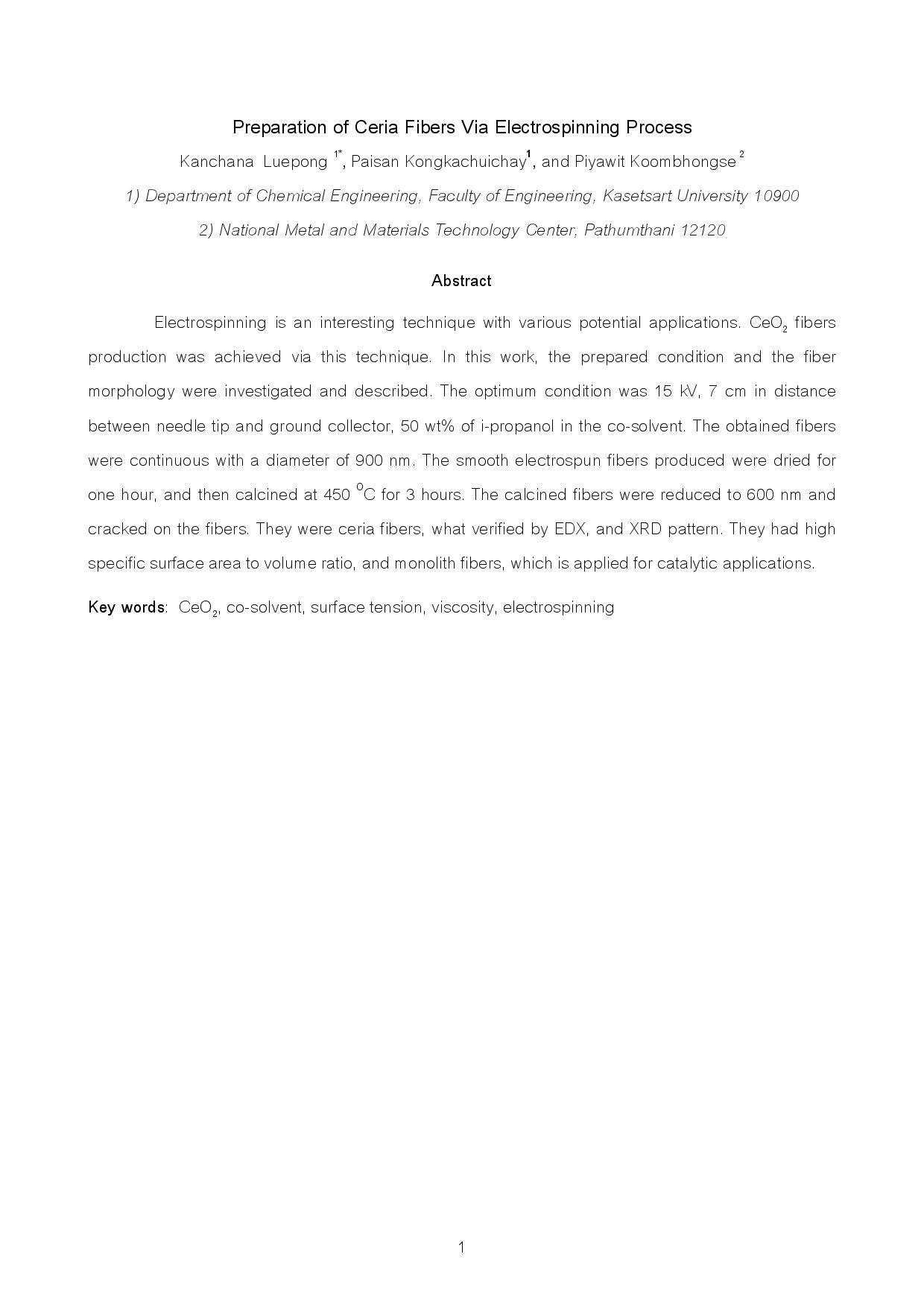
Preparation of Ceria Fibers Via Electrospinning Process
Electrospinning is an interesting technique with various potential applications. CeO2 fibers production was achieved via this technique. In this work the prepared condition and the fiber morphology were investigated and described. The optimum condition was 15 kV 7 cm in distance between needle tip and ground collector 50 wt% of i-propanol in the co-solvent. The obtained fibers were continuous with a diameter of 900 nm. The smooth electrospun fibers produced were dried for one hour and then calcined at 450 OC for 3 hours. The calcined fibers were reduced to 600 nm and cracked on the fibers. They were ceria fibers what verified by EDX and XRD pattern. They had high specific surface area to volume ratio and monolith fibers which is applied for catalytic applications.