จำนวน Repository ( 7 )
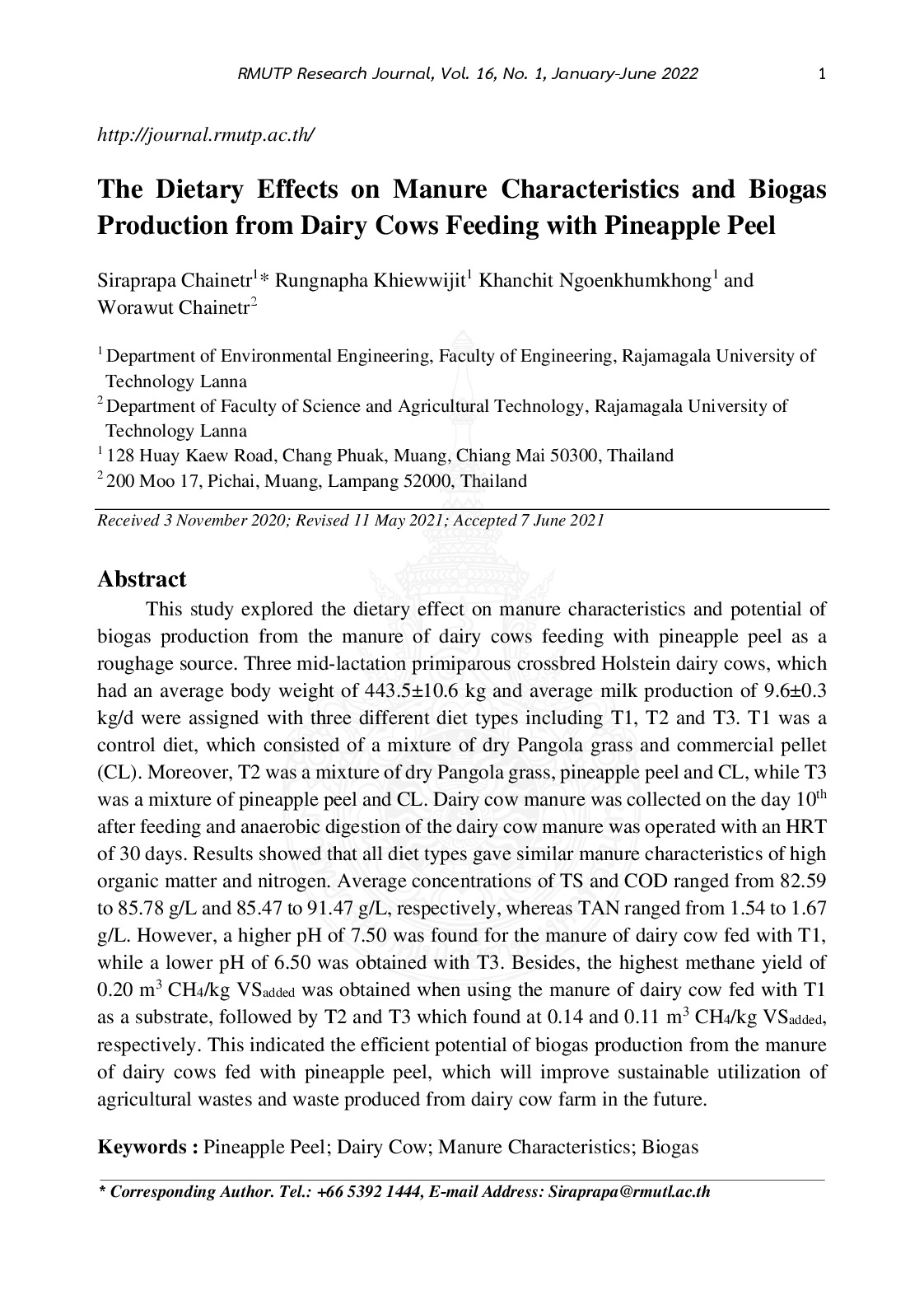
The Dietary effects on manure characteristics and biogas production from dairy cows feeding with pineapple peel
This study explored the dietary effect on manure characteristics and potential of biogas production from the manure of dairy cows feeding with pineapple peel as a roughage source. Three mid-lactation primiparous crossbred Holstein dairy cows which had an average body weight of 443.5±10.6 kg and average milk production of 9.6±0.3 kg/d were assigned with three different diet types including T1 T2 and T3. T1 was a control diet which consisted of a mixture of dry Pangola grass and commercial pellet (CL). Moreover T2 was a mixture of dry Pangola grass pineapple peel and CL while T3 was a mixture of pineapple peel and CL. Dairy cow manure was collected on the day 10th after feeding and anaerobic digestion of the dairy cow manure was operated with an HRT of 30 days. Results showed that all diet types gave similar manure characteristics of high organic matter and nitrogen. Average concentrations of TS and COD ranged from 82.59 to 85.78 g/L and 85.47 to 91.47 g/L respectively whereas TAN ranged from 1.54 to 1.67 g/L. However a higher pH of 7.50 was found for the manure of dairy cow fed with T1 while a lower pH of 6.50 was obtained with T3. Besides the highest methane yield of 0.20 m3 CH4/kg VSadded was obtained when using the manure of dairy cow fed with T1 as a substrate followed by T2 and T3 which found at 0.14 and 0.11 m3 CH4/kg VSadded respectively. This indicated the efficient potential of biogas production from the manure of dairy cows fed with pineapple peel which will improve sustainable utilization of agricultural wastes and waste produced from dairy cow farm in the future.

ปัจจัยส่วนประสมทางการตลาดบริการที่มีอิทธิพลต่อความพึงพอใจของ ผู้บริโภคในการเลือกใช้บริการธุรกิจออฟฟิศร่วมแบ่งปันในกรุงเทพมหานคร
The purpose of this research was to study personal factors and service marketing mix factors affecting consumer satisfaction towards co-working space in Bangkok. This research combined a research methodology between quantitative and qualitative research with tools for data collection including survey and in-depth interviews. Quantitative data was obtained from a survey of 400 samples using coworking space in Bangkok. Qualitative data was obtained by the use of in-depth interview with consumer manager and coworking space specialist. The results showed that the personal factors affecting consumer satisfaction towards coworking space in Bangkok were mainly 1) ages between 25 - 30 years old at 44.25% 2) private employees at 53.00% 3) average monthly salary 20001 to 30000 baht at 42.75% and 4) usage frequency 1 - 2 times per week at 37.25%. Service marketing mix factors affecting consumer satisfaction towards coworking space in Bangkok were 1) product (mean 4.22) and 2) physical evidence and presentation (mean 4.37) at the .05 statistical significance level.
การพัฒนาอุปกรณ์สวมใส่เพื่อเก็บข้อมูลการเคลื่อนไหวของวัวโดยใช้เทคโนโลยี ไอโอที
This project presents the development of wearable device for logging cow behavior using IoT technology. This project aims to develop the device that can collect the cow’s behavior and to identify the current position of cow. The accelerometer and ultrasonic sensors are used to measure walking behavior and sitting behavior respectively. The current position of cow is measured by GPS module. The measured data will be shown and stored in IoT platform. According to the experiments the developed systems can measure the behavior properly with human acting as a cow. Moreover the developed system can show the current position of the cow and message when the cow is out of area. In the future it is planned to implement the developed system with the actual cow in real situation
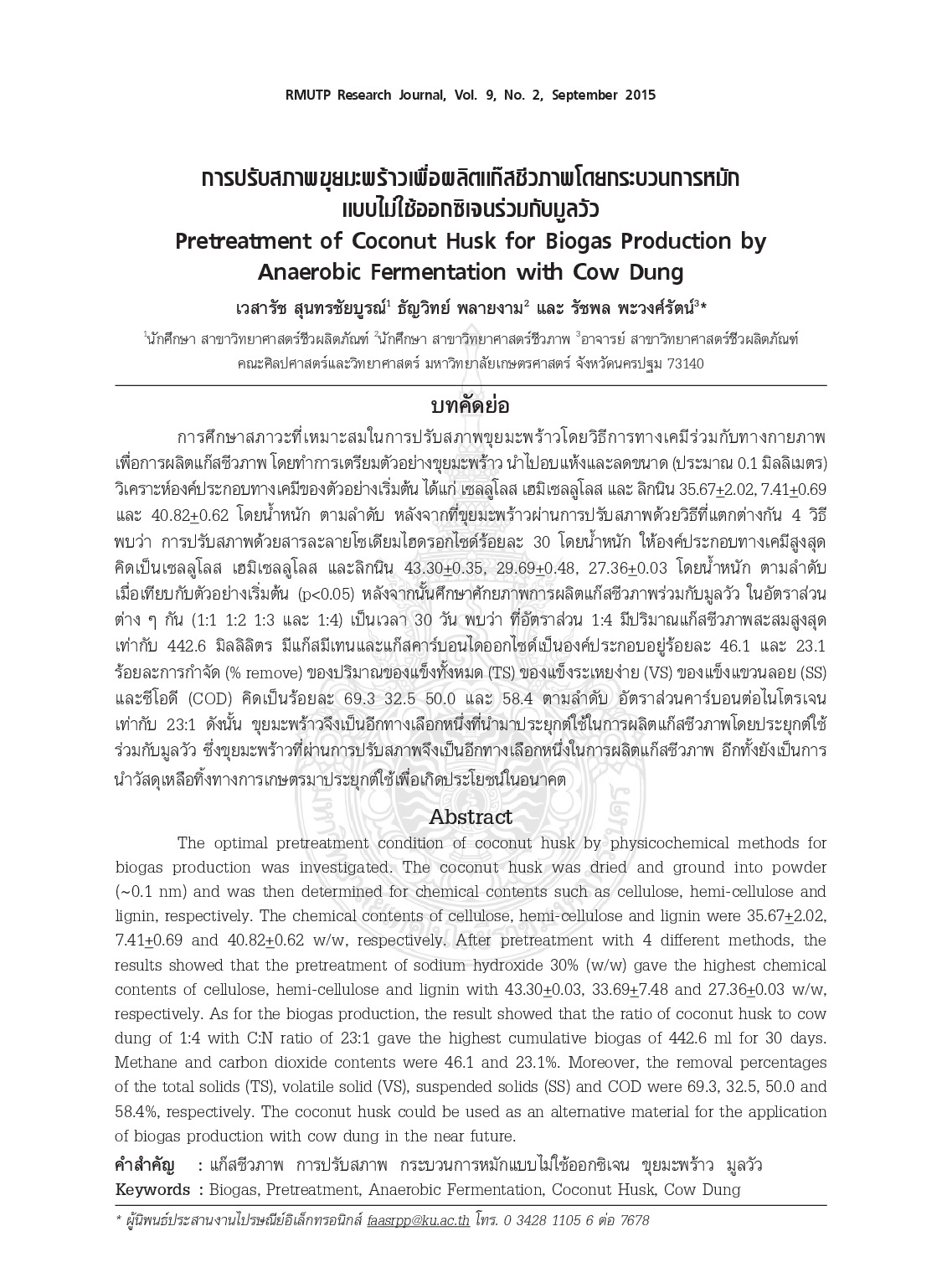
การปรับสภาพขุยมะพร้าวเพื่อผลิตแก๊สชีวภาพโดยกระบวนการหมักแบบไม่ใช้ออกซิเจนร่วมกับมูลวัว
The optimal pretreatment condition of coconut husk by physicochemical methods for biogas production was investigated. The coconut husk was dried and ground into powder (~0.1 nm) and was then determined for chemical contents such as cellulose hemi-cellulose and lignin respectively. The chemical contents of cellulose hemi-cellulose and lignin were 35.67±2.02 7.41±0.69 and 40.82±0.62 w/w respectively. After pretreatment with 4 different methods the results showed that the pretreatment of sodium hydroxide 30 % (w/w) gave the highest chemical contents of cellulose hemi-cellulose and lignin with 43.30±0.03 33.69±7.48 and 27.36±0.03 w/w respectively. As for the biogas production the result showed that the ratio of coconut husk to cow dung of 1:4 with C:N ratio of 23:1 gave the highest cumulative biogas of 442.6 ml for 30 days. Methane and carbon dioxide contents were 46.1 and 23.1 %. Moreover the removal percentages of the total solids (TS) volatile solid (VS) suspended solids (SS) and COD were 69.3 32.5 50.0 and 58.4 % respectively. The coconut husk could be used as an alternative material for the application of biogas production with cow dung in the near future.
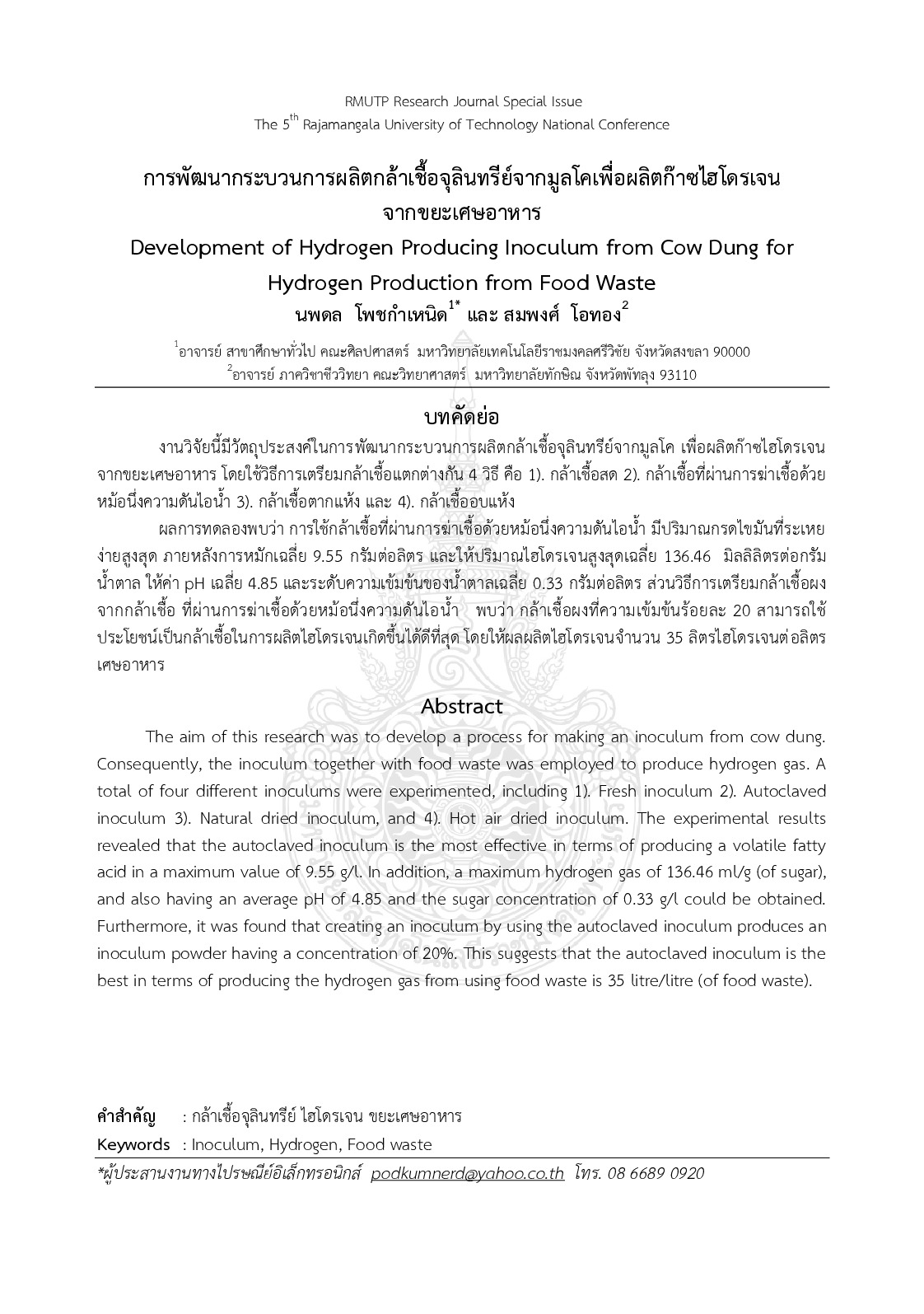
Development of hydrogen producing inoculum from cow dung for hydrogen production from food waste
The aim of this research was to develop a process for making an inoculum from cow dung. Consequently the inoculum together with food waste was employed to produce hydrogen gas. A total of four different inoculums were experimented including 1). Fresh inoculum 2). Autoclaved inoculum 3). Natural dried inoculum and 4). Hot air dried inoculum. The experimental results revealed that the autoclaved inoculum is the most effective in terms of producing a volatile fatty acid in a maximum value of 9.55 g/l. In addition a maximum hydrogen gas of 136.46 ml/g (of sugar) and also having an average pH of 4.85 and the sugar concentration of 0.33 g/l could be obtained. Furthermore it was found that creating an inoculum by using the autoclaved inoculum produces an inoculum powder having a concentration of 20%. This suggests that the autoclaved inoculum is the best in terms of producing the hydrogen gas from using food waste is 35 litre/litre (of food waste).