จำนวน Repository ( 6 )
การบำบัดน้ำสีย้อมผ้าโดยกระบวนการแอดวานซ์ออกซิเดชันด้วยโอโซน ร่วมกับสารไฮโดรเจนเปอร์ออกไซด์
This research is a study on treatment of Water Dyes from textile dyeing industry by Advance oxidation process with Ozone and hydrogen peroxide (H2O2). In this study Ozone generators with a capacity of 1.0 - 3.0 mg/ hr. were used to study the appropriate factors for treatment with adjusting wastewater conditions (pH 3 pH 7 and pH 11) Ozone exposure distance 120 minute the initial COD concentration is 250 - 1000 mg/l. and adding hydrogen peroxide at 4 8 and 12 ml/l. For the study found that above mentioned factors have an effect on the efficacy of color and COD treatment which the experiment at pH 11 used to Ozone treatment and added 4 ml/l. of H2O2. It makes the highest COD treatment efficiency when compared to pH 3 pH 7 and added more H2O2. it doesn’t affect to the higher of treatment efficiency. In addition it was found that higher initial COD concentration decreased treatment efficiency which the experimental ability for COD treatment has highest value was 46 percent and the COD concentration was 250 ml/l In order that when COD concentration in synthetic color water was increased to 500 ml/l and 1000 ml/l. it was found that the COD efficiency decreased to 31% and 40% respectively. For the treatment of Water Dyes from textile dyeing industry by oxidation process with Ozone together with hydrogen peroxide (H2O2) at pH 7 will has the highest of treatment efficiency. However the consideration of suitability for pH configuration used to treat both color and COD should choose pH 11 because it can treat both color and COD that makes the waste water quality meet the standards required by law. In addition if we consider the effectiveness of turbidity and BOD found that the decrease of dirtiness tends to be in the same direction with COD both 2 parameters.
การสร้างชุดเฝ้าระวังค่าความเป็นกรดเป็นเบสในน้ำแบบเวลาจริง
Nowadays the measurement technologies are continually growth in advanced. These can be seen in the developed and developing countries that research and develop the products which support the consumer behavior and/or country economy ic growth. However some advanced products are very expensive such as pH meter. Therefore this thesis develops the pH meter which allows the acid-base test of the water and it can be supported the agriculture. The proposed pH meter is included the pH pen sensor temperature sensor water level sensor. The proposed meter can measure the acid-base of the water by sending SMS alert signal via GSM module to the mobile phone of the farmer. As can be seen this thesis can prevent and solve the effect of the high acid-base of the water that possibly flows into the agriculture farm via using SMS alert signal of the mobile phone of the farmer.

Development of a hydrogen gas purifier for improving the quality of biogas in fermentation process
Hydrogen sulfide (H25 cheap materials activated carbon scraped iron sand cement and rice husks applied to the small scale biogas production at 30 ppm within 6 hours. The filter materials with highest to lowest H48.18 percent respectively. In the medium scale biogas production (20 L) at 30 ppm. Scraped iron and sand mixed with activated carbon filter had the best H(200 L) production of the biogas fermentation (30 ppm biogas product) sand mixed with activated carbon filter at the ratio 60:40 displayed the best performances in removing H2(3 day). It is the most environmental friendliness as well as cost-effective filter for biogas fermentation at scale up sizes at least 20 L. S) is found to be one major serious contaminant to biogas production system. In this research the team aimed to develop a high efficient filter for removing H2S from the biogas reaction. From all 2S absorptivity were activated carbon sand scraped iron and rice husks those accounted for 88.02 76.06 55 50 and 2S absorptivity (100 percent) and sand showed its H2S removal efficiency lower at 65 percent respectively. In larger scale S after incubated for 4.5 hours while scraped iron filter as well as activated carbon filter functioned in H2S removal longer time (2 and 3 days respectively). In order to be able to practically apply for continuous filtering H2S from the continuous biogas production sand mixed with activated carbon filter exhibited long last filtration
Dry reforming of methane reaction for hydrogen and syngas production using cobalt catalysts and nickel-cobalt bimetallic catalysts
The cobalt catalysts (cobalt content by weight: 7% 10% and 15%) and cobalt-nickel bimetallic catalysts (cobalt-nickel content by weight: 3.5%-3.5% 5%-5% and 7%-7%) were studied in dry reforming of methane for hydrogen and syngas production. All catalysts were synthesized by the wetness impregnation method. The dry reforming of methane was carried out at 700oC atmosphere pressure using a mixture; CH4 and CO2 in ratio 1:1. The result showed that the good activity and stability depend on metal content in catalysts and the combined 2 metals as bimetallic catalysts. The optimum amounts of catalysts are 10wt% Co for mono-metallic catalysts 75%CH4 and 75%CO2 conversion and 7wt% Ni-7wt% Co for bimetallic catalysts 87%CH4 and 89%CO2 conversion.
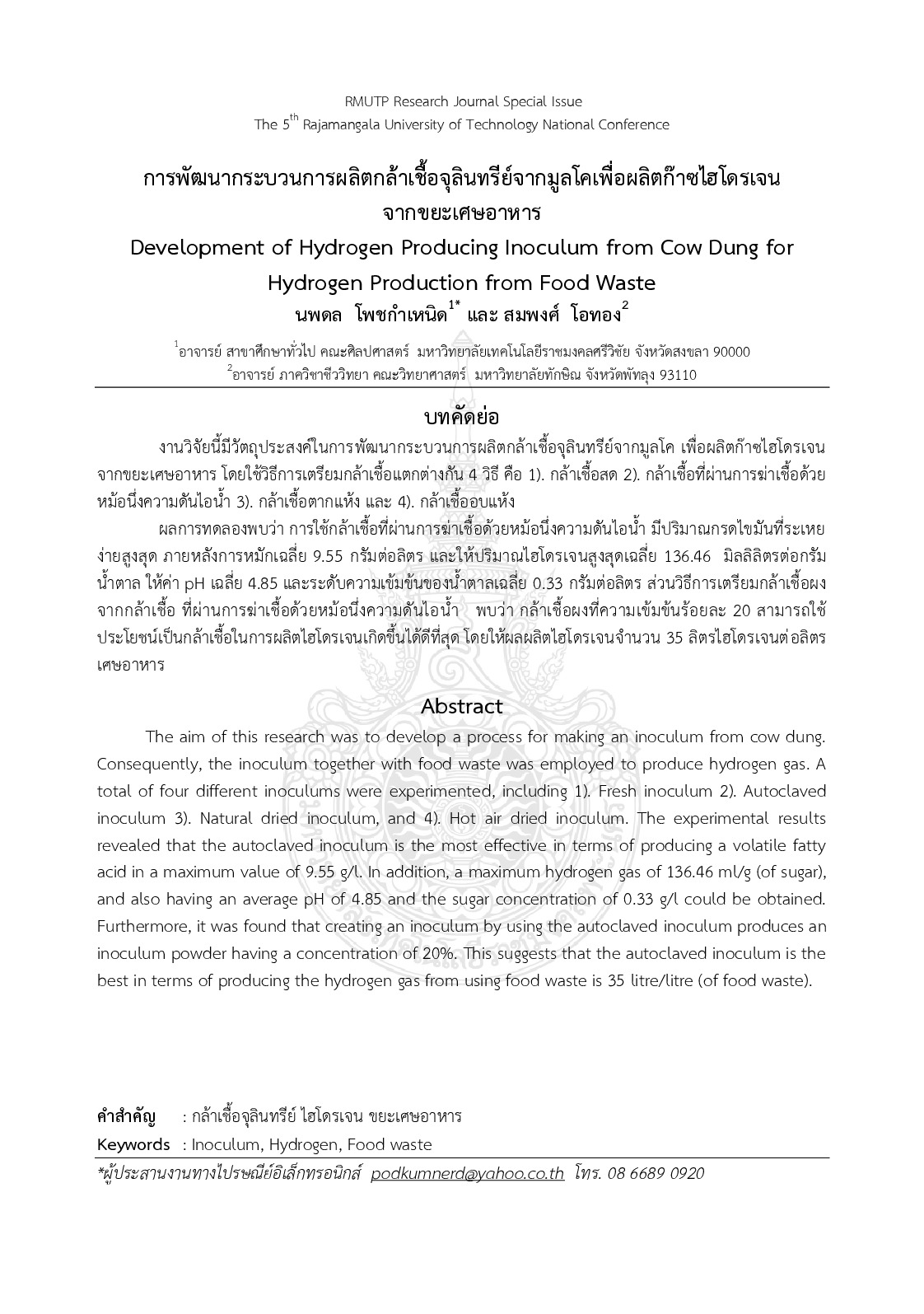
Development of hydrogen producing inoculum from cow dung for hydrogen production from food waste
The aim of this research was to develop a process for making an inoculum from cow dung. Consequently the inoculum together with food waste was employed to produce hydrogen gas. A total of four different inoculums were experimented including 1). Fresh inoculum 2). Autoclaved inoculum 3). Natural dried inoculum and 4). Hot air dried inoculum. The experimental results revealed that the autoclaved inoculum is the most effective in terms of producing a volatile fatty acid in a maximum value of 9.55 g/l. In addition a maximum hydrogen gas of 136.46 ml/g (of sugar) and also having an average pH of 4.85 and the sugar concentration of 0.33 g/l could be obtained. Furthermore it was found that creating an inoculum by using the autoclaved inoculum produces an inoculum powder having a concentration of 20%. This suggests that the autoclaved inoculum is the best in terms of producing the hydrogen gas from using food waste is 35 litre/litre (of food waste).