จำนวน Repository ( 136 )
การเพิ่มประสิทธิภาพกระบวนผลิตอุปกรณ์เครื่องใช้ไฟฟ้าโดยวิธีการจัดสมดุลสายการผลิต
This research aims to increasing efficiency in production and eliminate the problem of insufficient production capacity with respect to customer demand for electrical appliance factory by applying the line balancing method. Thus the study then developed two problem-solving approaches. The first approach is a method by which a firm applies the line balancing concept and ECRS technique (Eliminate Combine Rearrange and Simplify). On the contrary the second approach is required an investment in testing machine with value of 1000000 baht in order to support sufficient production capacity to meet customer demand. Also ECRS method is used to accomplish this process. Based on the results the first approach provided the production line efficiency improvement representing of 82.59% and reduced the labor cost of 277220 baht per year. However the loss of commercial opportunity has remained the same of 6336000 baht per year. Accordingly the second approach demonstrated of 92.11% of the production line efficiency improvement and the labor cost reduction valued of 277220 baht per year. As we expected the second approach satisfied production efficiency by eliminating the loss of commercial opportunity with value of 6336000 baht per year delivering a return of investment within two months.
ระบบควบคุมการเปิด-ปิดอุปกรณ์ไฟฟ้าด้วยเสียง
This abstract discussed the implementation of speech recognition applications to control the on-off electrical device of speech. The work is divided into two modes. Offline mode and online mode. To use voice commands to turn on-off electrical device. Which the words sound as a statement. The speech sounds in offline mode is saved in SOPARE voice and speech mode are saved online in Google Assistant via the microphone. Then process the Raspberry pi 3 board to send data to the wireless transceiver module to control the power on-off. From testing the control system for opening and closing electrical devices with sound it was found that the sound test in the offline mode of the power-on-off control system with sound the accuracy of 96 percent of the voice command and the accuracy of the lamp according to the voice command spoken 100 percent accuracy. Sound tests in the online mode of the power-on-off control system with sound the accuracy of 8 7 percent voice commands and the accuracy of the lamp according to the voice command spoken 100 percent accuracy. The power-on-off control system with sound. Can be used to effectively control the opening and closing of electrical equipment. Only the user speaks the voice commands as needed and can immediately turn on-off the electrical equipment. Helps reduce steps and shorten the time of use making it more convenient
ชุดสาธิตการผลิตไฟฟ้าด้วยพลังงานน้ำ
This project aims to create a series of demonstration power plant water. And the operation of the circuit Inverter split by the end of demonstration runs as follows. Theory and documents relating to the source of electrical power water power the working principle of the circuit. Inverter the principle of integrated battery charger main circuit voltage VDC LED LED SMD (Surface-Mounted-Device) a voltmeter. Ammeters digital LCD display couples. Make plans to offer advisors the project approved. Design demonstration kit Equipment supply and assembly Assembly and demonstration the production of electricity from hydropower 220 VAC test run is a series of demonstrations to generate electricity from water power to 220 VAC storage performance voltage and current output. And analyze the results of the operation of the demonstration production of electricity from hydropower 220 VAC and conclusions in this chapter are the results of the experiment demonstrated the production of electricity from hydropower and the conclusion of the trial in order to be used. effectiveness of the objectives of the experimental procedure the results can not load a load test. Test kits demonstration power plant and the demonstration set to produce 220 volts for 25 minutes at a constant voltage. The electricity does not increase or decrease. Always works The term of office is fixed or reduced by the ratio of active power increases.
การลดการดูดซับน้ำมันในผลิตภัณฑ์แห้วทอดด้วยเทคโนโลยีสนามไฟฟ้า
This research is studying of an electric field combine with a frying process in a Chinese water chestnut product for reducing oil absorb. An electric field that is used in an experiment will have a stress from 1-3 kV/cm. This will be generated by using a direct current high Voltage from 1066 to 3200 V. which is distributed to an electrode in an uniform and non-uniform of an electric field. This will have a dielectric barrier discharge. There is an analysis for finding a relationship of a moisture on absorbing oil of a Chinese water chestnut fried product due to a moisture has an effect on absorbing oil directly. From an experimental result this is found that the best electric field stress which will have an effect on reducing a moisture of a Chinese water chestnut is an non-uniform electric field form that is created from a direct current high voltage at 3200 V. and this will have an electric field stress at 3 kV/cm. This will have an average of a difference of a moisture at 0.6 g. This will select to use a direct current non-uniform electric field at 3 kV/cm. In an experiment combine with a fried process in a Chinese water chestnuts fried product this is done for reducing of absorbing oil. By this will fry at the temperature of 180๐C for 5 minutes. This is found that this can reduce an absorbing of oil best at 17.93% when this has compared to a Chinese water chestnuts fried that hasn’t passed an electric field.
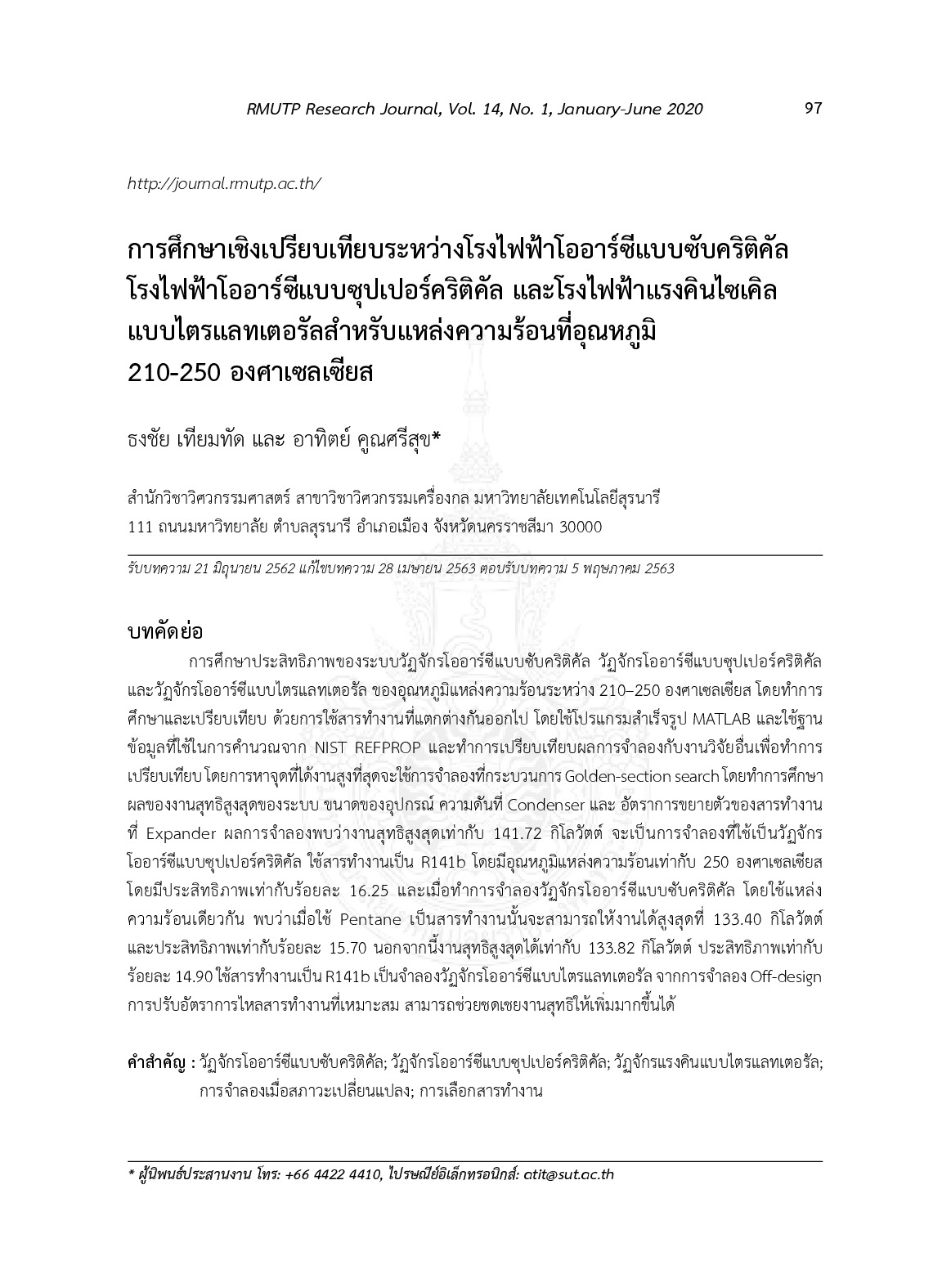
การศึกษาเชิงเปรียบเทียบระหว่างโรงไฟฟ้าโออาร์ซีแบบซับคริติคัลโรงไฟฟ้าโออาร์ซีแบบซุปเปอร์คริติคัล และโรงไฟฟ้าแรงคินไซเคิลแบบไตรแลทเตอรัลสำหรับแหล่งความร้อนที่อุณหภูมิ 210-250 องศาเซลเซียส
The performance investigations of subcritical ORC supercritical ORC and trilateral Rankine cycle (TLC) power plants with the heat source temperatures of 210-250°C were conducted and compared in this study. Several working fluids were evaluated. A MATLAB code was developed and used in this study. The thermodynamic properties of the working fluids were calculated by using NIST REFPROP program. The justification of the code was validated with a result taken from the literature. The optimal operating conditions were searched using the golden-section technique. The maximum net output power of 141.72 kW was obtained when using the supercritical ORC plant with R141b as its working fluid and the heat source temperature was at 250°C. The corresponding cycle efficiency was 16.25%. When using the subcritical plant at the same heat source temperature the maximum net output power of 133.40 kW and cycle efficiency of 15.70% are obtained when pentane is used as the working fluid. Furthermore the net output power of 133.82 kW and cycle efficiency of 14.90% are obtained when using R141b as the working fluid in the TLC power plant. According to the off-design simulations an appropriate adjustment of the working fluid flow rate can mitigate the variation of the net output power.