จำนวน Repository ( 2131 )
The development of waste heat energy conversion device to generate electricity through hermoelectric generator (TEG) apply to LPG cookstove
This research aims to develop the waste heat energy conversion device to generate electricity through a thermoelectric generator (TEG) which is called “CHEU. This device is applied to the LPG cookstove that serves as a waste heat source. The thermoelectric generator with 4 modules in series connection is used to convert heat energy to electricity. The present research shows a modification of the CHEU based on two concepts as follows: (1) re-design the structure for heat transfer improvement and (2) select the high capability of TEG to support a high temperature from a heat source as a result of (1). In this study the modified CHEU is called “MCHEU”. A heat-load condition is set as the gas pressure of LPG which varies in a range of 0.1 - 0.6 kg/cm2 and the throttle valve is fixed approximately at 40% of a fully opened throttle while the air entrainment is fully opened throttle. Also the water-cooling system is used for heat dissipation. Base on the performance evaluation of MCHEU the interesting results are drawn as follows: 1) the maximum temperature difference is on an average value of 278.5oC at a maximum heat load condition while a maximum voltage current and power are on an average value of 18.83 V 5.67 A and 107 W respectively. 2) The temperature difference of MCHEU is higher than that of CHEU with an average value of 50%. 3) The output power obtained by MCHEU is higher than that of CHEU with an average value of 52% and takes less time about 40% for fully charging a battery (12V 7.5Ah). Nevertheless MCHEU usage does not affect the thermal efficiency of a cookstove. 4) The efficiency of an energy conversion obtained by MCHEU is 20% which is higher than that of CHEU about 2%.
การผลิตและคุณลักษณะของแบคทีเรียลเซลลูโลสที่ผลิตด้วย Acetobacter xylinum TISTR 978 จากน้ำคั้นเปลือกสับปะรด
This research studies the production of bacterial cellulose from Acetobacter xylinum TISTR 975 with pineapple peel juice a low cost carbon source and coconut water as nutrient and carbon source. The factors influencing the production were studied including incubation time type of carbon sources and ratio of mixed carbon sources. In addition the characteristics of the produced bacterial cellulose were investigated using Fourier Transform Infrared Spectrophotometer (FTIR) Scanning Electron Microscope (SEM) Thermogravimetric Analyzer (TGA) Differential Scanning Colorimeter (DSC) and x-ray Diffractometer (xRD). It was found that the coconut water produced the amount of bacterial cellulose higher than the pineapple peel juice with 10 days of production. An addition of the coconut water into the pineapple peel juice increased the amount of bacterial cellulose. The characteristics of two bacterial celluloses from two different sources were nearly similar but the one from the pineapple peel juice had higher impurities. It can be concluded that the pineapple shell extract could be used as low cost carbon source for bacterial cellulose production.
การพัฒนาหลักสูตรระยะสั้นด้านการผลิตเคมีภัณฑ์ในครัวเรือน
The purpose of this research was to develop a short vocational training course on household chemical products and to develop a training course for shortterm vocational training in the production of household chemicals. Population groups Is a general public in Bangkok and metropolitan area by using the voluntary selection as follows. Trial of a short course on the production of household chemicals 10 participants. Evaluation of short courses in household chemical production 10 participants. Technology transfer the short-term training course on household chemical production 20 participants and five speakers. The tools used in the research are as follows: 1. Demand questionnaire 2. Short-term vocational training course 3. Satisfaction assessment. Data analysis using statistical software packages. The statistics used were mean ( X ) standard deviation (SD) and t-test. The research found that 1. Study and development of short courses in the production of household chemicals 1.1 selection of household chemicals that will lead to the creation of training courses based on components Where to buy Price per set Properties of components Safety and hazard Materials and equipment used for production storage use and distribution opportunities 1.2 Creating training courses training course components and training documents to have a sequence of steps that are easy and convenient for the learning of the general public 2. Trial of a short course on the production of household chemicals 2.1 Most trainees are satisfied with the short-term training program model as follows: Training procedures Training hours 1.30 hours per 1 course Short-term courses can be implemented and the curriculum can be used as a guideline for occupation at the highest level. As for the number of trainees four people per group per 1 course is at a high level. 2.2 Most of the trainees were satisfied with the speakers and short-term training. In explaining the various components of Household chemicals Explanation of the mixing process Household chemicals Integration of household chemical mixing techniques Explanation of caution In the mixing of household chemicals And explaining how to pack household chemicals at the highest level 3.Short-term evaluation of household chemical production 3.1 Most trainees are satisfied with the short-term training program model. The training process Training hours 1.30 hours per 1 course Short-term courses can be implemented and courses can be used as guidelines for their career at the highest level. As for the number of trainees four people per group per 1 course is at a high level. 3.2 Most of the trainees were satisfied with the speakers and short-term training. Explain the various components of household chemicals Explanation of the mixing process Household chemicals Integration of household chemical mixing techniques. Explanation of caution In the mixing of household chemicals And explaining how to pack household chemicals at the highest level 4.Technology transfer the short-term training course on household chemicalproduction 4.1 Most of the trainees were satisfied with the trainers for short-term training. Explain the various components of household chemicals Explanation of the mixing process Household chemicals Integration of household chemical mixing techniques Explanation of caution in the mixing of household chemicals and explaining how to pack household chemicals at the highest level 4.2 Most trainees were satisfied with the short-term training program model. Regarding the number of trainees four people per group Training procedures The number of training hours is 1.30 hours per course the highest level. Furthermore short courses can be implemented. As for the curriculum it can be used as a guideline for a career at a high level.
A simple solid-solid reaction for the synthesis of lead sulfide-montmorillonite hybrid
The hybrid materials of lead sulfide with montmorillonite were synthesized by a solid-solid reaction between lead-exchanged montmorillonite and sodium sulfide at ambient condition. The hybrids were characterized by powder X-ray diffraction (XRD) thermogravimetric-differential thermal analysis (TG-DTA).The basal spacing of heat-treated lead sulfide-montmorillonite-sodium sulfide (200oC) was 1.20 nm. The formation of lead sulfide in the hybrid confirmed by the non-resolved absorption band and absorption onset at 328 and 508 nm respectively for heat-treated lead sulfide-montmorillonite-sodium sulfide. The dramatic blue-shifted in the absorption onset relative to that of bulk was observed.The heat treated lead sulfide-montmorillonite-sodium sulfide showed an emission peak at 367 nm. The removal of adsorbed water resulted in the increasing intensity of the hybrid.
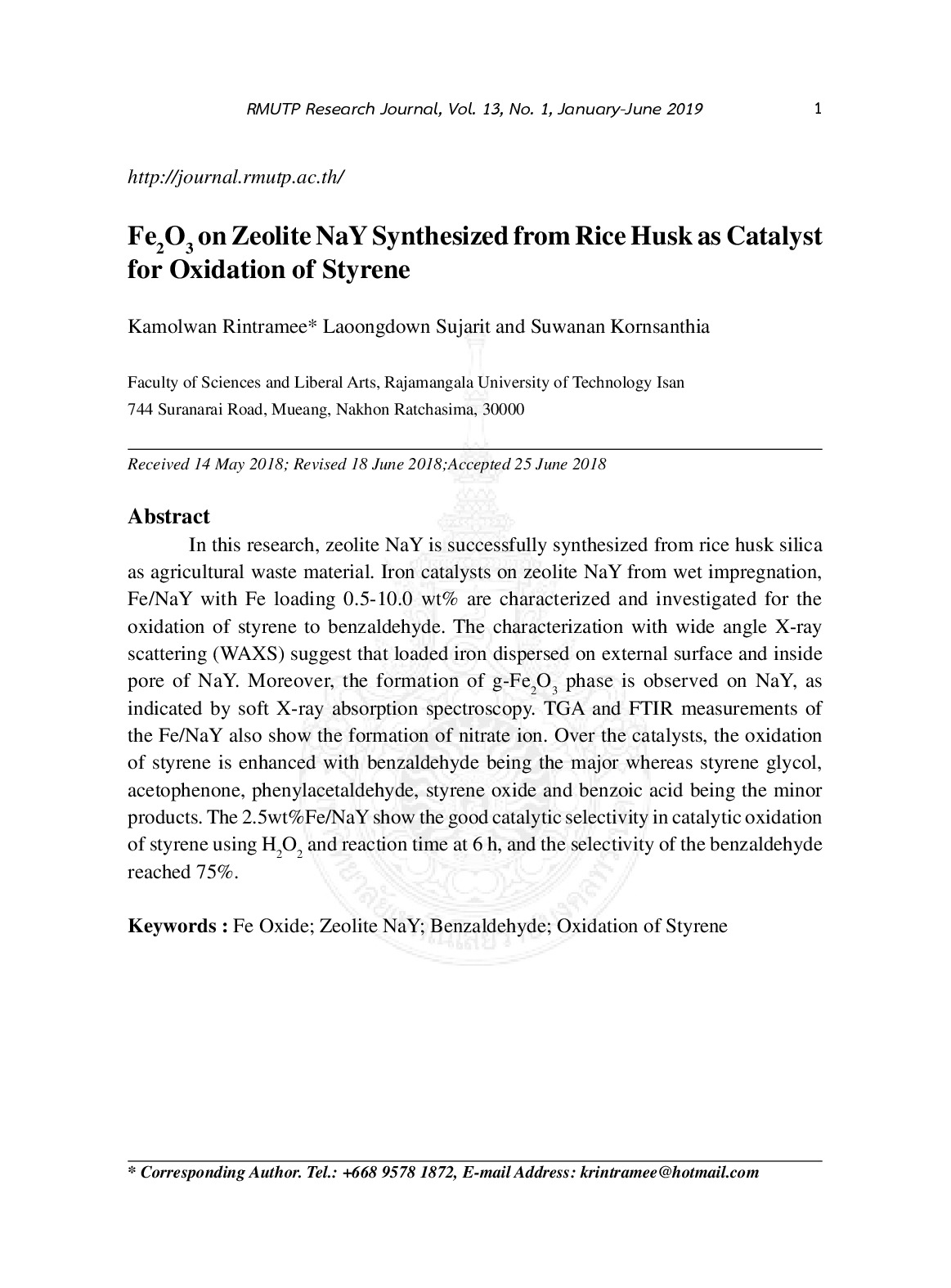
Fe2o3 on zeolite nay synthesized from rice husk as catalyst for oxidation of styrene
In this research zeolite NaY is successfully synthesized from rice husk silica as agricultural waste material. Iron catalysts on zeolite NaY from wet impregnation Fe/NaY with Fe loading 0.5-10.0 wt% are characterized and investigated for the oxidation of styrene to benzaldehyde. The characterization with wide angle X-ray scattering (WAXS) suggest that loaded iron dispersed on external surface and inside pore of NaY. Moreover the formation of g-Fe2O3 phase is observed on NaY as indicated by soft X-ray absorption spectroscopy. TGA and FTIR measurements of the Fe/NaY also show the formation of nitrate ion. Over the catalysts the oxidation of styrene is enhanced with benzaldehyde being the major whereas styrene glycol acetophenone phenylacetaldehyde styrene oxide and benzoic acid being the minor products. The 2.5wt%Fe/NaY show the good catalytic selectivity in catalytic oxidation of styrene using H2O2 and reaction time at 6 h and the selectivity of the benzaldehyde reached 75%.