จำนวน Repository ( 96 )
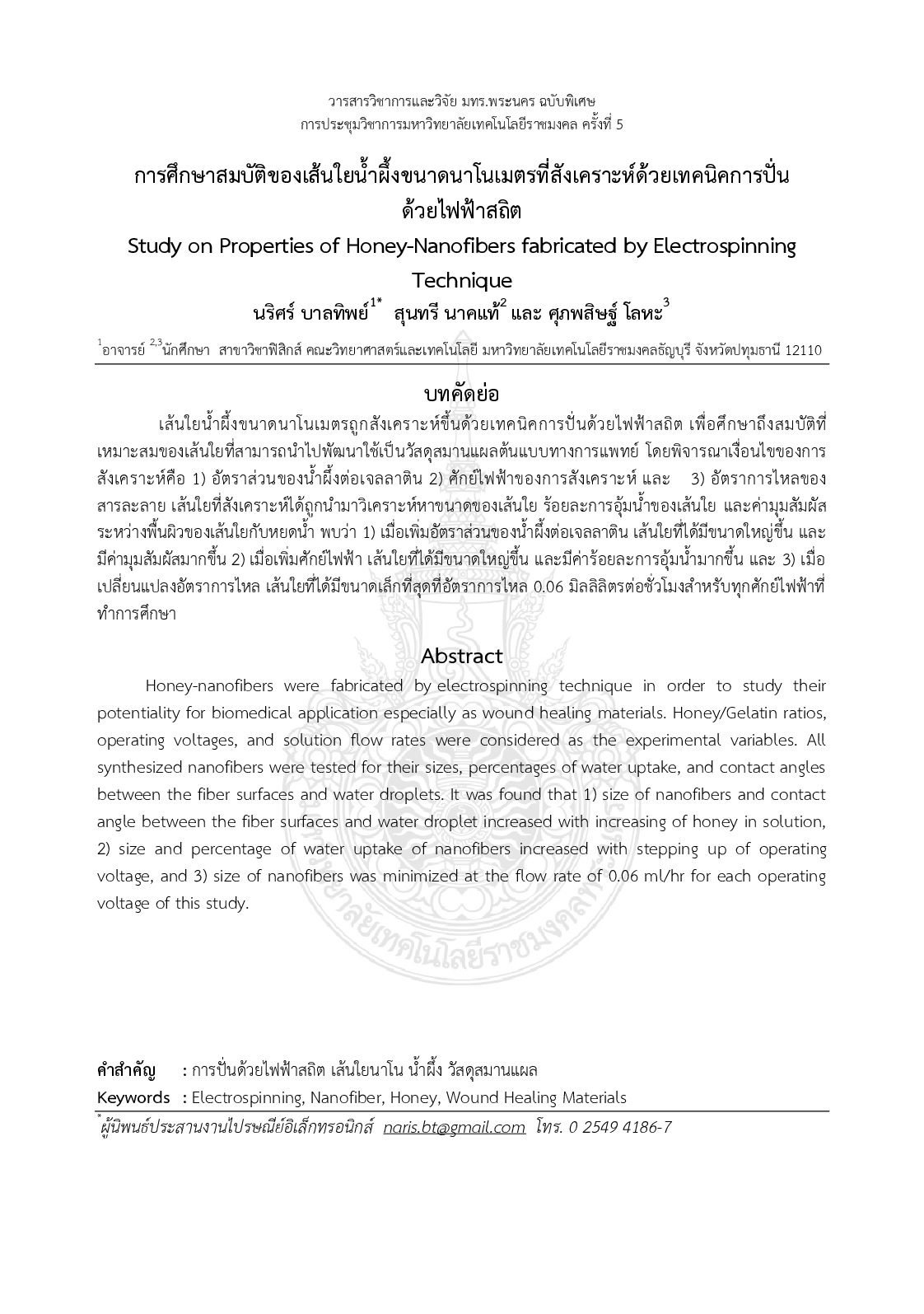
Study on properties of honey-nanofibers fabricated by electrospinning technique
Honey-nanofibers were fabricated by electrospinning technique in order to study their potentiality for biomedical application especially as wound healing materials. Honey/Gelatin ratios operating voltages and solution flow rates were considered as the experimental variables. All synthesized nanofibers were tested for their sizes percentages of water uptake and contact angles between the fiber surfaces and water droplets. It was found that 1) size of nanofibers and contact angle between the fiber surfaces and water droplet increased with increasing of honey in solution 2) size and percentage of water uptake of nanofibers increased with stepping up of operating voltage and 3) size of nanofibers was minimized at the flow rate of 0.06 ml/hr for each operating voltage of this study.

แผ่นใยอัดจากเส้นใยต้นมันสำปะหลัง
This research aims to study the application of cassava fiber. The fibers are taken from cassava and pineapple Head that 3 ratios are used to all of fiber mixing. The fiberboard production use 130°C of temperature with 20 – 50 kg/sq.cm of compressive pressure with 10 minutes per piece of rate. Their fiberboards have 681 – 724 kg/cu.m of density and 7.1 – 7.6 % of moisture. Resulting the CF 05 ratio (cassava: urea is equal to 0.95:0.13) is suitable ratio which has good physical and mechanical properties.
การเสริมใยอาหารในผลิตภัณฑ์มาการองด้วยรำข้าวสังข์หยด
The objective of this research to study the three formula basic of macarons amount of Sangyod Rice Bran usage in macarons product and nutritional composition of macarons product. The sensory evaluate of three formula of macarons the second and the third formula basic macarons non-significant in odor liking ( P< ) . However the three formulas are significant in appearance color liking odor liking taste liking texture liking a nd overall liking ( P> ). When consideration in average score 3rd formula of macarons acceptable that the most one formula. Therefore the third formula used to determine the proper amount of Sangyod Rice Bran to add on macarons in the next step. For the Enhancing of Sangyod Rice Bran in macarons. The three levels as follow; added Sangyod Rice Bran for % % and % of all total weight. The taster remains to accept all sample of Sangyod Rice Bran in macarons. Especially at the % of Sangyod Rice Bran to added in macarons to the highest acceptance . However the resulted of added Sangyod Rice Bran at % to decrease in the appearance and overall liking of macarons .Therefore supplementation of fiber in macarons product with Sangy od Rice Bran is not affectin macarons. Furturemore spicies and amount of other bran for macarons production should be intensive studied.
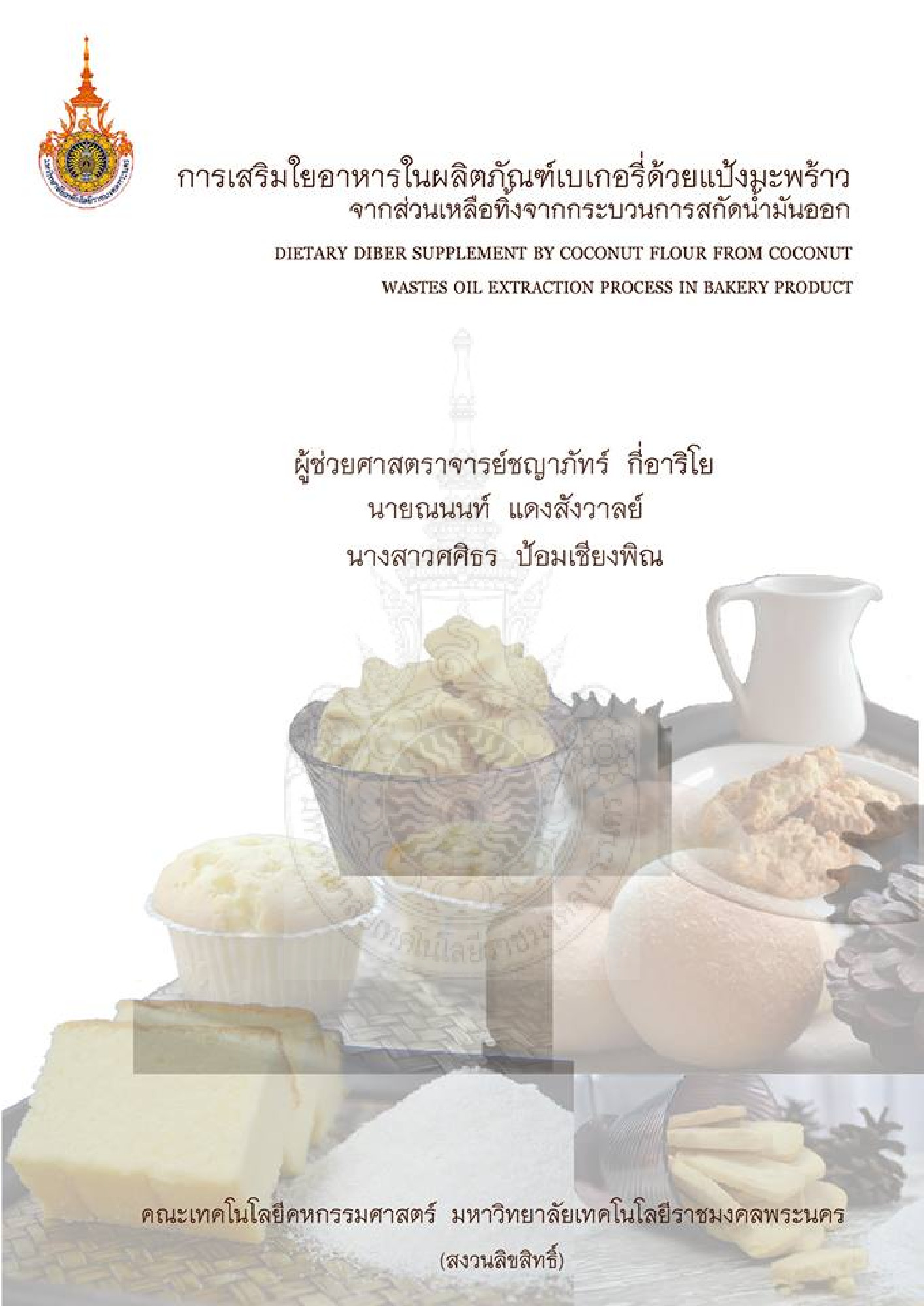
การเสริมใยอาหารในผลิตภัณฑ์เบเกอรี่ด้วยแป้งมะพร้าวจากส่วนเหลือทิ้งจากกระบวนการสกัดน้ำมันออก
The studies of Dietary Fiber Supplement by coconut flour from coconut Wastes Oil Extraction process in Bakery Product was investigated Production of coconut flour from coconut wastes oil extraction drying at 55 ° C for 12 hours and then grinding to powder gave the off-white fine powder. The chemical compositions of coconut flour were 57.70 % carbohydrate 29.4 % fat 6.23 % moisture 5.20 % protein and 1.48 % ash by dye weigh. Butter cake making experiment by substitution of wheat flour with coconut flour at 5 % of wheat flour weigh which has the highest sensory scores comparing butter cake with the control found that increase dietary fiber 1.34 g. /100 g. The majority of the tested consumers (92%) accepted butter cake with 5 % of coconut flour substitution. Muffin making experiment by substitution of wheat flour with coconut flour at 15 % of wheat flour weigh which has the highest sensory scores comparing muffin with the control found that increase dietary fiber 2.34 g /100 g. The majority of the tested consumers (81%) accepted muffin with 15 % of coconut flour substitution. Cornflake cookie making experiment by substitution of wheat flour with coconut flour at 20 % of wheat flour weigh which has the highest sensory scores comparing cornflake cookie with the control found that increase dietary fiber 3.54 g. /100 g. The majority of the tested consumers (94 %) accepted cornflake cookie with 20 % of coconut flour substitution. Butter cookie making experiment by substitution of wheat flour with coconut flour at 10 % of wheat flour weigh which has the highest sensory scorescomparing butter cookie with the control found that increase dietary fiber 3.04 g. /100 g. The majority of the tested consumers (94 %) accepted Butter cookie with 10 % of coconut flour substitution. Frozen cookie making experiment by substitution of wheat flour with coconut flour at 20 % of wheat flour weigh which has the highest sensory scores comparing cookie with the control found that increase dietary fiber 4.02g. /100 g. The majority of the tested consumers (93 %) accepted 20 % of coconut flour substitution. Butter bread making experiment by substitution of wheat flour with coconut flour at 15 % of wheat flour weigh which has the highest sensory scores comparing butter bread with the control found that increase dietary fiber 2.22 g. /100 g. The majority of the tested consumers (75 %) accepted 15% of coconut flour substitution. Whole wheat bread making experiment by substitution of wheat flour with coconut flour at 15 % of wheat flour weigh which has the highest sensory scores comparing whole wheat bread with the control found that increase dietary fiber 2.09 g. /100 g. The majority of the tested consumers (79 %) accepted 15 % of coconut flour substitution. Pie crust making experiment by substitution of wheat flour with coconut flour at 15 % of wheat flour weigh which has the highest sensory scores comparing pie crust with the control found that increase dietary fiber 2.91 g. /100 g. The majority of the tested consumers (82 %) accepted 15 % of coconut flour substitution.
การเสริมใยอาหารในผลิตภัณฑ์มาการองด้วยรำข้าวสังข์หยด
The objective of this research to study the three formula basic of macarons amount of Sangyod Rice Bran usage in macarons product and nutritional composition of macarons product. The sensory evaluate of three formula of macarons the second and the third formula basic macarons non-significant in odor liking (P<). However the three formulas are significant in appearance color liking odor liking taste liking texture liking and overall liking (P>). When consideration in average score 3rd formula of macarons acceptable that the most one formula. Therefore the third formula used to determine the proper amount of Sangyod Rice Bran to add on macarons in the next step. For the Enhancing of Sangyod Rice Bran in macarons. The three levels as follow; added Sangyod Rice Bran for % % and % of all total weight. The taster remains to accept all sample of Sangyod Rice Bran in macarons. Especially at the % of Sangyod Rice Bran to added in macarons to the highest acceptance. However the resulted of added Sangyod Rice Bran at % to decrease in the appearance and overall liking of macarons. Therefore supplementation of fiber in macarons product with Sangyod Rice Bran is not affect in macarons. Furturemore spicies and amount of other bran for macarons production should be intensive studied.