จำนวน Repository ( 64 )
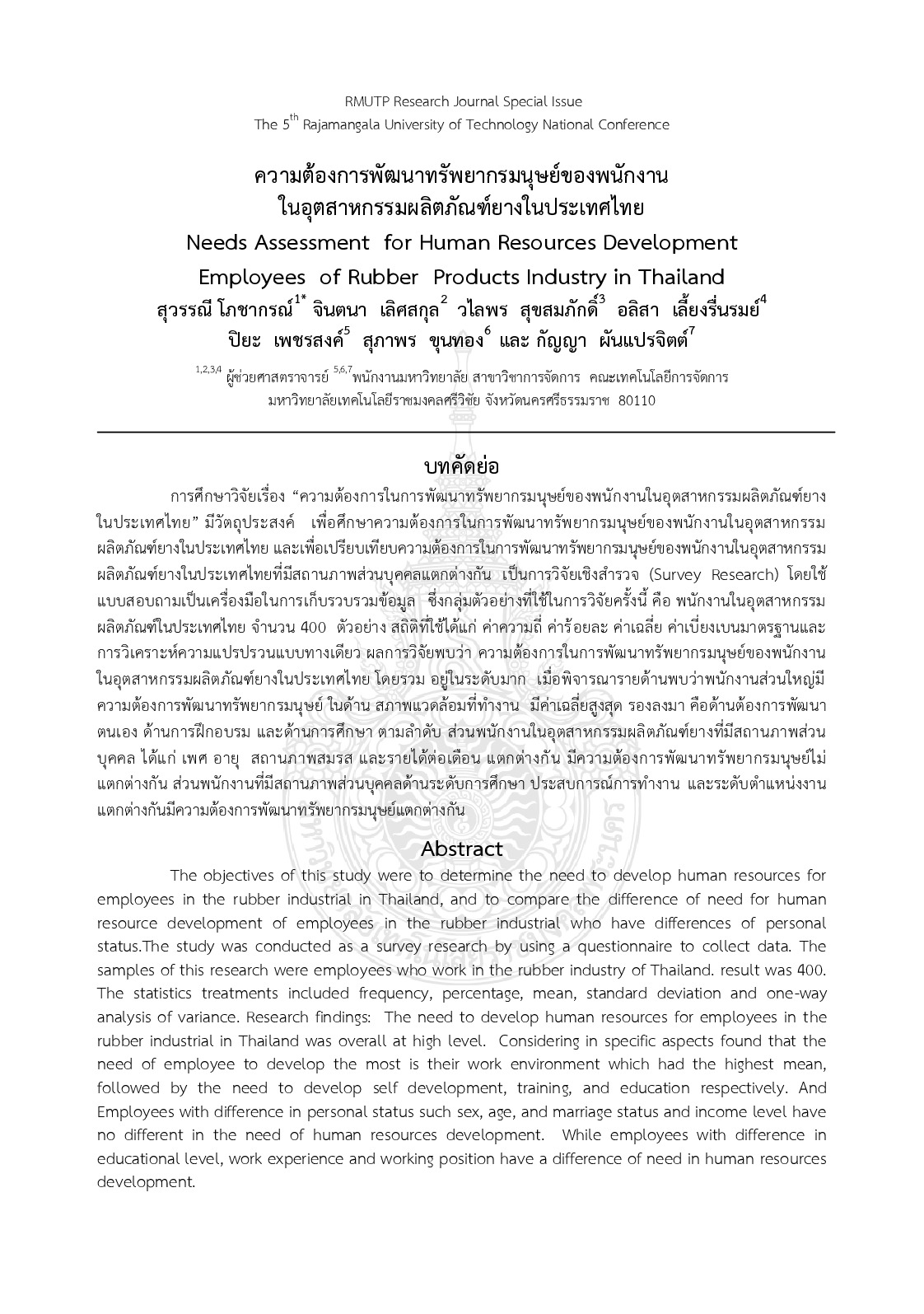
Needs assessment for human resources development employees of rubber products industry in thailand
The objectives of this study were to determine the need to develop human resources for employees in the rubber industrial in Thailand and to compare the difference of need for human resource development of employees in the rubber industrial who have differences of personal status.The study was conducted as a survey research by using a questionnaire to collect data. The samples of this research were employees who work in the rubber industry of Thailand. result was 400. The statistics treatments included frequency percentage mean standard deviation and one-way analysis of variance. Research findings: The need to develop human resources for employees in the rubber industrial in Thailand was overall at high level. Considering in specific aspects found that the need of employee to develop the most is their work environment which had the highest mean followed by the need to develop self development training and education respectively. And Employees with difference in personal status such sex age and marriage status and income level have no different in the need of human resources development. While employees with difference in educational level work experience and working position have a difference of need in human resources development.
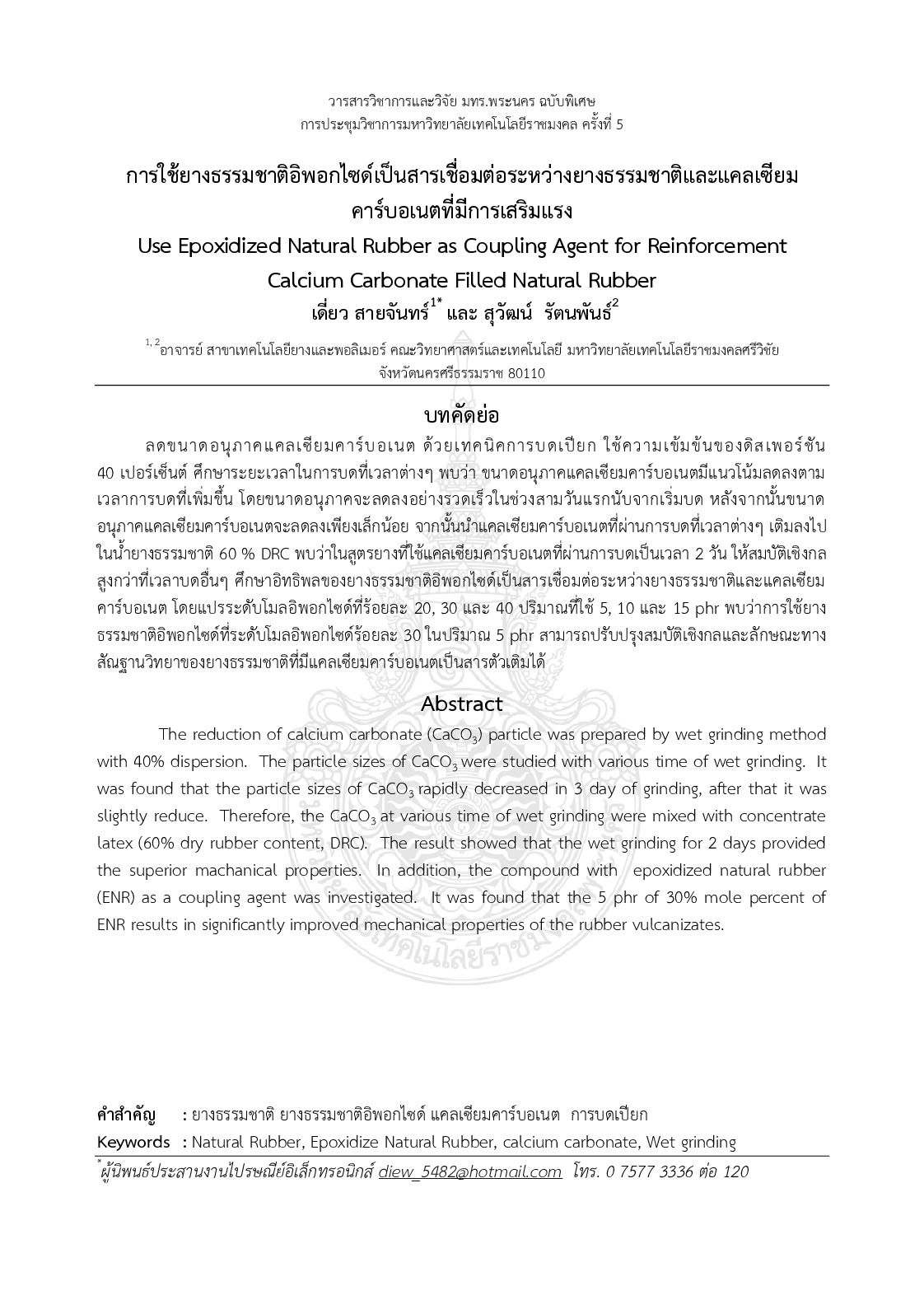
Use epoxidized natural rubber as coupling agent for reinforcement calcium carbonate filled natural rubber
The reduction of calcium carbonate (CaCO3) particle was prepared by wet grinding method with 40% dispersion. The particle sizes of CaCO3 were studied with various time of wet grinding. It was found that the particle sizes of CaCO3 rapidly decreased in 3 day of grinding after that it was slightly reduce. Therefore the CaCO3 at various time of wet grinding were mixed with concentrate latex (60% dry rubber content DRC). The result showed that the wet grinding for 2 days provided the superior machanical properties. In addition the compound with epoxidized natural rubber (ENR) as a coupling agent was investigated. It was found that the 5 phr of 30% mole percent of ENR results in significantly improved mechanical properties of the rubber vulcanizates.
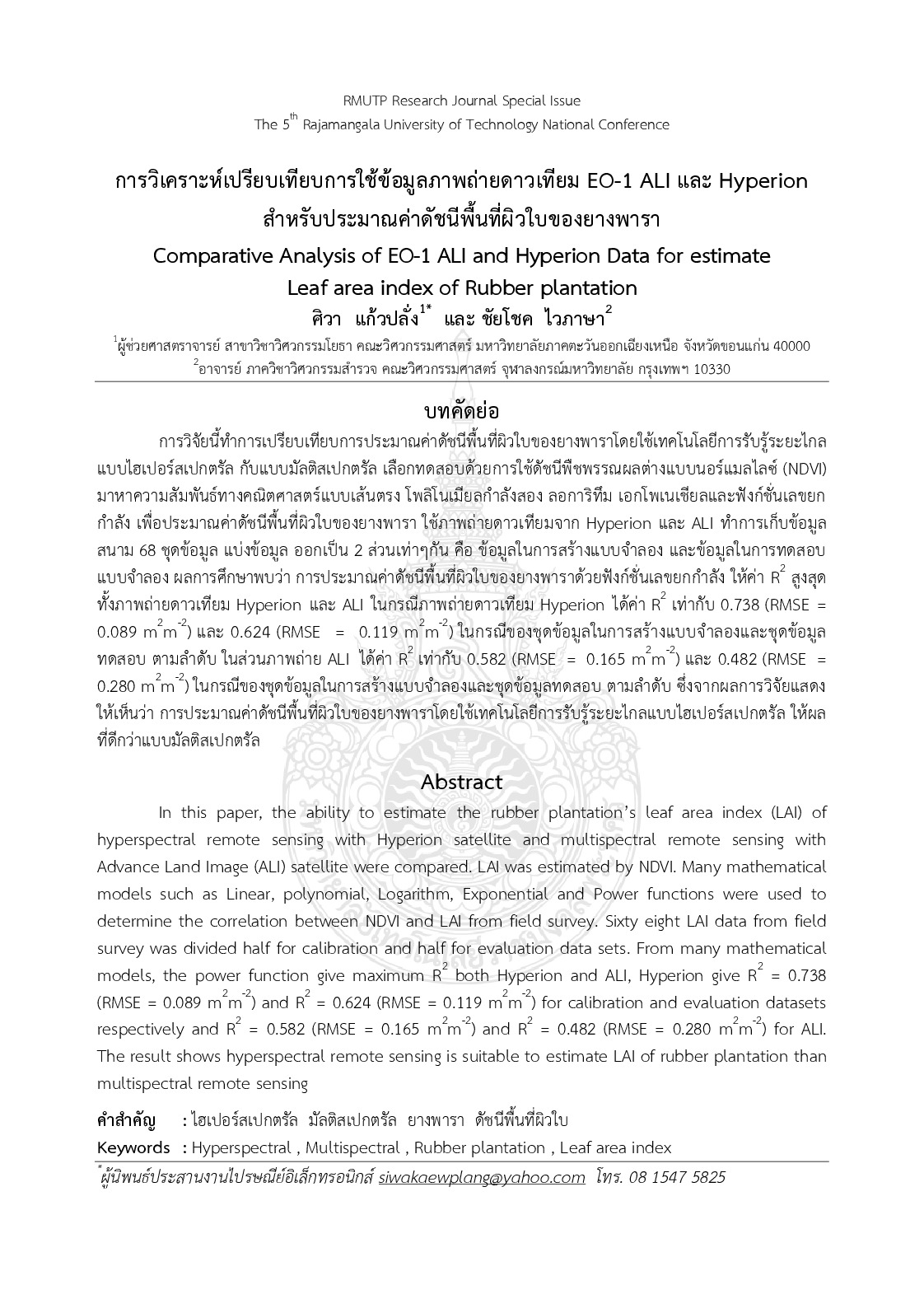
Comparative analysis of EO-1 ALI and Hyperion data for estimate leaf area index of rubber plantation
In this paper the ability to estimate the rubber plantation’s leaf area index (LAI) of hyperspectral remote sensing with Hyperion satellite and multispectral remote sensing with Advance Land Image (ALI) satellite were compared. LAI was estimated by NDVI. Many mathematical models such as Linear polynomial Logarithm Exponential and Power functions were used to determine the correlation between NDVI and LAI from field survey. Sixty eight LAI data from field survey was divided half for calibration and half for evaluation data sets. From many mathematical models the power function give maximum R2 both Hyperion and ALI Hyperion give R2 = 0.738 (RMSE = 0.089 m2m-2) and R2 = 0.624 (RMSE = 0.119 m2m-2) for calibration and evaluation datasets respectively and R2 = 0.582 (RMSE = 0.165 m2m-2) and R2 = 0.482 (RMSE = 0.280 m2m-2) for ALI. The result shows hyperspectral remote sensing is suitable to estimate LAI of rubber plantation than multispectral remote sensing

Forecasting model for the export quantity of concentrated latex
The objective of this research is to construct the appropriate forecasting model for the export quantity of concentrated latex by the three time series analysis methods which are Box-Jenkins method Winters’ multiplicative exponential smoothing method and combined forecasting method. Time series data from the website of Office of Agricultural Economics during January 1998 to February 2014 (194 values) are used and divided into two series. The first 182 values from January 1998 until February 2013 for the models prediction and the last 12 values from March 2013 until February 2014 for comparison the performance of forecasting models via the criterion of the lowest root mean squared error and the criterion of the highest correlation coefficient between existing values and forecasted values. Research findings indicated that for all forecasting methods that have been studied the most powerful method is the combined forecasting and the forecasting model is where and represent the single forecasts at time t from Box-Jenkins method and Winters’ multiplicative exponential smoothing method respectively.