จำนวน Repository ( 137 )

การวิเคราะห์ประสิทธิภาพการใช้อาคารเรียน คณะเทคโนโลยีคหกรรมศาสตร์
โครงการวิจัย เรื่อง การวิเคราะห์ประสิทธิภาพการใช้อาคารเรียน คณะเทคโนโลยีคหกรรมศาสตร์ มีวัตถุประสงค์เพื่อศึกษาและวิเคราะห์การใช้พื้นที่อาคารเรียน โดยเฉพาะห้องเรียน ทฤษฎีและห้องปฏิบัติการ คณะเทคโนโลยีคหกรรมศาสตร์ เพื่อใช้เป็นข้อมูลในการวางแผนการใช้ ห้องเรียน ให้เกิดประโยชน์สูงสุด รวมทั้งแก้ปัญหาห้องเรียนไม่เพียงพอต่อการใช้งาน โดยศึกษาข้อมูล การใช้ประโยชน์ห้องเรียนทฤษฎีและห้องปฏิบัติการ ในอาคารเรียน 3 หลัง คณะเทคโนโลยีคหกรรมศาสตร์ และพื้นที่ขอความอนุเคราะห์อาคารคณะครุศาสตร์อุตสาหกรรม วิเคราะห์ผลเปรียบเทียบตามเกณฑ์ มาตรฐานประสิทธิภาพการใช้ห้องเรียน ตามประกาศกระทรวงศึกษาธิการ เรื่องแนวทางการเพิ่ม ประสิทธิภาพการใช้ประโยชน์อาคารของสถาบันอุดมศึกษา 3 ด้าน จากการวิเคราะห์ข้อมูลการใช้ประโยชน์ พบว่า 1. ด้านการใช้ประโยชน์ตามความจุของห้องเรียน พบว่า การใช้ห้องเรียนทฤษฎีและ ห้องปฏิบัติการ คณะเทคโนโลยีคหกรรมศาสตร์ ยังไม่เป็นตามเกณฑ์มาตรฐานประสิทธิภาพการใช้ ห้องเรียน (ห้องเรียนทฤษฎี 17 ห้อง ห้องปฏิบัติการ 28 ห้อง) 2. ด้านการใช้ประโยชน์ตามเวลา พบว่า การใช้ห้องเรียนทฤษฎี อาคารเรือนปัญญา มี อัตราการใช้ประโยชน์ตามเวลา (ร้อยละ 82.34) และการใช้ห้องปฏิบัติการในอาคารทั้ง 3 หลัง สอดคล้องตามตามเกณฑ์มาตรฐานประสิทธิภาพการใช้ห้องเรียน คือ อาคารเรือนปัญญา (ร้อยละ 100.29) อาคาร 5 (ร้อยละ 86.76) และ อาคาร 5 (ร้อยละ 82.21) 3. ด้านประสิทธิภาพการใช้ห้องเรียน พบว่า การใช้ห้องเรียนทฤษฎี เฉพาะอาคารเรือน ปัญญา (ร้อยละ 67.75) และห้องปฏิบัติการ ในอาคาร 5 (ร้อยละ 60.79) มีอัตราการใช้ห้องตาม เกณฑ์มาตรฐานประสิทธิภาพการใช้ห้องเรียน ผลการศึกษาครั้งนี้ พบว่าการใช้ประโยชน์ห้องเรียนของคณะเทคโนโลยีคหกรรมศาสตร์ ยังไม่เป็นไปตามเกณฑ์ด้านความจุของห้องเรียนในทุกอาคาร แสดงถึงความไม่สัมพันธ์กันของจำนวน ความจุของห้องเรียนและจำนวนนักศึกษาที่จัดตารางเรียนตารางสอนจริง นอกจากนั้นในด้านการใช้ ประโยชน์ตามเวลา ห้องเรียนทฤษฎี ในอาคาร 5 และอาคารคณะครุศาสตร์อุตสาหกรรม ยังไม่เป็นไป ตามเกณฑ์การใช้ประโยชน์ตามเวลา เนื่องจากปัญหาความพร้อมและทันสมัยของสื่อเทคโนโลยีเพื่อการศึกษา
การวิเคราะห์สินค้าบกพร่องในโรงงานผลิตชิ้นส่วนรถยนต์โดยใช้ ตัวแบบผสมเชิงเส้นวางนัยทั่วไป
The objectives of this research are to propose a proper model for defective products in an autoparts manufacturing industry to apply the proposed model to the defective products data to investigate the factors related to the machines producing defective products and to compare the proposed model with the generalized estimating equations model (GEE). The proposed model is a generalized linear mixed model (GLMM) in which the dependent variables have a Poisson distribution. The parameter are estimated using a Bayesian method. The data were collected from 12 machines 15 days for each machine from an autoparts manufacturing factory. The data collection dates vary depending on the working steps and the product types. The results show that the proposed model fits the data. The factors related to the machines producing defective products are working steps workers and product types. According to the estimates of the factors effects the working step producing the largest number of defective products is the working step 2 followed by the working steps 3 1 and 4 respectively. The worker producing the largest of defective products is the worker 4 followed by the workers 10 5 8 6 2 3 1 7 and 9 respectively. The product type 3 has the largest number of defective products followed by the product types 2 and 1 respectively. If the population-averaged effects are focused the GEE is applied. However the subject-specific is focused the GLMM is applied.
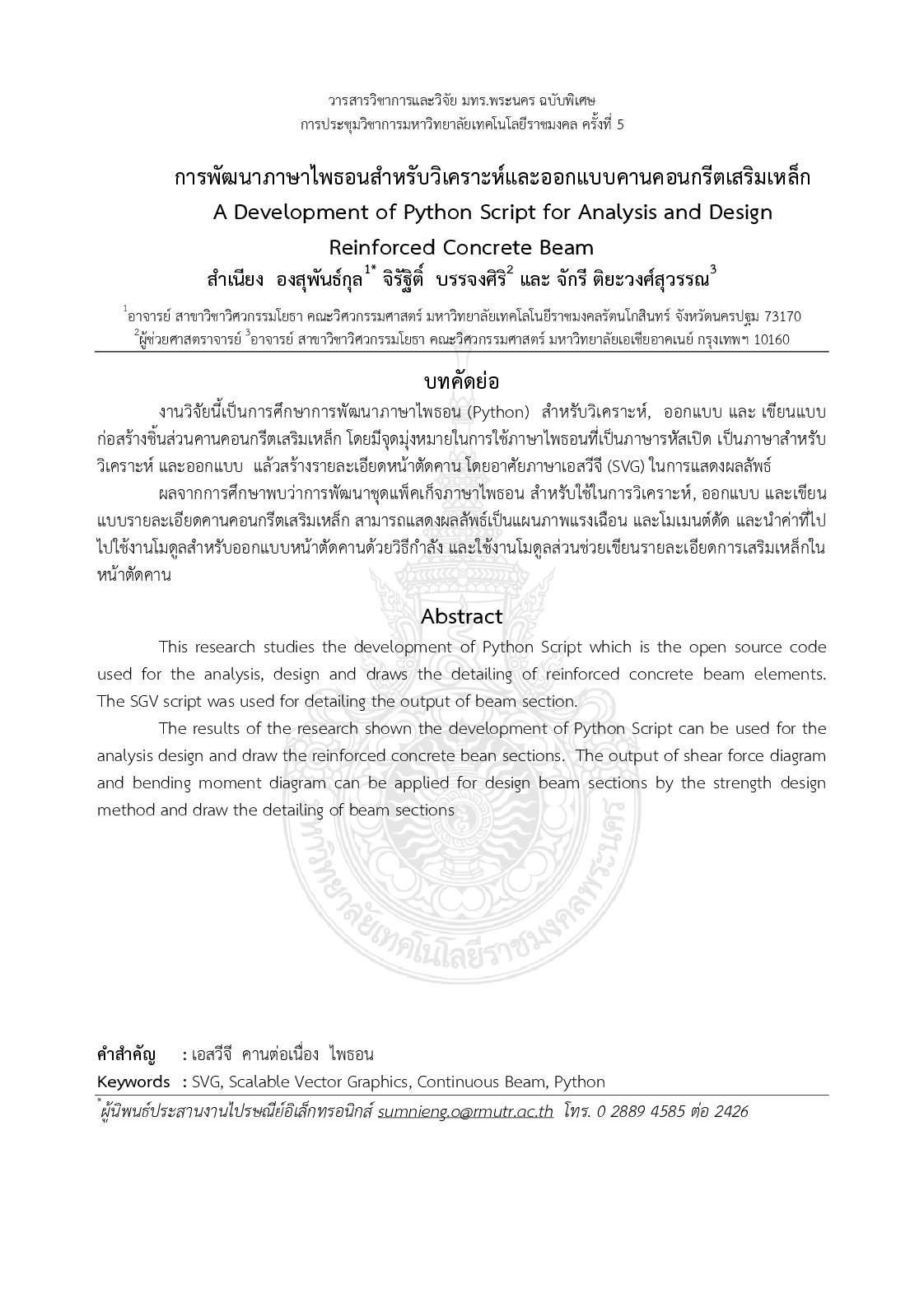
A development of python script for analysis and design reinforced concrete beam
This research studies the development of Python Script which is the open source code used for the analysis design and draws the detailing of reinforced concrete beam elements. The SGV script was used for detailing the output of beam section. The results of the research shown the development of Python Script can be used for the analysis design and draw the reinforced concrete bean sections. The output of shear force diagram and bending moment diagram can be applied for design beam sections by the strength design method and draw the detailing of beam sections
การเลือกฟังก์ชันการแจกแจงความน่าจะเป็นสะสมสำหรับแนวโน้มเพื่อสร้างตัวแบบสำหรับวิเคราะห์ข้อมูลอนุกรมเวลาหลายๆตัวพร้อมกันที่มีค่า อัตตสหสัมพันธ์แนวโน้ม และค่าผิดปกติ ด้วยวิธีของเบย์: กรณีศึกษาราคาหุ้นที่มีความผันผวนของตลาดหลักทรัพย์แห่งประเทศไทย
The objective of this research is to select a proper cumulative function for trend in an analysis of simultaneous multiple time series data with autocorrelation trend and outliers using a Bayesian method. The proposed model is applied to fluctuate stock price data in the stock exchange of Thailand. The data consist of the closing prices of 5 stocks. The algorithms are written in OpenBUGS and the performance of the model is evaluated via a simulation study in R. The cumulative distribution functions considered here are a Weibull cumulative distribution function and an exponential cumulative distribution. They are compared using RMSE MAPE and MAE as criteria. The research found that an exponential cumulative function for trends gives smaller values of the three criteria in both model fitting and model validation for the4 stocks EA NWR and KTB. However a Weibull cumulative distribution function gives smaller values of three criteria for the PTT in both model fitting and model validation.
การวิเคราะห์สาเหตุของการผลิตสินค้าบกพร่องและเสียด้วยตัวแบบการถดถอยโลจิสติกส์แบบเบย์: กรณีศึกษาโรงงานผลิตชิ้นส่วนรถยนต์
This research proposes a Bayesian logistic regression model which is applied to the data from autoparts manufacturing machines. Factors related to defective and bad products are investigated. The proposed model is compared with the logistic regression using maximum likelihood method for parameter estimation. The data were collected from 132 machines in an autoparts manufacturing factory. The research found that useful life machine type 6 worker group 3 and 4 working step 1 and 2 influence to the risk of producing defective and bad products. When the useful life is increased by 1 month the risk of producing defective and bad products will be increased by 2.2%. The risk that the machine type 6 will produce defective and bad products is 4.078 times greater than the risk that the machine type will do. The risk that the worker group 3 will produce defective and bad products is 61.7% less than the risk that the worker group 12 will do. The risk that the worker group 4 will produce defective and bad products is 61.5% less than the risk that the worker group 12 will do. The risk that the working step 1 will produce defective and bad products is 2.831 times greater than the risk that the working step 4 will do. The risk that the working step 2 will produce defective and bad products is 13.8 % greater than the risk that the working step 4 will do. The parameter estimates from the Bayesian logistic regression are very close to the ones from the logistic regression using maximum likelihood method for parameter estimation