จำนวน Repository ( 952 )
The Problems and Needs of Students and Teachers in Using Registration website of Rajamangala University of Technology Phra Nakhon
This research aimed to study problems and needs of students and teachers in using registration website of Rajamangala University of Technology PhraNakhon based on genders age faculties and internet access experience. The samples were 400 undergraduate students and 233 teachers from Rajamangala University of Technology Phra Nakhon. The research tool was a questionnaire. Data collection was analyzed by SPSS (Statistics Package for Social Science) to find percentage mean and standard deviation (S.D.) T-test and f-test were used to find different problems and needs inusing registration website. The research findings were as follows;
An Evaluation Project of Using Degree Curriculums for Rajamangala University of technology Phra Nakorn, B.E. 2549-2550
The objectives of this lnstitutional research were an evaluation of using curriculums by studying and comparing opinion levels of students teachers and administrators inclusion in students’ satisfaction for educational process of Rajamangala University of Technology Phra Nakhon. The 1415 samples of this study were 1259 students’ 134 teacher and 22 administrators from six faculties which are as follows faculty of lndustrial Textiles and Fashion Design’ faculty of Science and Technology faculty of Engineering faculty of lndustrial Education faculty of Home Economics Technology and faculty of Mass Communication Technology. The data were collected by questionnaires and grouping by the samples. The results of this study were analyzed by percentage average value and Likert scale.
The Satisfaction of the Inspected towards The Internal Audit of Rajamangala University Of Technology Phra Nakhon
The purposes of this research were to study the satisfaction of the inspected towards the internal audit and to compare the inspected satisfaction in each aspect according to sex age job position and experience. The sample participated in this research consisted of 200 of unit executives faculty secretaries division heads and operating officials who dealt with the process of the internal audit. The tool used to collect data was a questionnaire; the statistics used to analyze the data were percentage Arithmetic mean standard deviation t-test one-way ANOVA and Fisher’s Least Significant Difference (LSD) was used after significant difference was found between groups.
A System Dynamics Model to Analyze Behavior of Manufacturing in Supply Chain
This research offers. The system dynamics study of supply chain processes in the manufacturing industry. The production is made-up of make to order from the building stock and flow with the fourth cycle and parameters define to test the behavior by using Vensim program to simulation situation by the time 50 weeks showed that the response to increases in the order of 20% in the production process made the amplification behavior. The process resulted in levels of inventory bog down. The reduction of inventory conflicts with the desire to keep the inventory caused by delays of customer change. The organizational behavior is not balance the products backlog and made the level of order fulfillment ratio lower than 100%
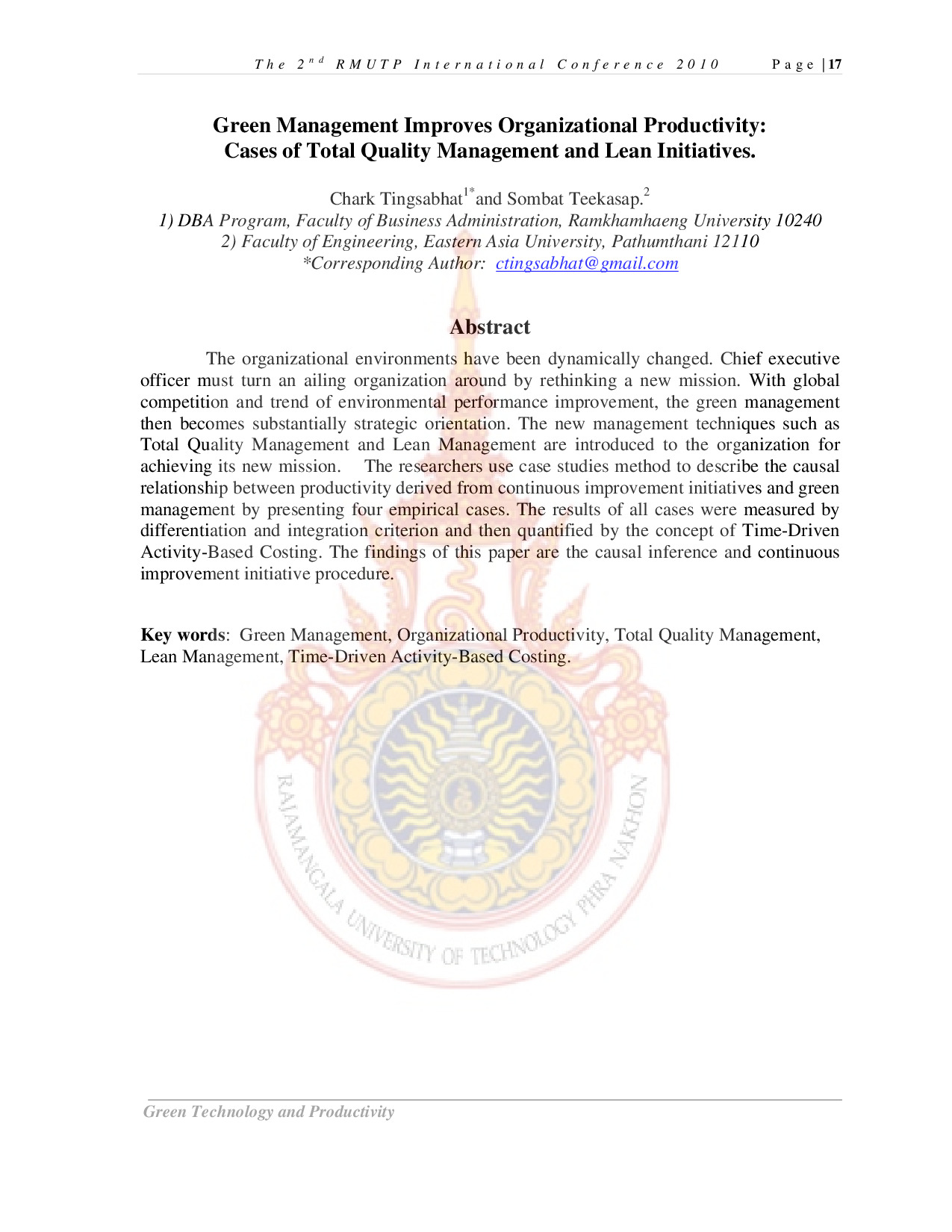
Green Management Improves Organizational Productivity:Cases of Total Quality Management and Lean Initiatives
The organizational environments have been dynamically changed. Chief executive officer must turn an ailing organization around by rethinking a new mission. With global competition and trend of environmental performance improvement the green management then becomes substantially strategic orientation. The new management techniques such as Total Quality Management and Lean Management are introduced to the organization for achieving its new mission. The researchers use case studies method to describe the causal relationship between productivity derived from continuous improvement initiatives and green management by presenting four empirical cases. The results of all cases were measured by differentiation and integration criterion and then quantified by the concept of Time-Driven Activity-Based Costing. The findings of this paper are the causal inference and continuous improvement initiative procedure