จำนวน Repository ( 98 )

Energy saving strategies in refrigeration systems by defrost management
Defrosting at evaporator panel is one of working cycles in freezer. Power consumption in defrosting does not meet the objective of using freezer therefore the approach to decrease power consumption in defrosting is one strategy for energy saving. Normally the cycle of defrosting in freezer is a constant time that specify by referring to the highest humidity period. With this control concept the problem of temperature exchange is not occurred from ice accumulation at evaporator panel but it makes the over necessity of defrosting process in the low humidity season and cause the unnecessary power usage in freezer. This research presents the control approach for defrosting by using the difference of the temperature at evaporator and the temperature at chilling area. By using this approach the defrosting process is operated depend on load and the fan is on or off relate to defrosting time. Test results demonstrate that about 12% of power can be saved by this control approach when compared to constant time control.
การจำลองกังหันลมเชื่อมต่อระบบกริดไฟฟ้า 1 เฟส
This research project presents about wind turbine simulation for connected single phase grid system using hysteresis current control technique to generate PWM signals for controlling a single-phase voltage source inverter. The simulation system presented here uses the program. MATLAB/Simulink in the simulation of the wind turbine connected to the shaft of a three-phase permanent magnet generator is produced by alternating current through the full bridge rectifier circuit. Then the power supply is applied to the single-phase inverter circuit which is connected to the single-phase autotransformer to power transfer to the single-phase grid system. The simulation results confirm the validity of the proposed system with satisfaction under various conditions.
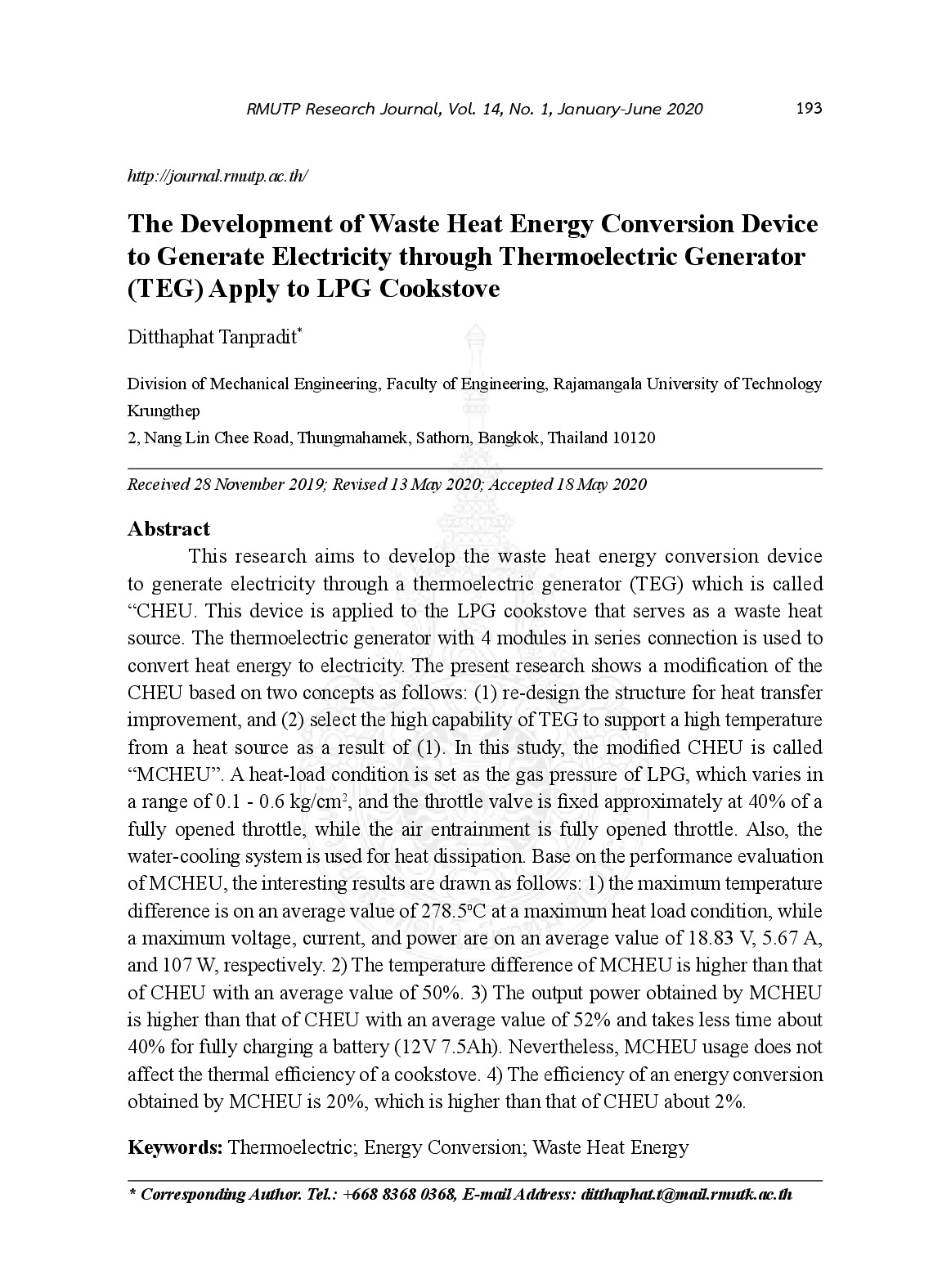
The development of waste heat energy conversion device to generate electricity through hermoelectric generator (TEG) apply to LPG cookstove
This research aims to develop the waste heat energy conversion device to generate electricity through a thermoelectric generator (TEG) which is called “CHEU. This device is applied to the LPG cookstove that serves as a waste heat source. The thermoelectric generator with 4 modules in series connection is used to convert heat energy to electricity. The present research shows a modification of the CHEU based on two concepts as follows: (1) re-design the structure for heat transfer improvement and (2) select the high capability of TEG to support a high temperature from a heat source as a result of (1). In this study the modified CHEU is called “MCHEU”. A heat-load condition is set as the gas pressure of LPG which varies in a range of 0.1 - 0.6 kg/cm2 and the throttle valve is fixed approximately at 40% of a fully opened throttle while the air entrainment is fully opened throttle. Also the water-cooling system is used for heat dissipation. Base on the performance evaluation of MCHEU the interesting results are drawn as follows: 1) the maximum temperature difference is on an average value of 278.5oC at a maximum heat load condition while a maximum voltage current and power are on an average value of 18.83 V 5.67 A and 107 W respectively. 2) The temperature difference of MCHEU is higher than that of CHEU with an average value of 50%. 3) The output power obtained by MCHEU is higher than that of CHEU with an average value of 52% and takes less time about 40% for fully charging a battery (12V 7.5Ah). Nevertheless MCHEU usage does not affect the thermal efficiency of a cookstove. 4) The efficiency of an energy conversion obtained by MCHEU is 20% which is higher than that of CHEU about 2%.
การตรวจสอบความเสียหายของถังเก็บน้ำมันด้วยการตรวจสอบแบบไม่ทำลายโดยใช้เทคนิคการปลดปล่อยคลื่นเสียง
Non-destructive test with Acoustic Emission technique was used for monitoring of the corrosion in the above ground oil storage tank. In the analytical characteristics of acoustic emission wave however Acoustic Emission test has to be prior used for the location detection of corrosion especially indication of the severity of corrosion. In this research the relationship between the corrosion rate and the sound wave energy was studied. The corrosion and damage detected on the surface of the aboveground storage tank was determined by the Acoustic Emission Test. Nine pieces of low carbon steel grade SS400 was soaked in sodium chloride solution in simulated tanks at concentrations of 1.5 3.5 and 5.5 wt%. Next the corrosion activity was checked by performing with the Acoustic Emission Testing for 1 hour and thus calculating the corrosion rate of the test specimens. From the experiment it was found that the rate of corrosion affects the Acoustic Emission Energy. The corrosion rate was increased with the concentrations of the solution increasing from the corrosion process. The corrosion rate was also increased with the sound wave power increases. Therefore in order to achieve the corrosion rate and the position of the defects on the inner surface of the tank non-destructive testing with acoustic emission technique can be factually chosen for this specific application.
การเพิ่มประสิทธิภาพหม้อต้มไอน้ำจากการใช้ความร้อนปล่อยทิ้งภายในปล่องควันด้วยเทคโนโลยีการแลกเปลี่ยนความร้อนอีโคโนไมเซอร์และการบำรุงรักษา
The objectives of this study is to increase efficiency of steam boiler 2.5 ton per hour which used liquid petroleum gas LPG as fuel. bringing heat recovery inside boiler chimney stack to preheat feed water with technology heat Exchanger Economize. Taking the economizer with its pipe length of 1000 mm and 62 mm diameter for 64 pipe is a cross flow with staggered tube to increase water temperature before entering the boiler pass to deaerator The study is carried out to compare the differences and savings of the feed water temperature steam boiler efficiency and fuel consumption between having the economizer installed and uninstalled. reference to study The result after installed the heat exchanger economizer the feed water is passed into steam boiler deaerator higher temperature from 38.30°C to 67.20°C which leads to increase efficiency of steam boiler from 81.59 % to 85.65 % meaning that the fuel consumption of steam boiler will be reduced 4.97 %