จำนวน Repository ( 121 )

การใช้เศษกระดาษเหลือทิ้งเป็นมวลรวมในบล็อกประสานมวลเบาจากหน้าดินขาว
The objective of this research is to study about physical mechanical and thermal insulation properties of light-weight Kaolin top soil interlocking block mixed with milk carton waste. The ratio of cement: aggregates (Kaolin top soil and milk carton waste): sanitary water is 1: 7: 1 by weight. 10 ratios of aggregates (Kaolin top soil to milk carton waste ratio) are fixed at 7: 0 6.8: 0.2 6.6: 0.4 6.4: 0.6 6.2: 0.8 6: 1 5.8: 1.2 5.6: 1.4 5.4: 1.6 and 5.2: 1.8 by weight. The interlocking block samples are cast for testing the necessary properties followed the TCPS standard 602-2547. From the experiment the best Kaolin top soil to milk carton waste ratio which has the most milk carton waste and can pass the standard is 6.2: 0.8. The suitable quantity of milk carton waste can reduce the density water absorption and thermal conductivity of Kaolin top soil interlocking block.
Awareness and behavior on mobile phone hazardous waste management : A case study of youth in Bangkok Metropolitan
The purposes of this research are to examine the students’ Awareness and Behavior on Mobile Phone Hazardous Waste Management (ABMPWM) comparative studies of dependent variables among the levels of independent variables and their Corresponding correlation’s between their exposure to information and ABMPWM and to yield the appropriate means for managing mobile phone waste. The survey research using self-administered questionnaires was conducted on 450 random samples from 264027 students with study standing at junior and senior high school in Bangkok. The analytical statistical methods used were percentage mode mean S.D.(Standard Deviation) T-Test F-Test One-way ANOVA Analysis Correlation Analysis and Regression Analysis & Prediction Model. The level of the Awareness on Mobile Phone Hazardous Waste Management index (AMPHWM index) was high. The AMPHWM index of men was higher than women and significance difference (p<.05). The group of 13-14 years of age had AMPHWM index at the highest level. The samples of junior high school students had higher AMPHWM index than the group of senior high school students. The group of students who bought the mobile phone themselves had higher AMPHWM index than the others. The group of students belonging the mobile phone with 15000 baht had higher AMPHWM index than the low price. The group of students paying service charge monthly about 301-500 had higher AMPHWM index than the group paying more or less. The group of exposure to information had higher AMPHWM than no exposure to information group. Most of students received information from T.V.. The Awareness on Management of Mobile Phone Waste of the group of exposure to information and the group did not expose to information had correlation to the Behavior on Management of Mobile Phone Waste. The level of the Behavior on Mobile Phone Hazardous Waste Management index (BMPHWM index ) was average. The BMPHWM index of men was higher than women. The group of 13-14 years of age had higher than the others. The samples of junior high school students had higher BMPHWM index than the group of senior high school students. The group of students who bought the mobile phone themselves had higher BMPHWM index than the others. The group of students belonging the mobile phone with more 8001-15000 baht had higher BMPHWM index than the lower and higher price. The group of students paying service charge monthly about 301-500 had higher BMPHWM than the group paying more or less. The group of exposure to information had higher BMPHWM index than no exposure to information group. The group of students received information from internet or electric media had higher BMPHWM index than the group students who received the information from the others.
Education blade design for chopped digest material waste from rice straw
The main objective of the study is to design blades for chopping heart rice straw. This study is composed of three main testing parameters. The first parameter used is speeds at which the knife blades that will chop the straw. They will have 2 speeds one at 540 and the other at 720 rpm. The second parameter is the types of blades that will be used eclipse blades and smooth blades. The last parameter is the cutting edges. The eclipse and smooth types of the blades will have 4 5 and 6 cutting edges. For this test we use stubble sorted 50 heart rice straws. Placing the straw on the prepared steel and test with all three testing parameters repeating each testing parameter thrice and record the results. Based on the testing and evaluation the 6 edge eclipse blades with a speed of 720 rpm. Yielded the highes results for chopping heart rice straw at 66 percent. For the 6 edged smooth blades with a speed of 720 rpm the yield results for chopping heart rice straw was at 35.76%
The plant growth and production from swine farm wastewater usage
The usage of wastewater from swine farm for agriculture have study on the production of three plants such as shallot (Allium ascalonicum L.) marigold (Tagetes erecta L.) and ruzi grass (Bachiaria ruziziensis). The experiment was focusing on the growth production and metals accumulation (Pb Cu Fe Zn) in plant. The results shown that swine farm wastewater were a lot of organic substant and nutrient. The biological oxygen demand and chemical oxygen demand were out of standard. The heavy metals lead zinc copper and iron were amount 0.106 0.218 0.082 และ 0.866 mg/kg respectively. The productivity of shallot and ruzi grass were high growing that treated by swine farm wastewater. The marigold production (flower size dry weight and fresh weight) treated by swine farm wastewater found that were not significant from the marigold production that treated by control water. The amount of lead in shallot ruzi grass and marigold flower were out of standard. The shallot and ruzi root found the amount of zinc out of standard. The amount of copper and iron were not out of standard all three plant.
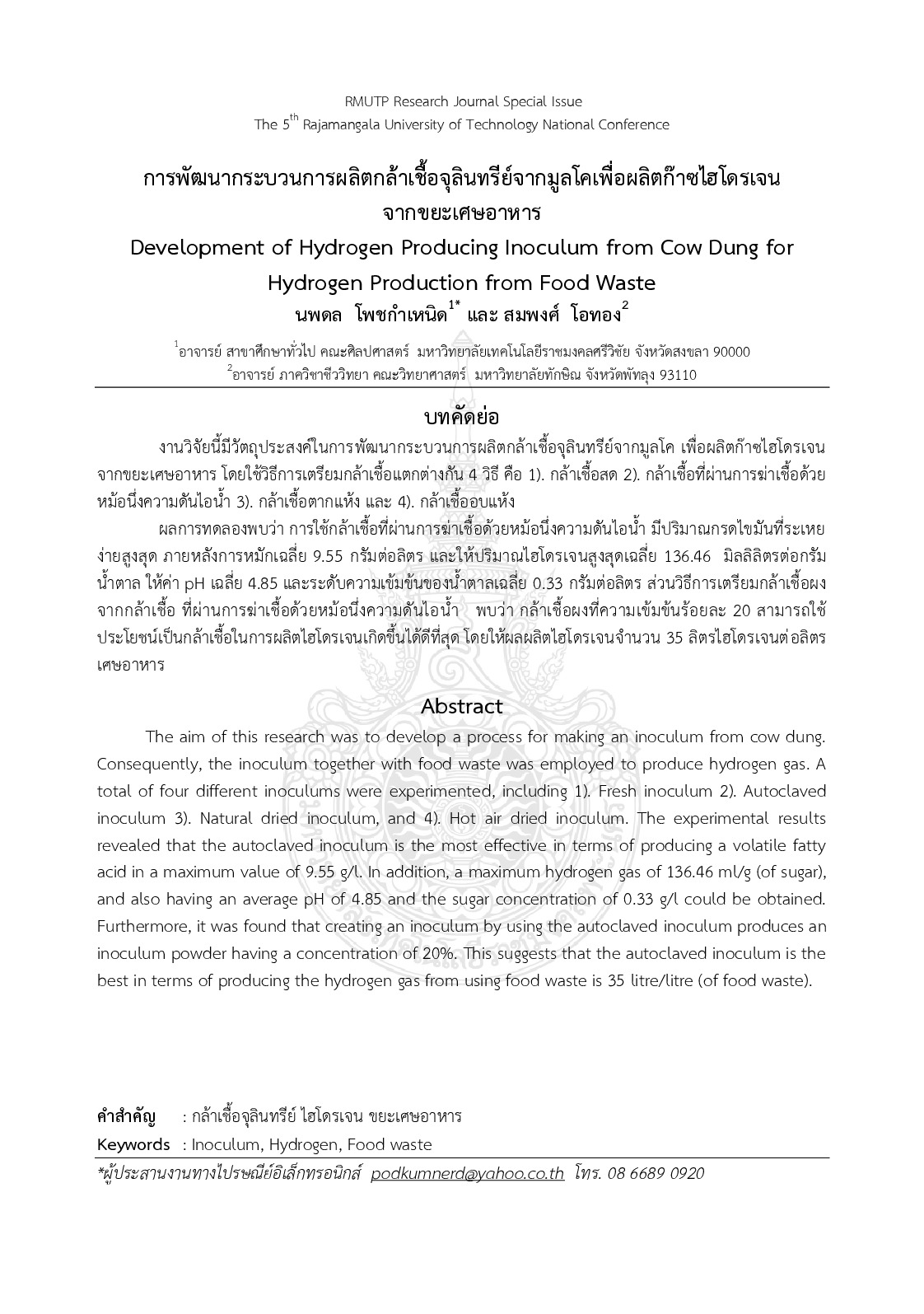
Development of hydrogen producing inoculum from cow dung for hydrogen production from food waste
The aim of this research was to develop a process for making an inoculum from cow dung. Consequently the inoculum together with food waste was employed to produce hydrogen gas. A total of four different inoculums were experimented including 1). Fresh inoculum 2). Autoclaved inoculum 3). Natural dried inoculum and 4). Hot air dried inoculum. The experimental results revealed that the autoclaved inoculum is the most effective in terms of producing a volatile fatty acid in a maximum value of 9.55 g/l. In addition a maximum hydrogen gas of 136.46 ml/g (of sugar) and also having an average pH of 4.85 and the sugar concentration of 0.33 g/l could be obtained. Furthermore it was found that creating an inoculum by using the autoclaved inoculum produces an inoculum powder having a concentration of 20%. This suggests that the autoclaved inoculum is the best in terms of producing the hydrogen gas from using food waste is 35 litre/litre (of food waste).