จำนวน Repository ( 12 )
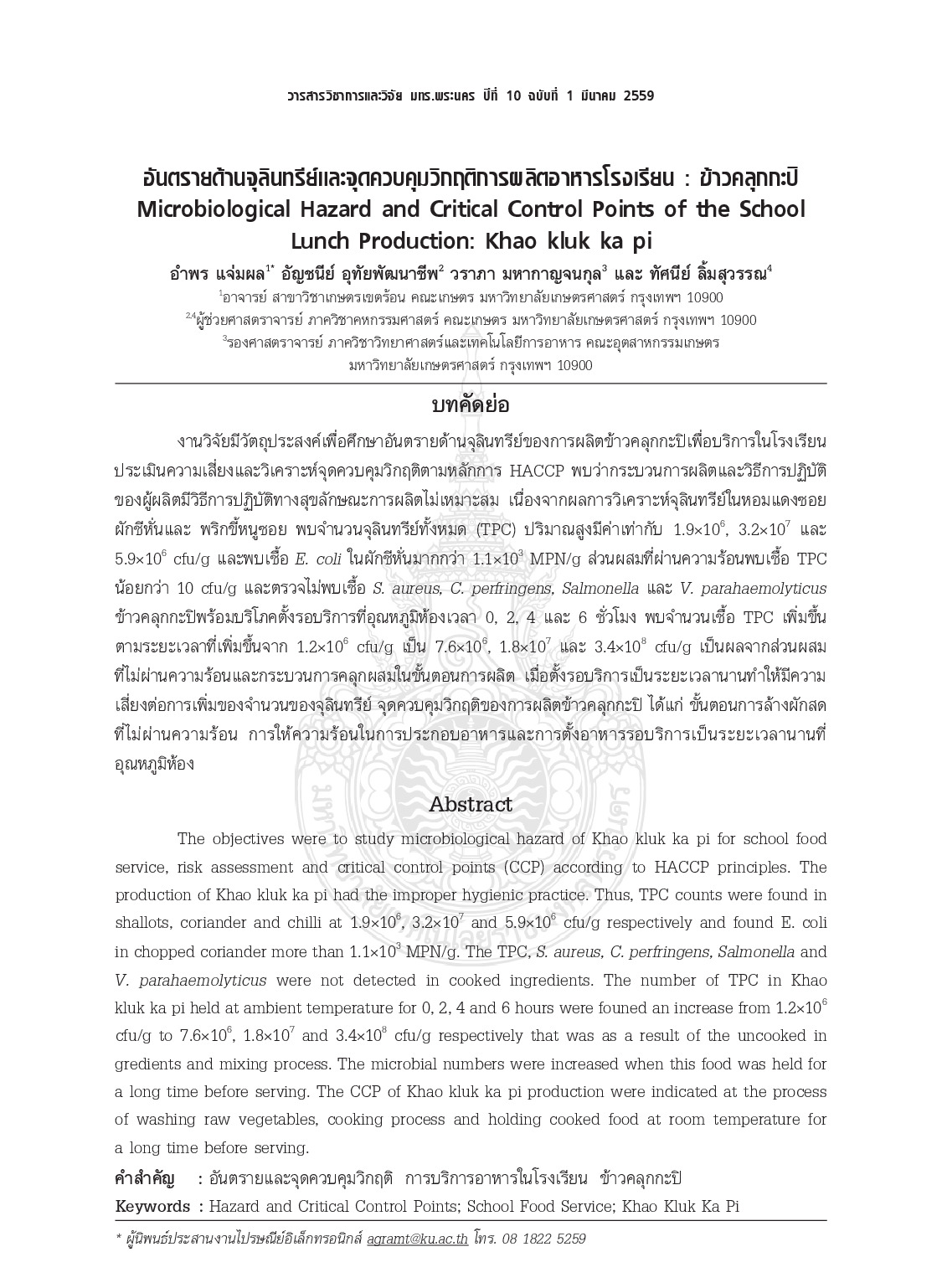
อันตรายด้านจุลินทรีย์และจุดควบคุมวิกฤติการผลิตอาหารโรงเรียน : ข้าวคลุกกะปิ
The objectives were to study microbiological hazard of Khao kluk ka pi for school food service risk assessment and critical control points (CCP) according to HACCP principles.The production of Khao kluk ka pi had the improper hygienic practice. Thus TPC counts were found in shallots coriander and chilli at 1.9×10⁶ 3.2×10⁷ and 5.9×10⁶ cfu/g respectively and found E. coli in chopped coriander more than 1100 MPN/g. The TPC S. aureus C. perfringens Salmonella and V. parahaemolyticus were not detected in cooked ingredients. The number of TPC in Khao kluk ka pi held at ambient temperature for 0 2 4 and 6 hours were founed an increase from 1.2×10⁶ cfu/g to 7.6×10⁶ 1.8×10⁷ and 3.4×10⁸ cfu/g respectively that was as a result of the uncooked ingredients and mixing process. The microbial numbers were increased when this food was held for a long time before serving. The CCP of Khao kluk ka pi production were indicated at the process of washing raw vegetables cooking process and holding cooked food at room temperature for a long time before serving.

Antimicrobial activity of endophytic fungi isolated from myrtaceae at kuankreng peatlands
The purpose of this research was to study antimicrobial activity of endophytic fungi isolated from Myrtaceae ( Melaleuca cajeputi Malaleuca leucadendra Syzygium cumini L. and Rhodomyrtus tomentasa (Ait.) Hassk.) at Kuankreng Peatlands. A total of 124 isolates of endophytic fungi were obtained from all plant types. Three week old fermentation broths of endophytic fungi were tested for antimicrobial activity against pathogenic microorganisms using the agar well diffusion method. Forty- six isolates (37.1%) inhibited at least 1 type of pathogen. Fermentation broth and cells of active endophytes were further extracted with organic solvents and tested for MIC using the microdilution broth method. The results show that 156 of the total of 174 crude extracts (89.6%) produced MIC ? 200 g/mL. The lowest MIC for S. aureus ATCC25923 MRSA SK1 P. aeruginosa ATCC27853 C. albicans ATCC90028C. neoformans ATCC90012 and M. gypseum were 128 200 200 64 200 16 and 200 g/mL respectively.
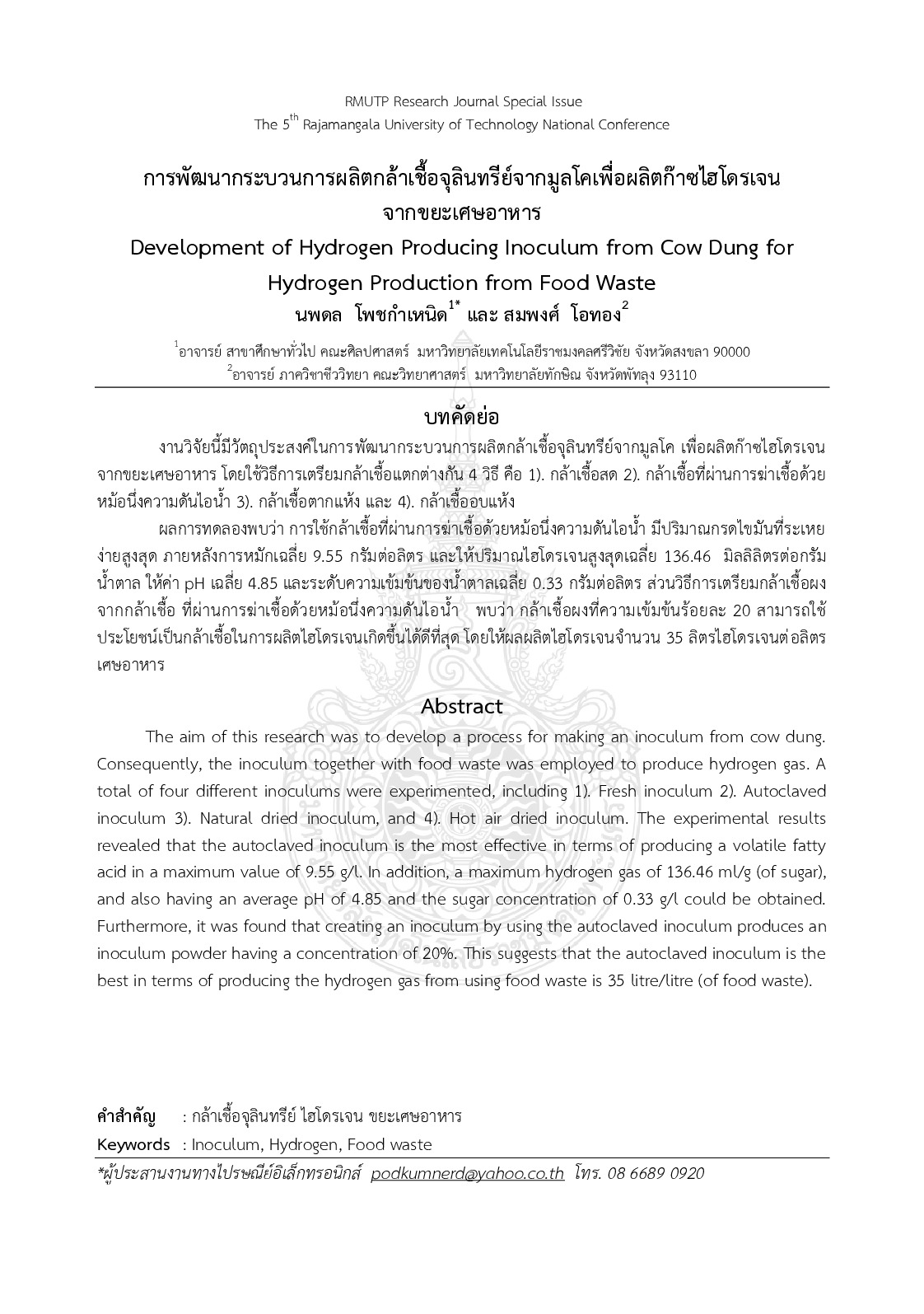
Development of hydrogen producing inoculum from cow dung for hydrogen production from food waste
The aim of this research was to develop a process for making an inoculum from cow dung. Consequently the inoculum together with food waste was employed to produce hydrogen gas. A total of four different inoculums were experimented including 1). Fresh inoculum 2). Autoclaved inoculum 3). Natural dried inoculum and 4). Hot air dried inoculum. The experimental results revealed that the autoclaved inoculum is the most effective in terms of producing a volatile fatty acid in a maximum value of 9.55 g/l. In addition a maximum hydrogen gas of 136.46 ml/g (of sugar) and also having an average pH of 4.85 and the sugar concentration of 0.33 g/l could be obtained. Furthermore it was found that creating an inoculum by using the autoclaved inoculum produces an inoculum powder having a concentration of 20%. This suggests that the autoclaved inoculum is the best in terms of producing the hydrogen gas from using food waste is 35 litre/litre (of food waste).
The Study and development of certain microorganisms with high capability in nanosilver particle biosynthesis
This research report is manipulated that summarized the moment of research project in the subject of “The Study and Development of Certain Microorganisms with High Capability in Nanosilver Particle Biosynthesis”. This project had been take time in 12 mounts. We focused on the isolation of microorganism that from manufacturing process and forming in gems and jewelry industry. Results showed that the initial silver refinery microorganism performed only in terms of Pseudomonas genus especially in AgNO3 solution. In contrast Bacillus genus was not clearly effective silver refinery. These results could be the basis information for establish and develop system for silver refinery and/or silver quality improvement with biological process especially microorganisms in future.
The Efficacy of Peroxyacetic Acid and Sodium Hypochlorite Solutions in Reducing Microorganisms on the Surface of Carved Fruits and Vegetables
This study examined the efficacy of two sanitizers; peroxyacetic acid (PAA) and sodium hypochlorite (NaOCl) in reducing total microbial counts on the carved leaf-shape surface of five types of fruits and vegetables: pumpkin carrot radish cantaloupe and Japanese cucumber. The samples were dipped for 3 or 5 min in various concentrations of PAA (40 60 or 80 mg/L) and NaOCl (50 or 75 mg/L) with distilled water as the control. After dipping the samples were drained for 5 min and the total plate counts were determined in triplicate. Dipping in 60 mg/L of PAA for 3 min was the best treatment for reducing microorganisms on the surface of carved carrot and radish; and 80 mg/L of PAA for 5 min was the best treatment for reducing microorganisms on the surface of carved pumpkin cantaloupe and Japanese cucumber. PAA at concentration 60 -80 mg/L showed potential as an effective sanitizer for carved fruits and vegetables more so than both concentrations of NaOCl.