จำนวน Repository ( 15 )
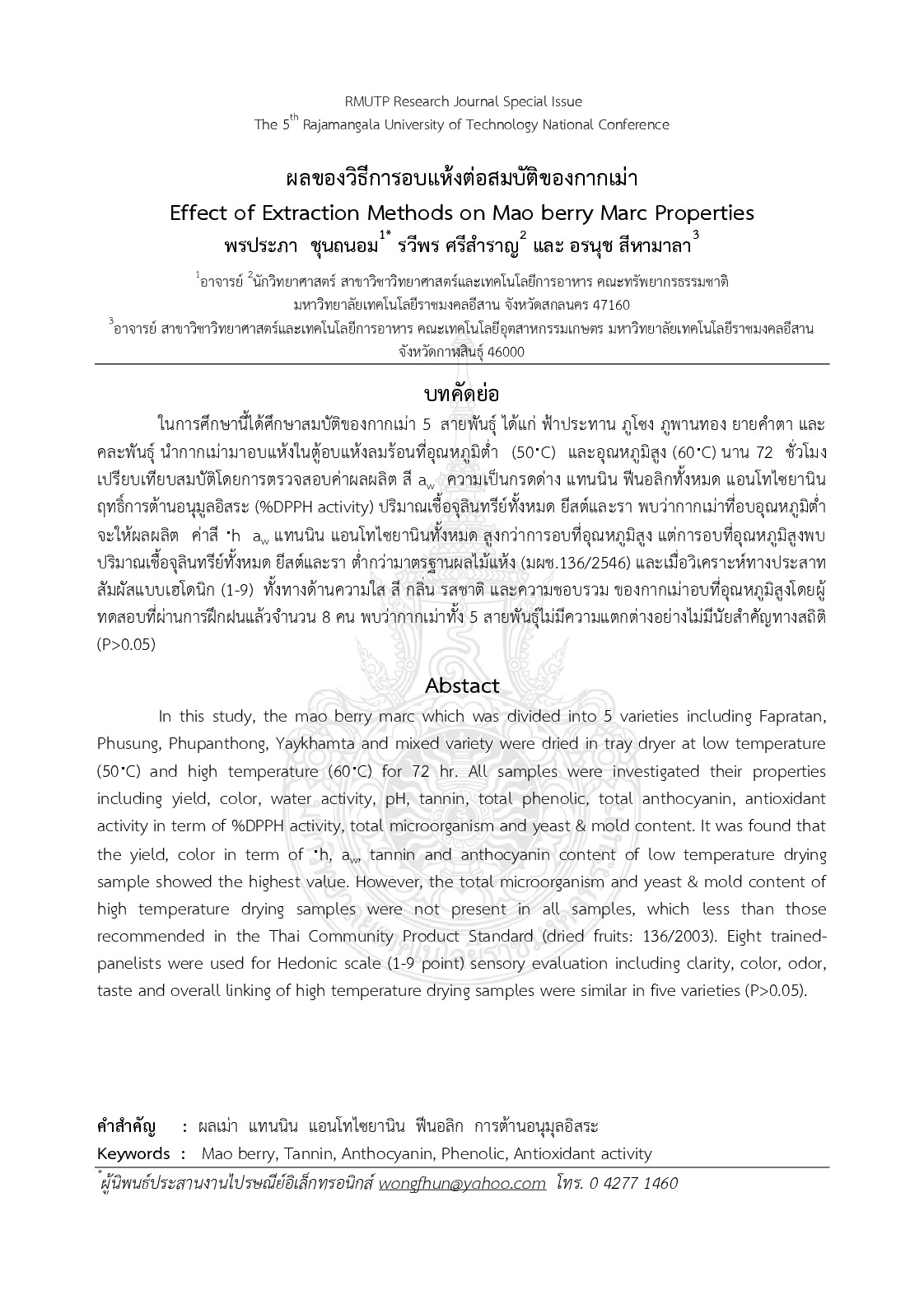
Effect of extraction methods on mao berry marc properties
In this study the mao berry marc which was divided into 5 varieties including Fapratan Phusung Phupanthong Yaykhamta and mixed variety were dried in tray dryer at low temperature (50?C) and high temperature (60?C) for 72 hr. All samples were investigated their properties including yield color water activity pH tannin total phenolic total anthocyanin antioxidant activity in term of %DPPH activity total microorganism and yeast & mold content. It was found that the yield color in term of ?h aw tannin and anthocyanin content of low temperature drying sample showed the highest value. However the total microorganism and yeast & mold content of high temperature drying samples were not present in all samples which less than those recommended in the Thai Community Product Standard (dried fruits: 136/2003). Eight trained-panelists were used for Hedonic scale (1-9 point) sensory evaluation including clarity color odor taste and overall linking of high temperature drying samples were similar in five varieties (P>0.05).
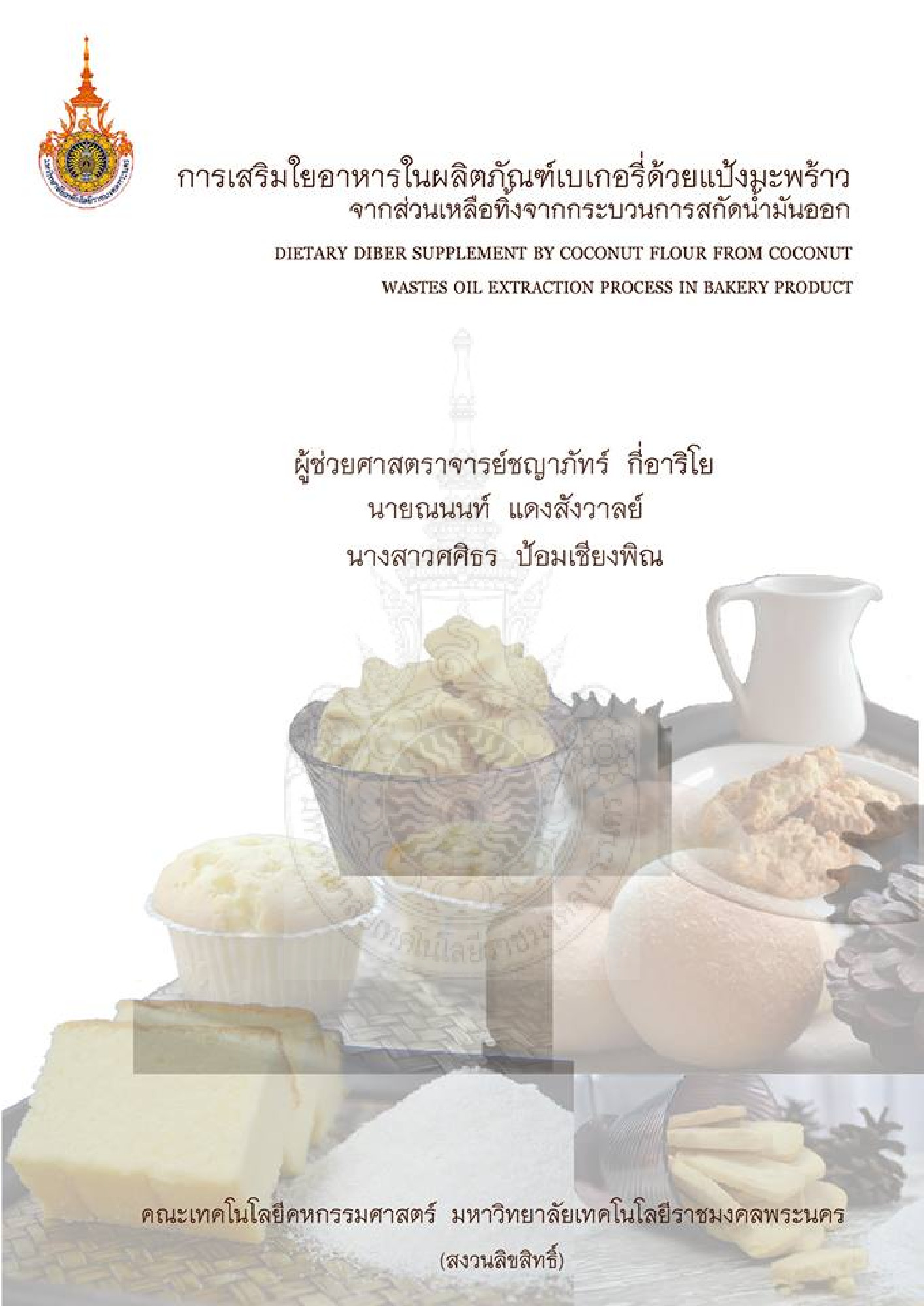
การเสริมใยอาหารในผลิตภัณฑ์เบเกอรี่ด้วยแป้งมะพร้าวจากส่วนเหลือทิ้งจากกระบวนการสกัดน้ำมันออก
The studies of Dietary Fiber Supplement by coconut flour from coconut Wastes Oil Extraction process in Bakery Product was investigated Production of coconut flour from coconut wastes oil extraction drying at 55 ° C for 12 hours and then grinding to powder gave the off-white fine powder. The chemical compositions of coconut flour were 57.70 % carbohydrate 29.4 % fat 6.23 % moisture 5.20 % protein and 1.48 % ash by dye weigh. Butter cake making experiment by substitution of wheat flour with coconut flour at 5 % of wheat flour weigh which has the highest sensory scores comparing butter cake with the control found that increase dietary fiber 1.34 g. /100 g. The majority of the tested consumers (92%) accepted butter cake with 5 % of coconut flour substitution. Muffin making experiment by substitution of wheat flour with coconut flour at 15 % of wheat flour weigh which has the highest sensory scores comparing muffin with the control found that increase dietary fiber 2.34 g /100 g. The majority of the tested consumers (81%) accepted muffin with 15 % of coconut flour substitution. Cornflake cookie making experiment by substitution of wheat flour with coconut flour at 20 % of wheat flour weigh which has the highest sensory scores comparing cornflake cookie with the control found that increase dietary fiber 3.54 g. /100 g. The majority of the tested consumers (94 %) accepted cornflake cookie with 20 % of coconut flour substitution. Butter cookie making experiment by substitution of wheat flour with coconut flour at 10 % of wheat flour weigh which has the highest sensory scorescomparing butter cookie with the control found that increase dietary fiber 3.04 g. /100 g. The majority of the tested consumers (94 %) accepted Butter cookie with 10 % of coconut flour substitution. Frozen cookie making experiment by substitution of wheat flour with coconut flour at 20 % of wheat flour weigh which has the highest sensory scores comparing cookie with the control found that increase dietary fiber 4.02g. /100 g. The majority of the tested consumers (93 %) accepted 20 % of coconut flour substitution. Butter bread making experiment by substitution of wheat flour with coconut flour at 15 % of wheat flour weigh which has the highest sensory scores comparing butter bread with the control found that increase dietary fiber 2.22 g. /100 g. The majority of the tested consumers (75 %) accepted 15% of coconut flour substitution. Whole wheat bread making experiment by substitution of wheat flour with coconut flour at 15 % of wheat flour weigh which has the highest sensory scores comparing whole wheat bread with the control found that increase dietary fiber 2.09 g. /100 g. The majority of the tested consumers (79 %) accepted 15 % of coconut flour substitution. Pie crust making experiment by substitution of wheat flour with coconut flour at 15 % of wheat flour weigh which has the highest sensory scores comparing pie crust with the control found that increase dietary fiber 2.91 g. /100 g. The majority of the tested consumers (82 %) accepted 15 % of coconut flour substitution.

การพัฒนาหม้อนึ่งแรงดันสูงเพื่อการสกัดสีและย้อมสีธรรมชาติภายใต้แผนงานวิจัย การจัดการองค์ความรู้ทางสิ่งทอในการพัฒนาและอนุรักษ์ภูมิปัญญาชุมชน กรณีศึกษาผ้าทอกะเหรียง
This research had an aim to develop an autoclave for using in natural dyes extraction and dyeing process. The autoclave used the stainless steel as the major material what it was a noble durable material and good resistance for the chemical used in the processes. The achievement results showed by the comparison data between the conventional process and the development using autoclave in term of extraction efficiency deep of shade (K/S) time equivalent process time and amount of gas consumption saver. The knowledge from the research would transfer to the target group at Bann Yang Nam Klad Tai Phetchaburi province. The results were following as 1. For the extraction process: the extraction process using 100oC for 45 min. They obtained product was the same dye quality but the autoclave process was smaller water evaporation as 26.71% whereas the conventional process was 41.99%. 2. For the dyeing process: All condition from the autoclave using make a deeper dye shade (K/S) than conventional process. The dyeing time equivalent as 15 minutes to make the depth shape via autoclave process as alike the conventional process for 45 min. 3. Saving time and gas consumption: the autoclave process could save 66.67% time process and 88.99% amount of gas consumption. 4. The Complacency for knowledge assignment: the satisfaction level in the content time and period was good. Furthermore the utilization the instructors and the value obtained were excellent. This research accomplished the study objectives. The results were not only corresponding to energy conservation but them also reducing the chemical toxic and pollutant vapor inhalant to the worker.
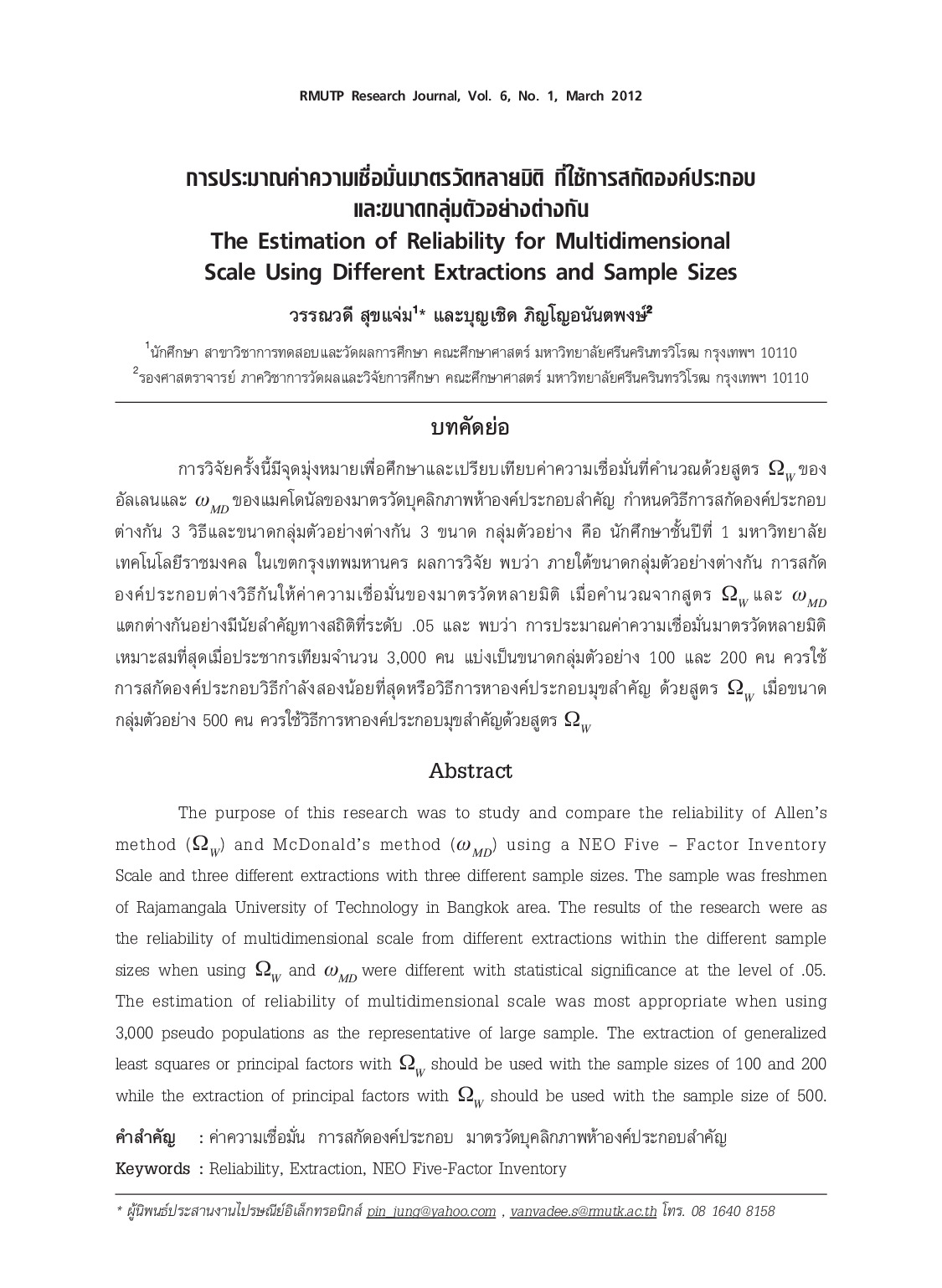
The Estimation of Reliability for Multidimensional Scale Using Different Extractions and Sample Sizes
The purpose of this research was to study and compare the reliability of Allen’s method (ΩW) and McDonald’s method (ωMD) using a NEO Five – Factor Inventory Scale and three different extractions with three different sample sizes. The sample was freshmen of Rajamangala University of Technology in Bangkok area. The results of the research were as the reliability of multidimensional scale from different extractions within the different sample sizes when using ΩW and ωMD were different with statistical significance at the level of .05. The estimation of reliability of multidimensional scale was most appropriate when using 3000 pseudo populations as the representative of large sample. The extraction of generalized least squares or principal factors with ΩW should be used with the sample sizes of 100 and 200 while the extraction of principal factors with ΩW should be used with the sample size of 500.
The Extraction and Biological Activity of Medicinal Plant Extracts.
The biological activity of erude hexane ethylacetate and methanol extracts from stem bark of Xylocarpus granatum Koen. Walsura trichostemon Miq. And Parinari anamense Hance with sequential extraction and maceration technique. The crude extract was employed toevaluate the biological activity such as the antimicrobial activities test by the Microplate broth dilution techniques the antioxidant activities test by DPPH radical scavenging assay the totalphenolic contents test by the Folin-Ciocalteu method the anti-malaria (Plasmodium falciparum) test by Microculture Radioisotope Technique the anti-Mycobacterium Tuberculosis (anti-TB) test by Green fluorescent protein microplate assay (GFPMA) and the anti-cancer (KB-Oral cavity cancer) test by Resazurin Microplate assay (REMA)