จำนวน Repository ( 15 )
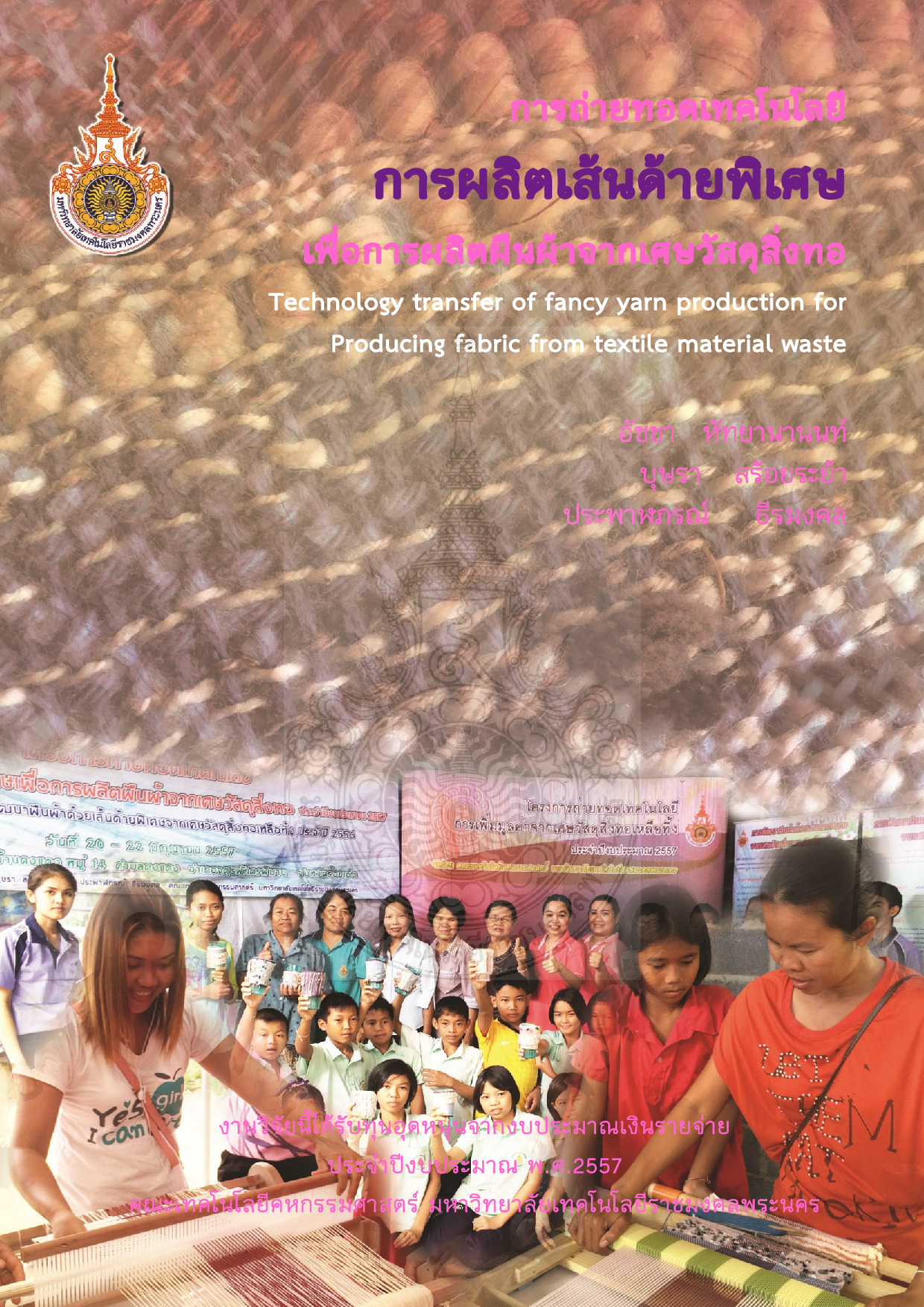
การถ่ายทอดเทคโนโลยีการสร้างตราสินค้าและบรรจุภัณฑ์เพื่อเพิ่มมูลค่าผลิตภัณฑ์จากเศษวัสดุสิ่งทอเหลือทิ้ง
The research aimed to Technology transfer of fancy yarn production for producing fabric from textile material waste. The purpose is to technology transfer of fancy yarn production for producing fabric to people and community and to evaluate of technology transfer of fancy yarn production for producing fabric. The procedures were as follows target population for the transfer of knowledge and technology as Small and Micro community Enterprise--SMCE and individuals interested in Dang Dong sub-district Bang Bon district at Roi-Ed province. A total of 34 peoples and two days on 20 - 21 June 2557 and a satisfaction survey with a questionnaire after training. The data were analyzed using frequency percentage and mean. The results that general Information are female and younger than 21 years of education in elementary education as a student. A question that asking about their satisfaction with the course and to divide into three aspects: the purpose of the project The course structure and the contents of the course. The majority were satisfied with the very best. The purpose and the content are high level of satisfaction. In relation to technology transfer of fancy yarn production for producing fabric from textile material waste divided into three aspects: the process provides trainers and facilities was found that were satisfied at all of the 3 parts. The participants are mainly used to provide benefits to themselves for one month to apply the knowledge gained after the training. The participants modified using a new material and used local materials applied accordingly. Moreover a focus will be capped by the school to take courses and workshops and to teach another one for working out or as part of the courses taught at the school. Satisfaction with the benefits of technology transfer and utilization. Satisfaction at the highest level. The comments and suggestions of the participants found that they need for re-training again. They would like to have a longer period of training in order to gain more knowledge. All lecturer can transfer knowledge during the training as well.
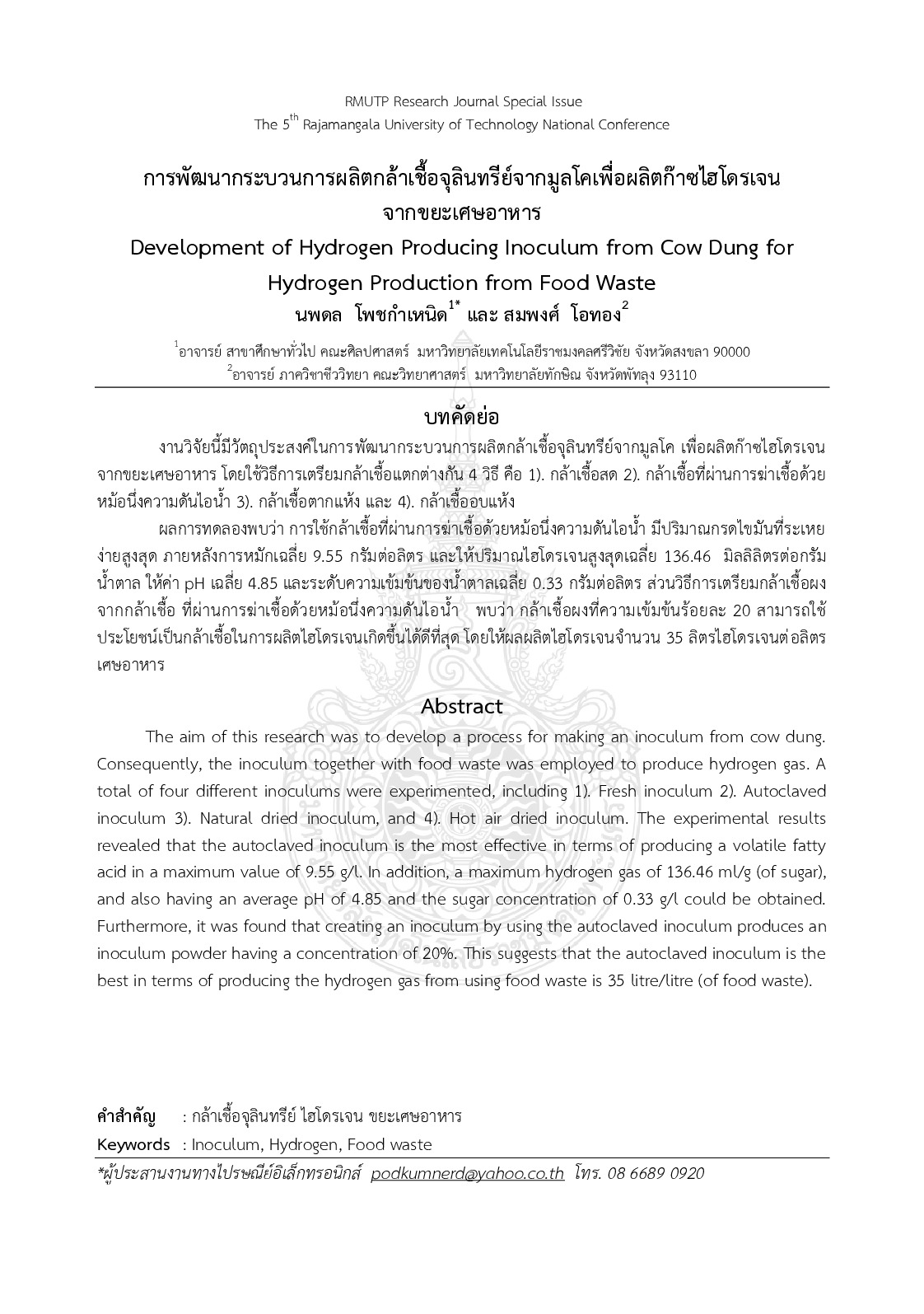
Development of hydrogen producing inoculum from cow dung for hydrogen production from food waste
The aim of this research was to develop a process for making an inoculum from cow dung. Consequently the inoculum together with food waste was employed to produce hydrogen gas. A total of four different inoculums were experimented including 1). Fresh inoculum 2). Autoclaved inoculum 3). Natural dried inoculum and 4). Hot air dried inoculum. The experimental results revealed that the autoclaved inoculum is the most effective in terms of producing a volatile fatty acid in a maximum value of 9.55 g/l. In addition a maximum hydrogen gas of 136.46 ml/g (of sugar) and also having an average pH of 4.85 and the sugar concentration of 0.33 g/l could be obtained. Furthermore it was found that creating an inoculum by using the autoclaved inoculum produces an inoculum powder having a concentration of 20%. This suggests that the autoclaved inoculum is the best in terms of producing the hydrogen gas from using food waste is 35 litre/litre (of food waste).
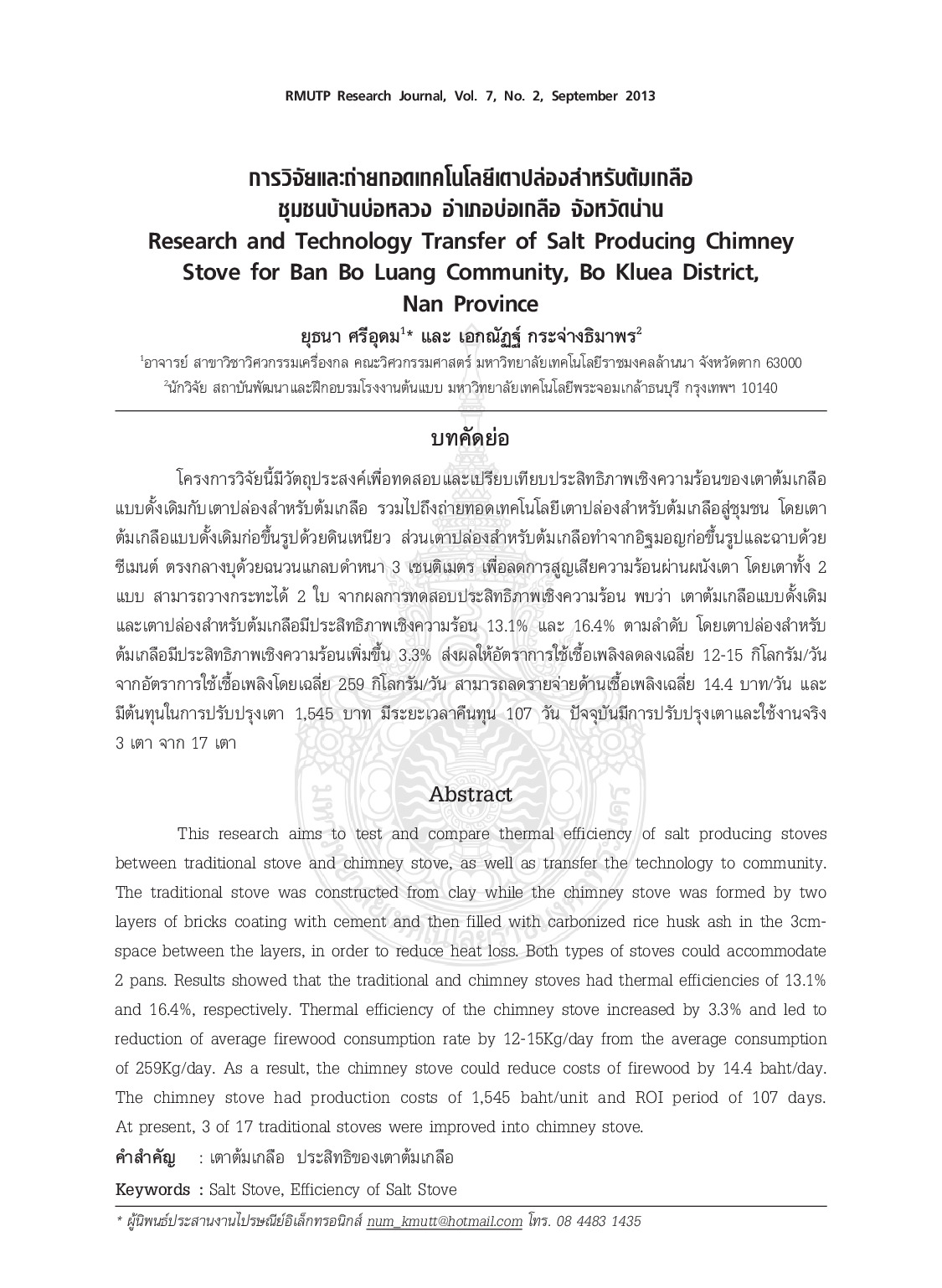
Research and technology transfer of salt producing chimney stove for ban bo luang community, bo kluea district, Nan Province
This research aims to test and compare thermal efficiency of salt producing stoves between traditional stove and chimney stove as well as transfer the technology to community. The traditional stove was constructed from clay while the chimney stove was formed by two layers of bricks coating with cement and then filled with carbonized rice husk ash in the 3cm-space between the layers in order to reduce heat loss. Both types of stoves could accommodate 2 pans. Results showed that the traditional and chimney stoves had thermal efficiencies of 13.1% and 16.4% respectively. Thermal efficiency of the chimney stove increased by 3.3% and led to reduction of average firewood consumption rate by 12–15Kg/day from the average consumption of 259Kg/day. As a result the chimney stove could reduce costs of firewood by 14.4 baht/day. The chimney stove had production costs of 1545 baht/unit and ROI period of 107 days. At present 3 of 17 traditional stoves were improved into chimney stove.

การศึกษากระบวนการถ่ายทอดเทคโนโลยีการผลิตปุ่บอินทรีย์อัดเม็ดจากวัสดุท้องถิ่นของชุมชน
The main objective of this articipatory research was to study technology ransfer process for producing granule organic fertilizer in Nongkrathum community using qualitative and semi-experimental methodology. The main instruments consisted of interview questionnaire and training. The samples and key informants were farmers and technology instructors. Data analysis and synthesis involved content and inductive analysis fundamental statistical analysis and Wilcoxon Sign-Rank test. Results showed that the technology transfer process was divided into three stages: 1) Knowledge and persuasion stage 2) Decision stage and 3) Implementation stage which included 2 training sessions. Only eight of farmers could participate in both training sessions. The total mean scores of satisfaction in technology were at moderate level ( =3.28) before training and very high level ( =4.25) after training. Regarding expectation of utilizing the technology before training 62.5% of farmers had high expectation. However 87.5% of the farmers had a very high expectation after training. Comparison of expectations before and after training showed significant differences at the level of .05.
Canonical Correlation Analysis Between some Factors and Motivation on Producing Academic Papers of Instructors in The Office of Rajamangala University of Techlnology Phra Nakhon
The purposes of this research were to study the canonical relationship between some factors and motivation on producing that relative contribute to academic papers and to study the canonical weights of some factory motivation on producing academic papers. The Sample were the 222 instructors in the office Rajamangala University of technology Phra Nakhon who work during the first semester of Academic year 2005. The stratified random sampling technique was used for selecting the sample. The instruments were the questionnaire considering the salary work load working experience Attitudes toward producing academic papers Self development Internal control Academic ability Motivation on advancement Motivation on recognition and Motivation on environment of producing academic papers. The findings were as follow: 1. The canonical correlation between Salary Work load Working experience Attitudes toward producing academic papers Self development Internal control Academic ability Motivation on advancement Motivation on recognition and Motivation on environment of producing academic papers were .510 .231 and .134 respectively. The first canonical function was Statistically Significant at .05 level. The second and third canonical function were Statistically nonsignificant. 2. The canonical weights for Attitudes toward producing academic papersself development and Internal Control relative contributed to Motivation on advancement Motivation on recognition and Motivation on environment of producing academic papers in the first canonical function.