จำนวน Repository ( 17 )
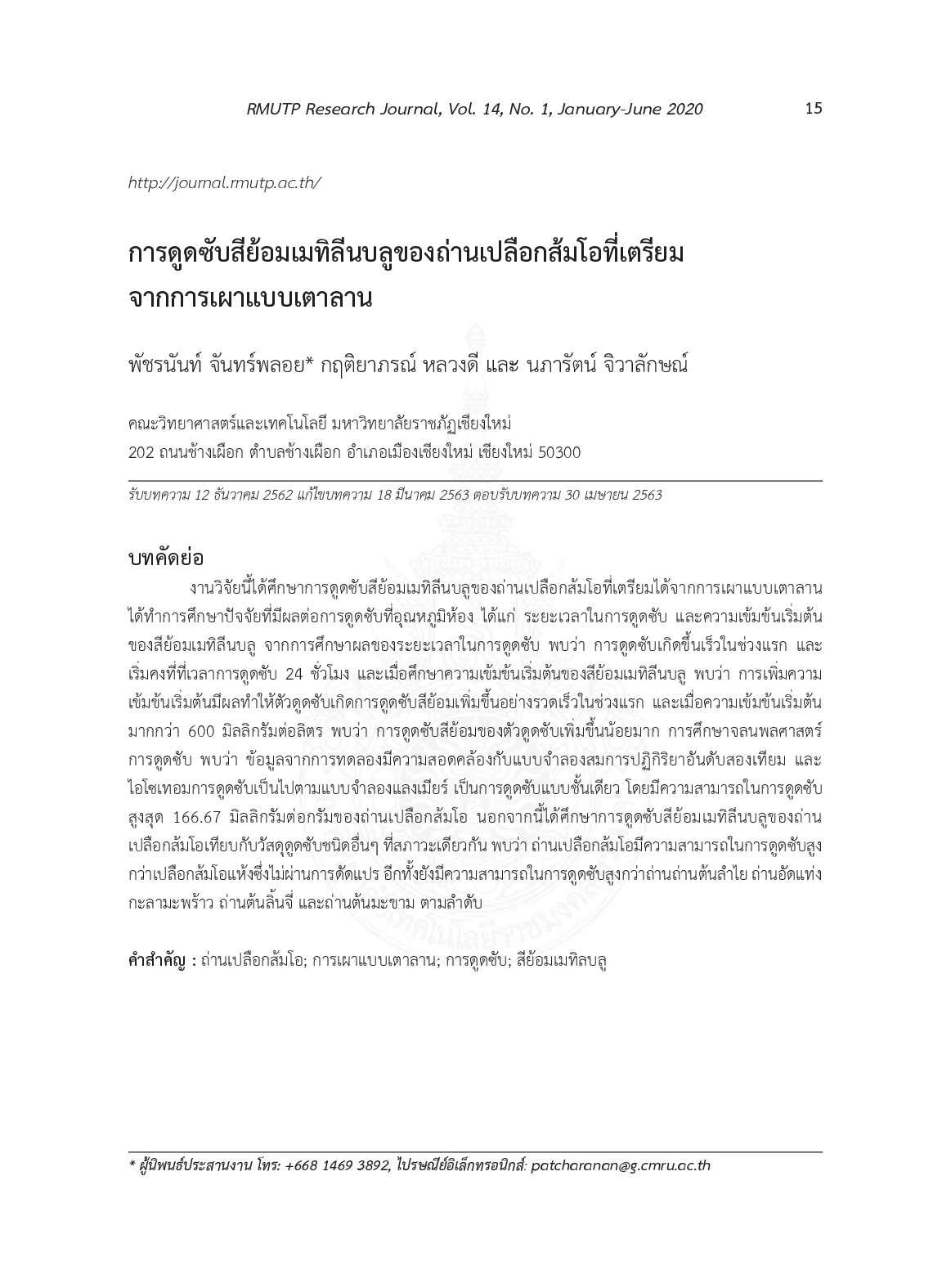
การดูดซับสีย้อมเมทิลีนบลูของถ่านเปลือกส้มโอที่เตรียมจาการเผาแบบเตาลาน
The pomelo peels charcoal was successfully prepared by traditional charcoal burning and its adsorption of methylene blue was investigated. The influences of methylene blue adsorption including contact time and methylene blue initial concentration were studied at room temperature. The adsorption rate initially increased rapidly until 24 h and 600 mg/L of methylene blue initial concentration. The further increase in contact time and methylene blue initial concentration did not significantly increase the adsorption due to it reached equilibrium. Kinetic of adsorption were investigated that the pseudo-second order model best described adsorption kinetic data. The adsorption isotherms were evaluated and the data correlated with Langmuir adsorption model with the maximum adsorption capacity was found to be 166.67 mg/g. The adsorption of pomelo peel charcoal was studied comparing to other adsorbents at the same experimental conditions. The results showed higher adsorption of pomelo peel charcoal than dried pomelo peel longan wood charcoal coconut shell charcoal litchi wood charcoal and tamarind wood charcoal respectively.
ศักยภาพของมะดูกพืชสมุนไพรพื้นบ้านของไทยในการรักษาโรคเพื่อพัฒนาองค์ความรู้ของภูมิปัญญาท้องถิ่นไปสู่การใช้ประโยชน์อย่างยั่งยืน
The research project on The potential of Siphonodon celastrineus Griff traditional medicinal plants of Thailand for treatment from local wisdom knowledge lead to the development of sustainable use with the objective of studying the botanical phytochemical and biological activity of the Siphonodon celastrineus to create confidence in the use of S. celastrineus in herbal medicine by using the bark leaves and fruit of the S. celastrineus to extract with 3 types of solvents. Each of hexane ethyl acetate and methanol respectively from low to high polarity. All nine extracts will be extracted. Preliminary examinations for phytochemistry Antioxidant activity by DPPH radical scavenging assay and quantitative determination of phenolic compounds by Folin-Ciocalteu method and antimicrobial activity were tested. The research found that. 1. The extract of the results of the methanol layer of the S.celastrineus shows a reduction in the amount of 11-diphenol-2-picrylhydrazyl (DPPH) had the highest EC50 equal to 31 mg/ml. The amount of phenol compounds found that the extracts from the methanol extract of S. celastrineus contain the amount of phenol. The highest concentration of 95.23 mg GAE / g dw 2. Extract from the bark of the S. celastrineus with methanol showed the best inhibition of the growth of Vibrio paraheamolyticus with the MIC value of 15.60 mg/ml. The extracts of the S. celastrineus leaf extracts with hexane showed the best inhibition of the growth of Vibrio cholerae with the MIC value equal to 31.25 mg/ml and leaf extracts with ethyl acetate showed the best inhibitory effect on the growth of Vibrio cholerae with a MIC value of 31.25 mg/ml and the extract of the fruit with ethyl acetate to inhibit the growth of Vibrio paraheamolyticus most with MIC equal to 15.60 mg/ml.

การรับรู้คุณภาพการบริการ คลินิกหัวเฉียวไทย - จีน แพทย์แผนไทย
This independent study was aimed to 1) explore the users’ demographic characteristics 2) level of perception of service quality and 3) comparison of demographic characteristics differences of the perceived service quality at Hua Chiew Thai – Chinese traditional Thai medication. The samples used in the research were 400 service users of Hua Chiew Thai – Chinese traditional Thai medication. The questionnaire was applied for the data collection. The statistics used for data analysis were descriptive statistics including frequency percentage mean standard deviation t-test F-test and the analysis of One-Way ANOVA. When the statistical significance. 0.05 was found multiple comparison test using Scheffes method was applied. The study results revealed that the users who differed in terms of demographic characteristics education level and marital status perceived the overall service quality differently.
ศักยภาพภูมิปัญญาท้องถิ่นด้านอาหารพื้นบ้านเพื่อเพิ่มมูลค่าพืชท้องถิ่น ของชุมชนแพรกหนามแดง อาเภออัมพวา จังหวัดสมุทรสงคราม
The purposes of this research were to investigate the types of local foods of Praknamdaeng Community and the potential of local wisdom of the community’s traditional foods in the aspect of raw material resources production process commercial production wisdom transfer to collect the knowledge of food ingredients and cooking methods and to study nutritive values of 15 recipes (using INMUCAL-Nutrients program) in Praknamdaeng Community Amphawa Samutsongkhram. This research was conducted by in-depth interviews with 12 local food experts who have lived in six villages of Praknamdaeng Community. Two people per village were purposively selected. The research tools were interview forms a tape recorder and a camera. The data were analyzed by mean percentage and rating scales. The study revealed that 132 types of local foods were found and classified into three groups namely main dish (75%) dessert (15.15%) as well as preserved and processed foods (9.85%). As for the potential in raw material resources all types of traditional foods were at a high level (100%) and in the aspect of the potential in production process all kinds of the foods were also at a high level namely main dish (93.94%) preserved and processed foods (84.62%) and dessert (80%). Furthermore the potential in preserved and processed food’s commercial production was at a high level (53.85%) whereas the potential in dessert’s commercial production was at a moderate level (40%) and the potential in main dish was at a low level (52.53%). From the result of wisdom transfer all types of the foods were at a moderate level including dessert (100%) preserved and processed foods (100%) and main dish (67.67%). As a result of the collection of the knowledge of food ingredients and cooking methods the commonly used meat to cook main dishes were found in the local areas and consisted of cuttle fish tilapia long-whiskered catfish mullet sea catfish sea bass rock cod mackerel bream white bait nile tilapia shakehead fish giant tiger prawn banana shrimp jinga shrimp sea crab and salt mardi crab. Moreover the vegetable ingredients were phak plang (Bacella alba Linn.) cha-kram (seablite) luk sam sip (Asparagus race mosus willd) phak bia (rose moss) nam pung do (Azima sarmentosa Benth) and phak kom hin (Trianthema portulacastrum). Most dessert ingredients were coconut milk palm sugar and granulated sugar whereas the ingredients of preserved and processed foods were fishes shrimps and salt which were used to preserve foods; for example drying salting etc. In addition the findings showed that the main dishes’ cooking methods of six villages were curries with local vegetables including hot and sour soup with phak kom hin (Trianthema portulacastrum) hot and sour soup with cha-kram (seablite) hot and sour soup with phak plang (Bacella alba Linn.) hot and sour soup with tua tob tab (Derris trifoliate Lour.) hot and sour soup with yod prong thalee (queen sago leaf) hot and sour soup with sano (Sesbania javanica Mig.) flower kaeng liang (spicy herb soup) with phak kom hin (Trianthema portulacastrum) kaeng oom (dill soup) with nam pung do leaf and red curry with Nipa palm’s fruit. Nowadays the ready-made curry paste which is available in the market is normally used. If any vegetables used were bitter salty or astringent they would be boiled before cooking. Most of the desserts were boiled ones such as khanom tom (Thai coconut munchkins) khuay buat chi (banana in sweet coconut milk) buat fak thong (pumpkin in sweet coconut milk) green beans in light syrup soft sweet sticky rice pudding with young coconut meat and tapioca pearl pudding with young coconut meat. Due to lots of fishes all year-round most of the favorite preserved and processed foods in the community were sun-dried fish and deep-fried marinated fish. Due to study the nutritive values of 15 recipes of local foods of Praknamdaeng Community it was found that cha-kram red curry with cockle provided highest energy (2578.59 kcal) highest fat (196.29 g) highest iron (74.35 mg.) highest Vitamin B1 (0.70 mg) and highest Vitamin B2 (2.76 mg) respectively. Cha-kram Jam provided highest carbohydrate (347.76 g). Steamed tilapia curry in banana leaves with cha-kram provided highest protein (135.15 g) highest Vitamin C (65.65 mg) and highest Niacin (24.73 mg) respectively. Nam Pung Do scrambled egg provided highest Vitamin A (736 µg RE). According to sensory evaluation test on appearance color odor taste texture and preference of 15 recipes of Praknamdaeng’s local foods the result of taster acceptability test indicated that they highly liked every aspect of 13 recipes while steamed tilapia curry in banana leaves with cha-kram and Cha-kram Jam were accepted between a moderate level and a high level.
ศักยภาพภูมิปัญญาท้องถิ่นด้านอาหารพื้นบ้านเพื่อเพิ่มมูลค่าพืชท้องถิ่น ของชุมชนแพรกหนามแดง อำเภออัมพวา จังหวัดสมุทรสงคราม
The purposes of this research were to investigate the types of local foods of Praknamdaeng Community and the potential of local wisdom of the community’s traditional foods in the aspect of raw material resources production process commercial production wisdom transfer as well as to collect the knowledge of food ingredients and cooking methods in Praknamdaeng Community Amphawa Samutsongkhram. This research was conducted by in-depth interviews with 12 local food experts who have lived in six villages of Praknamdaeng Community. Two people per village were purposively selected. The research tools were interview forms a tape recorder and a camera. The data were analyzed by mean percentage and rating scales. The study revealed that 132 types of local foods were found and classified into three groups namely main dish (75%) dessert (15.15%) as well as preserved and processed foods (9.85%). As for the potential in raw material resources two types of traditional foods were at a high level (100%) and in the aspect of the potential in production process all kinds of the foods were also at a high level preserved and processed foods (84.62%) and dessert (80%) and main dish was at a moderate level (54.55%) Furthermore the potential in preserved and processed food’s commercial production was at a high level (53.85%) whereas the potential in dessert’s commercial production was at a moderate level (45%) and the potential in main dish was at a low level (59.60%). From the result of wisdom transfer all types of the foods were at a moderate level including dessert (100%) preserved and processed foods (100%) and main dish (67.67%). As a result of the collection of the knowledge of food ingredients and cooking methods the commonly used meat to cook main dishes were found in the local areas and consisted of cuttle fish tilapia long-whiskered catfish mullet sea catfish sea bass rock cod mackerel bream white bait nile tilapia shakehead fish giant tiger prawn banana shrimp jinga shrimp sea crab and salt mardi crab. Moreover the vegetable ingredients were phak plang (Bacella alba Linn.) cha-kram (seablite) luk sam sip (Asparagus race mosus willd) phak bia (rose moss) nam pung do (Azima sarmentosa Benth) and phak kom hin (Trianthema portulacastrum). Most dessert ingredients were coconut milk palm sugar and granulated sugar whereas the ingredients of preserved and processed foods were fishes shrimps and salt which were used to preserve foods; for example drying salting etc. In addition the findings showed that the main dishes’ cooking methods of six villages were curries with local vegetables including hot and sour soup with phak kom hin (Trianthema portulacastrum) hot and sour soup with cha-kram (seablite) hot and sour soup with phak plang (Bacella alba Linn.) hot and sour soup with tua tob tab (Derris trifoliate Lour.) hot and sour soup with yod prong thalee (queen sago leaf) hot and sour soup with sano (Sesbania javanica Mig.) flower kaeng liang (spicy herb soup) with phak kom hin (Trianthema portulacastrum) kaeng oom (dill soup) with nam pung do leaf and red curry with Nipa palm’s fruit. Nowadays the ready-made curry paste which is available in the market is normally used. If any vegetables used were bitter salty or astringent they would be boiled before cooking. Most of the desserts were boiled ones such as khanom tom (Thai coconut munchkins) khuay buat chi (banana in sweet coconut milk) buat fak thong (pumpkin in sweet coconut milk) green beans in light syrup soft sweet sticky rice pudding with young coconut meat and tapioca pearl pudding with young coconut meat. Due to lots of fishes all year-round most of the favorite preserved and processed foods in the community were sun-dried fish and deep-fried marinated fish.