จำนวน Repository ( 211 )

ตัวแปรที่ส่งผลต่อพฤติกรรมการบริโภคอาหารของกลุ่มเสี่ยงโรคอ้วนลงพุง กรณีศึกษา : โรงพยาบาลส่งเสริมสุขภาพตำบลไผ่งาม อำเภอ โคกสูง จังหวัด สระแก้ว
The objectives of this research are; 1) To study the food consumption behavior of metabolic syndrome risk group PhaiNgam Health Promotion Hospital Khok Sung District Sakaeo Province; 2) To study variables affecting food consumption behavior of metabolic syndrome risk group; 3) Propose alteration food consumption behavior of metabolicsyndrome risk group to executive of PhaiNgam Health Promotion Hospital. A group of 190 Metabolic syndrome risk group was sample with purposive sampling. Data were gathered through questionnaire. Data analysis used the number percentage mean standard deviation and Chi-square test (𝜒2). The food consumption behavior of the group was at a moderate level good. Variables affecting food consumption behavior. Found that body mass index waistnumber of children monthly income exertion or physical activity affect food consumption behavior of the group at the statistical significance of 0.05. Propose alteration foodcunsumption behavior. 1) Using red orange green 3 feeding model. 2) Establishing the principle of eating to control energy. 3) Collaboration with public health officials group activities centered around the relationship achieved a rong. For to executive ofPhaiNgam Health Promotion Hospital.
Perception and participation in food safety program of health personnel in muang kamphaengphet
The objectives of this survey research are to study perception participation and relationship of the factors influence the participation in food safety program. The population was health personnel with purposive sampling represented 30 samples. The tools were questionnaire and descriptive statistics included percentage and chi square test in which to analyze the relationship of the factors influence the participation. The result of this study revealed that the valid perception of the health personnel in 4 aspects of food safety program consisted of perception in danger of food contamination perception of food sanitation perception of best practices and utilities of food safety and perception of threads were generally in the moderate level. The samples participated in every steps of the food safety program which consisted of planning implementation and evaluation revealed that 35.67% of them had participated. The factors related the participation in food safety program had a statistic significance (p<0.05) included the status of consumer protection the information perception in consumer protection and frequency of implementation of the health personnel in consumer protection.
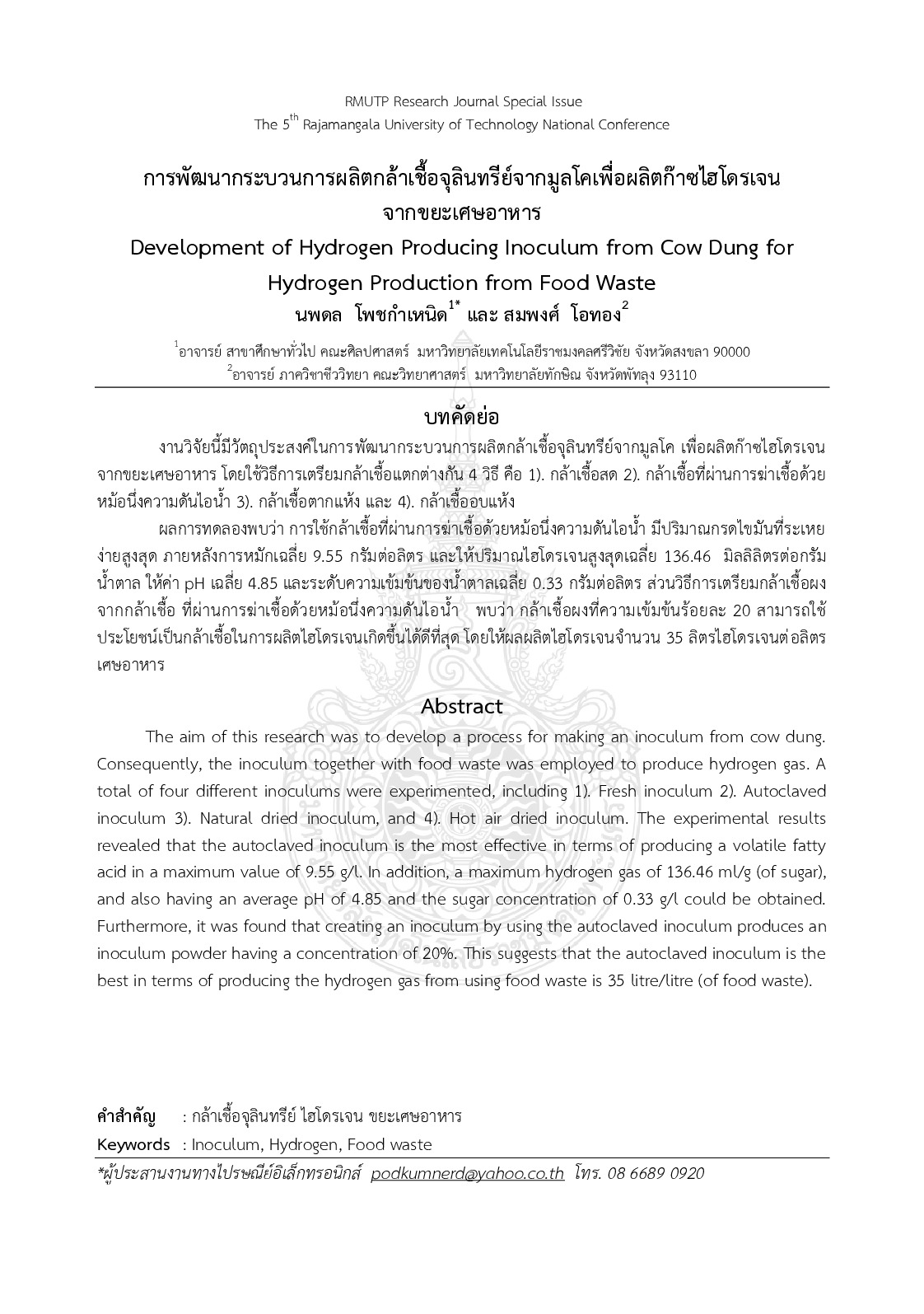
Development of hydrogen producing inoculum from cow dung for hydrogen production from food waste
The aim of this research was to develop a process for making an inoculum from cow dung. Consequently the inoculum together with food waste was employed to produce hydrogen gas. A total of four different inoculums were experimented including 1). Fresh inoculum 2). Autoclaved inoculum 3). Natural dried inoculum and 4). Hot air dried inoculum. The experimental results revealed that the autoclaved inoculum is the most effective in terms of producing a volatile fatty acid in a maximum value of 9.55 g/l. In addition a maximum hydrogen gas of 136.46 ml/g (of sugar) and also having an average pH of 4.85 and the sugar concentration of 0.33 g/l could be obtained. Furthermore it was found that creating an inoculum by using the autoclaved inoculum produces an inoculum powder having a concentration of 20%. This suggests that the autoclaved inoculum is the best in terms of producing the hydrogen gas from using food waste is 35 litre/litre (of food waste).
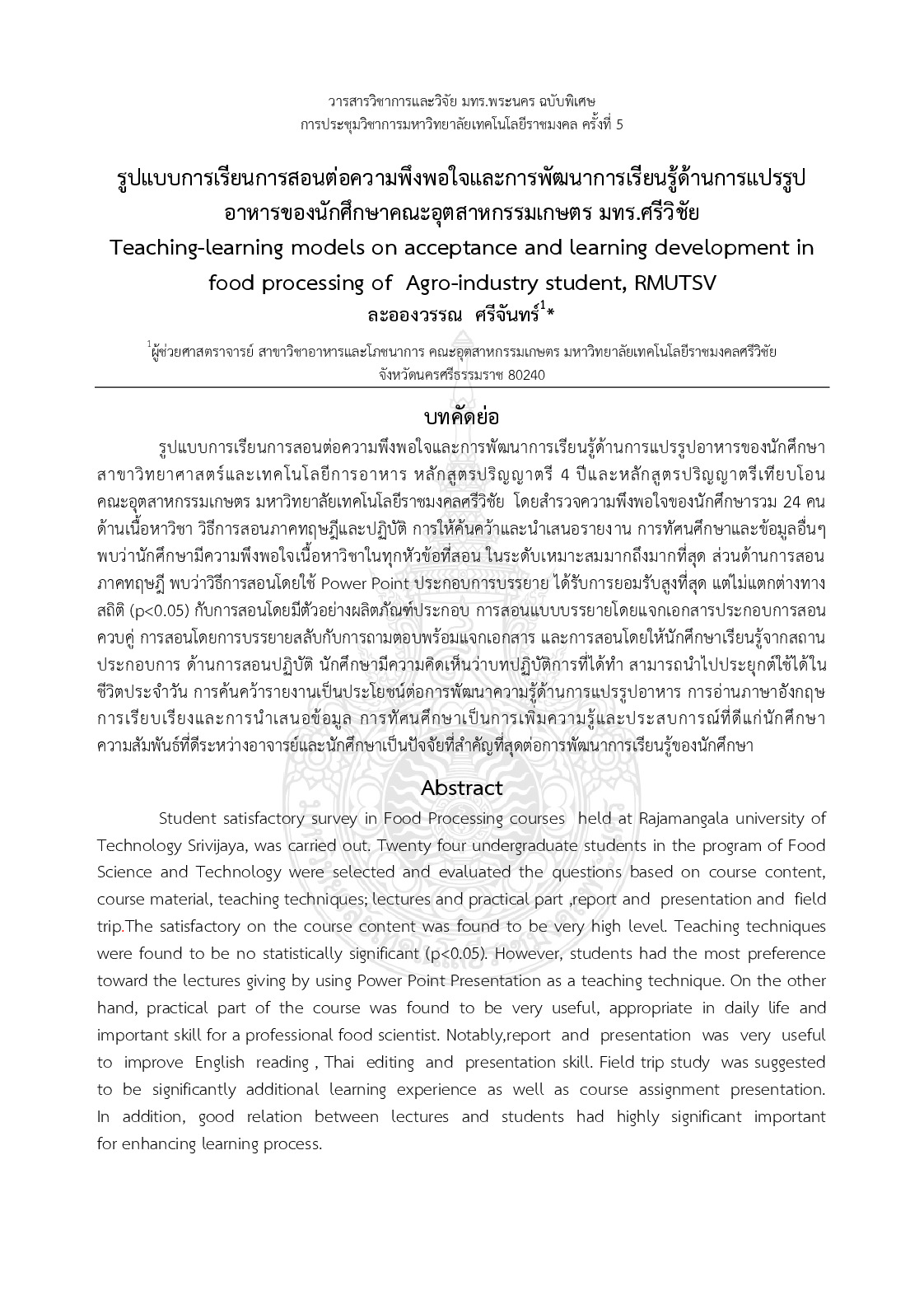
Teaching-learning models on acceptance and learning development in food processing of agro-industry student, RMUTSV
Student satisfactory survey in Food Processing courses held at Rajamangala university of Technology Srivijaya was carried out. Twenty four undergraduate students in the program of Food Science and Technology were selected and evaluated the questions based on course content course material teaching techniques; lectures and practical part report and presentation and field trip.The satisfactory on the course content was found to be very high level. Teaching techniques were found to be no statistically significant (p<0.05). However students had the most preference toward the lectures giving by using Power Point Presentation as a teaching technique. On the other hand practical part of the course was found to be very useful appropriate in daily life and important skill for a professional food scientist. Notablyreport and presentation was very useful to improve English reading Thai editing and presentation skill. Field trip study was suggested to be significantly additional learning experience as well as course assignment presentation. In addition good relation between lectures and students had highly significant important for enhancing learning process.
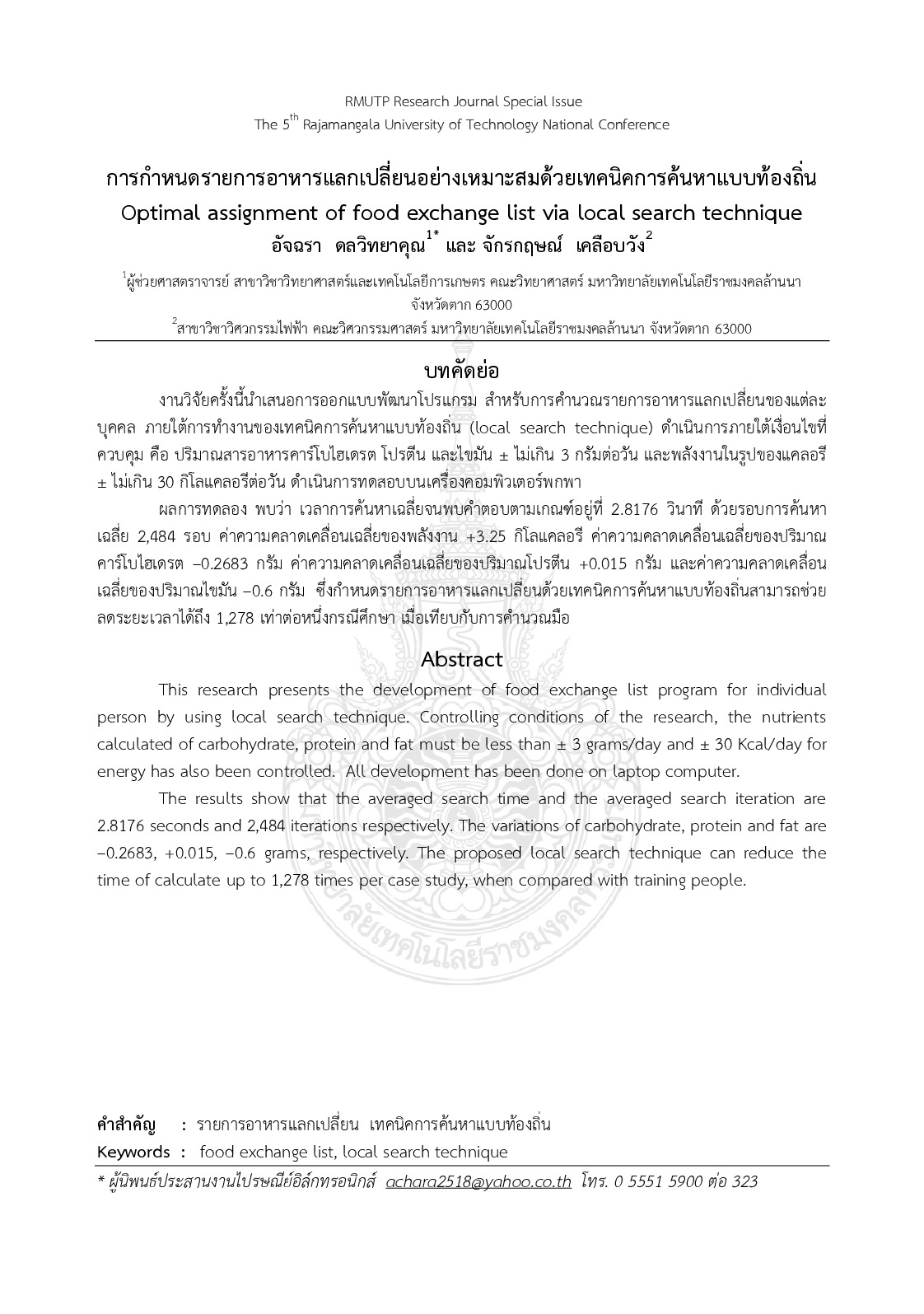
Optimal assignment of food exchange list via local search technique
This research presents the development of food exchange list program for individual person by using local search technique. Controlling conditions of the research the nutrients calculated of carbohydrate protein and fat must be less than 3 grams/day and 30 Kcal/day for energy has also been controlled. All development has been done on laptop computer. The results show that the averaged search time and the averaged search iteration are 2.8176 seconds and 2484 iterations respectively. The variations of carbohydrate protein and fat are –0.2683 +0.015 –0.6 grams respectively. The proposed local search technique can reduce the time of calculate up to 1278 times per case study when compared with training people.