จำนวน Repository ( 141 )
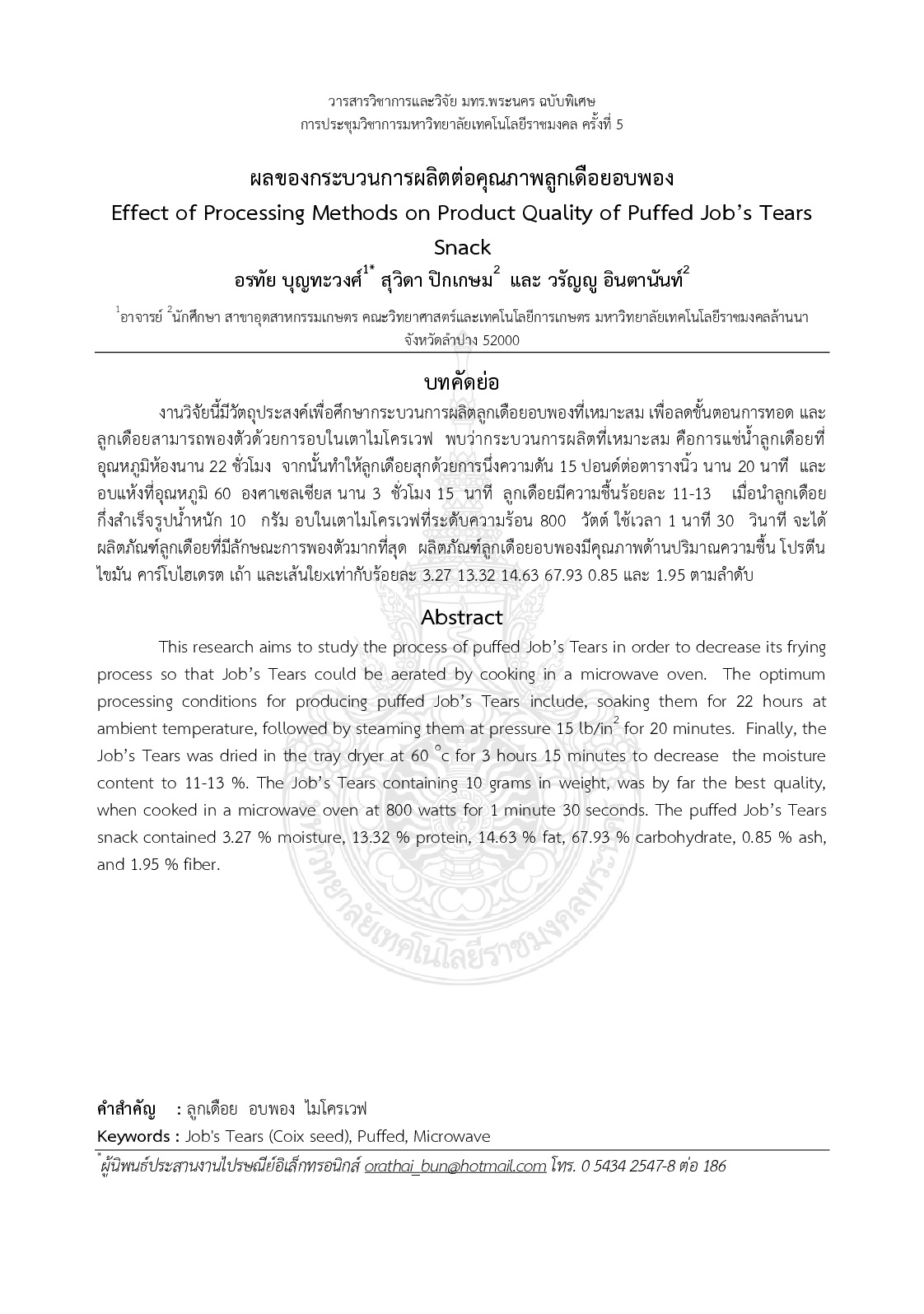
Effect of processing methods on product quality of puffed job’s tears snack
This research aims to study the process of puffed Job’s Tears in order to decrease its frying process so that Job’s Tears could be aerated by cooking in a microwave oven. The optimum processing conditions for producing puffed Job’s Tears include soaking them for 22 hours at ambient temperature followed by steaming them at pressure 15 lb/in2 for 20 minutes. Finally the Job’s Tears was dried in the tray dryer at 60 oc for 3 hours 15 minutes to decrease the moisture content to 11-13 %. The Job’s Tears containing 10 grams in weight was by far the best quality when cooked in a microwave oven at 800 watts for 1 minute 30 seconds. The puffed Job’s Tears snack contained 3.27 % moisture 13.32 % protein 14.63 % fat 67.93 % carbohydrate 0.85 % ash and 1.95 % fiber.
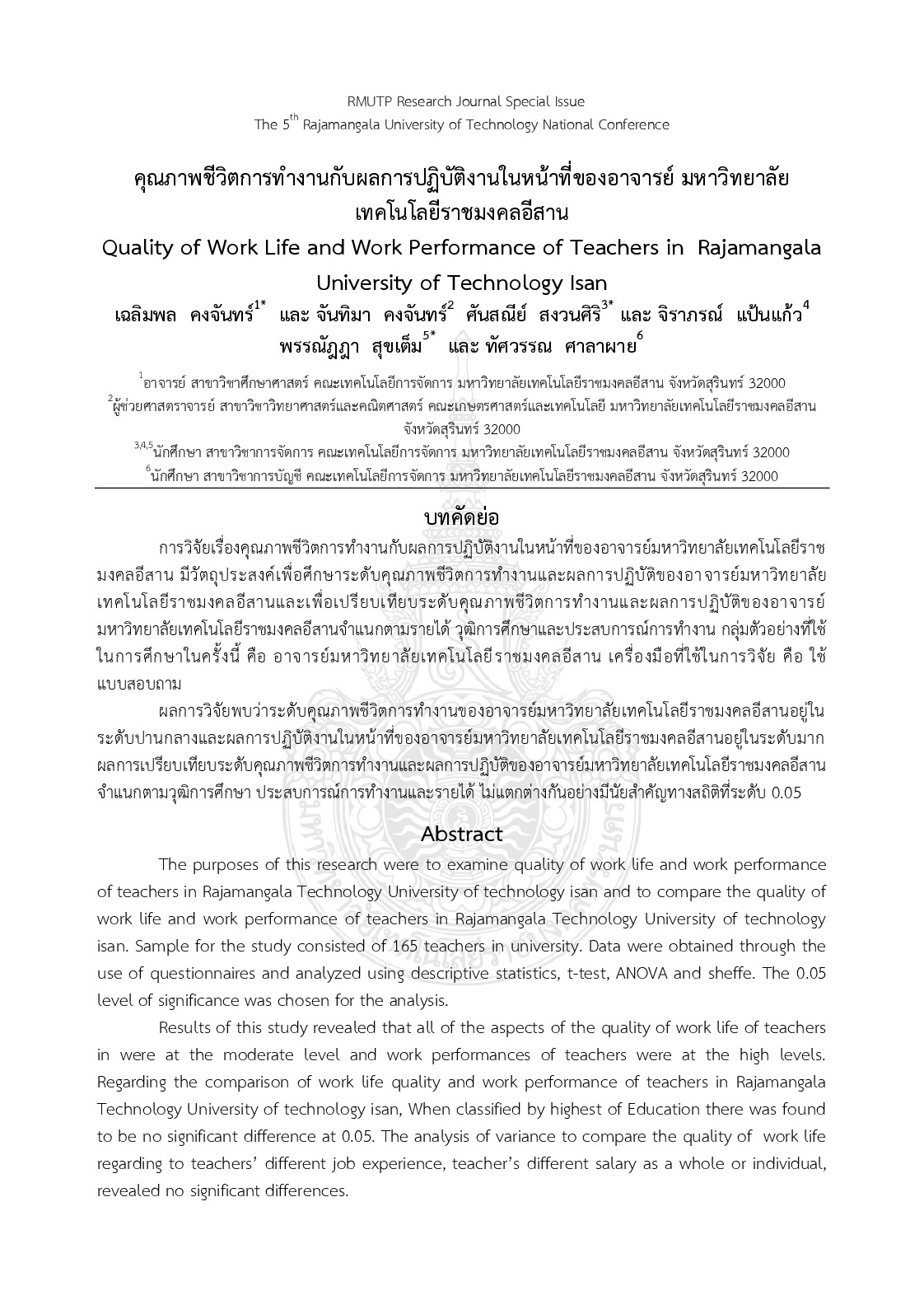
Quality of work life and work performance of teachers in Rajamangala University of Technology isan
The purposes of this research were to examine quality of work life and work performance of teachers in Rajamangala Technology University of technology isan and to compare the quality of work life and work performance of teachers in Rajamangala Technology University of technology isan. Sample for the study consisted of 165 teachers in university. Data were obtained through the use of questionnaires and analyzed using descriptive statistics t-test ANOVA and sheffe. The 0.05 level of significance was chosen for the analysis. Results of this study revealed that all of the aspects of the quality of work life of teachers in were at the moderate level and work performances of teachers were at the high levels. Regarding the comparison of work life quality and work performance of teachers in Rajamangala Technology University of technology isan When classified by highest of Education there was found to be no significant difference at 0.05. The analysis of variance to compare the quality of work life regarding to teachers’ different job experience teacher’s different salary as a whole or individual revealed no significant differences.
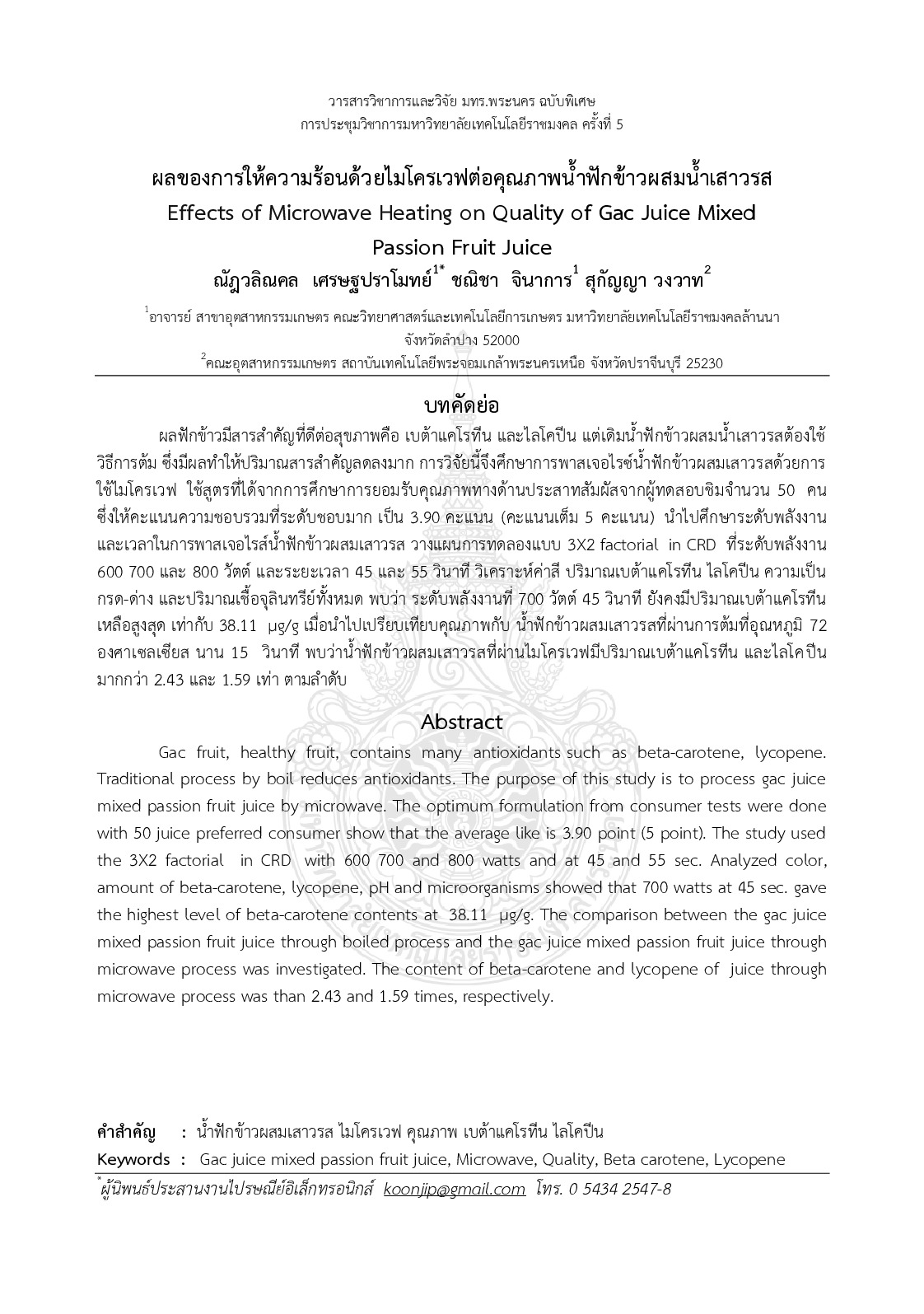
Effects of microwave heating on quality of gac juice mixed passion fruit juice
Gac fruit healthy fruit contains many antioxidants such as beta-carotene lycopene. Traditional process by boil reduces antioxidants. The purpose of this study is to process gac juice mixed passion fruit juice by microwave. The optimum formulation from consumer tests were done with 50 juice preferred consumer show that the average like is 3.90 point (5 point). The study used the 3X2 factorial in CRD with 600 700 and 800 watts and at 45 and 55 sec. Analyzed color amount of beta-carotene lycopene pH and microorganisms showed that 700 watts at 45 sec. gave the highest level of beta-carotene contents at 38.11 ?g/g. The comparison between the gac juice mixed passion fruit juice through boiled process and the gac juice mixed passion fruit juice through microwave process was investigated. The content of beta-carotene and lycopene of juice through microwave process was than 2.43 and 1.59 times respectively.
การปรับปรุงคุณภาพและการยืออายุการเก็บรักษาผักและผลไม้แกะสลัก
The objective of this research was to find the suitable types of carving style for five fruits and vegetables e.g. pumpkin carrot radish cantaloupe and Japanese cucumber. Physiological changes and methods to improve quality and extend shelf-life were also studied. The results showed that the leave-carved operations stimulated the respiration rate ethylene production and the electrolyte leakage more than flower-carved operations. These responses depended on the size of wound and surface area that contacted with atmospheric oxygen. Two concentrations of peroxyacetic acid (60 and 80 mg/L) solutions showed the efficacy in reducing microorganism populations better than sodium hypochlorite (50 and 75 mg/L). The three firming agents of calcium chloride (0.5-1.5%) calcium lactate (0.5-2%) and calcium propionate (0.5-2%) could improve texture at different concentrations. The combination effects of peroxyacetic acid (80 mg/L) and firming agents (0.5% calcium chloride 1.5% calcium lactate and 2% calcium propionate) and/or 0.25 and 0.5% of chitosan coating were applied on rose and lotus-carved fruits and vegetables. All off flower-carved fruits and vegetables were stored at 5?1oC in clamshell container. Then they were placed in a control temperature chamber at 25?1oC every day for 3 hours until the end of shelf-life. The results showed that 0.25 and 0.5% chitosan coating had the best coating solutions for extended shelf-life of carved pumpkin carrot and cantaloupe. The control treatment dipped in tap distilled water showed the suitable treatment for rose-carved radish and lotus-carved Japanese cucumber. The best chemical treatment for each fruit and vegetable was repeated in the storage experiment and then they were stored at 5?1oC in clamshell containers to determine the shelf-life of three carved fruits and vegetables (rose carnation and lotus). The shelf-life of two styles of flower from carved pumpkin did not exceed 6 days. Carved carrot in rose and carnation flowers had shelf-life for 12 days while radish was not more than 9 days. The shelf-life of rose and carnation carved cantaloupe did not exceed 9 and 6 days respectively. Lotus-carved Japanese cucumber had shelf-life for 6 days. Carved radish and Japanese cucumber were dipped in tap distilled water which had high initial microbial population that caused the short shelf-life. Thus the application of 2% calcium propionate and 80 mg/L peroxyacetic acid was the suitable treatment for reducing microbial population and improving the appearance quality and extended shelf-life.

The Information System for Service Quality Assessment of Rajamangala University of Technology Phra Nakhon Library Services Using LibQUAL+TM
The purposes of this research are 1) to desired level of services University of Technology Phra Nakhon Library Using LibQUAL+TM 2) to evaluate the quality of services University of Technology Phra Nakhon Library Using LibQUAL+TM 3) to investigate the respondent’s suggestions for improving the service quality of Rajamangala University of Technology Phra Nakhon Library. This research survey by questionnaire topics showed that minimum-acceptable service level desire level of service and Perceived level of service. Questionnaires were collected 390 users from 191 undergraduate students 73 graduate students and 121 teachers in University of Technology Phra Nakhon. Then data were analyzed by SPSS for Windows for percentage mean and standard deviation The results revealed as follows; 1. The opinion of user about the services of the library it was found that the minimum acceptable level and the perceived level of services were at a moderate level while the desired level of services were at a high level. 2. On basic of the services quality it was found that mean of the perceived services was in zone of tolerance. The adequacy gap was positive. It meant that the services quality was acceptable. However that was not precisely the respondent’s expectation. The superiority gap was negative; it meant that quality of services did not equal the level of the respondent’s expectation. 3. Their suggestions were 1) Affect of service; including there were no enough library staff 2) Information control; including there were the books whose contents match the subjects offered is minimal not enough demand 3) Library as place; including there were restrictive library. Should provide enough space for the number of active users .